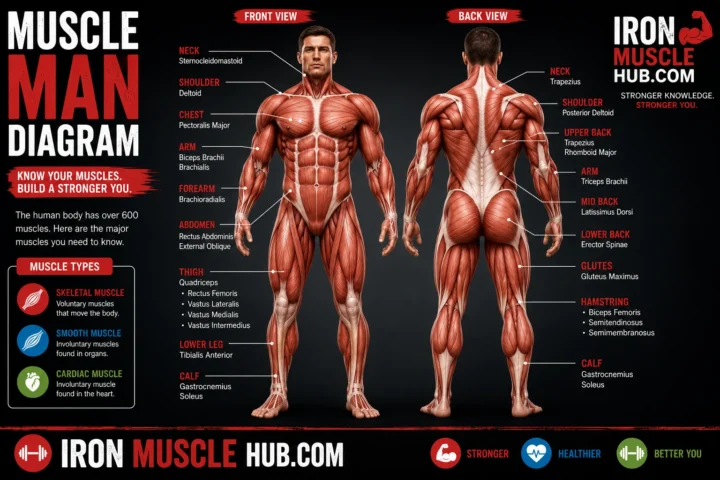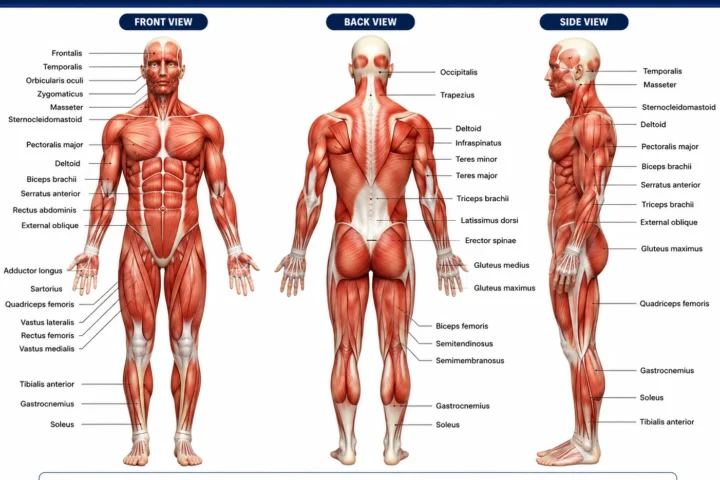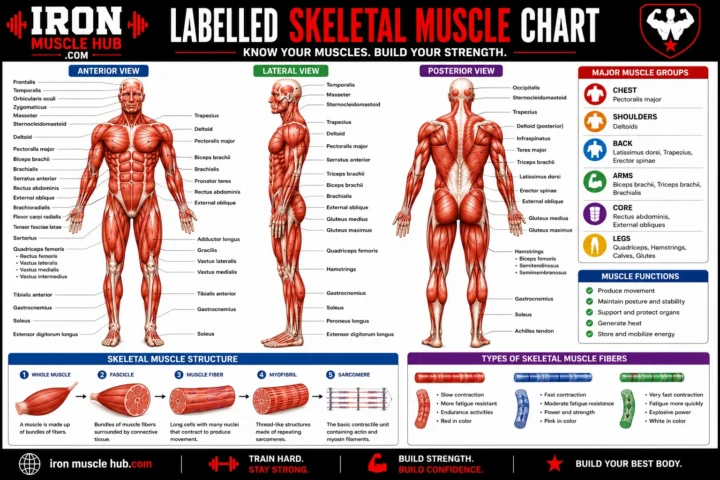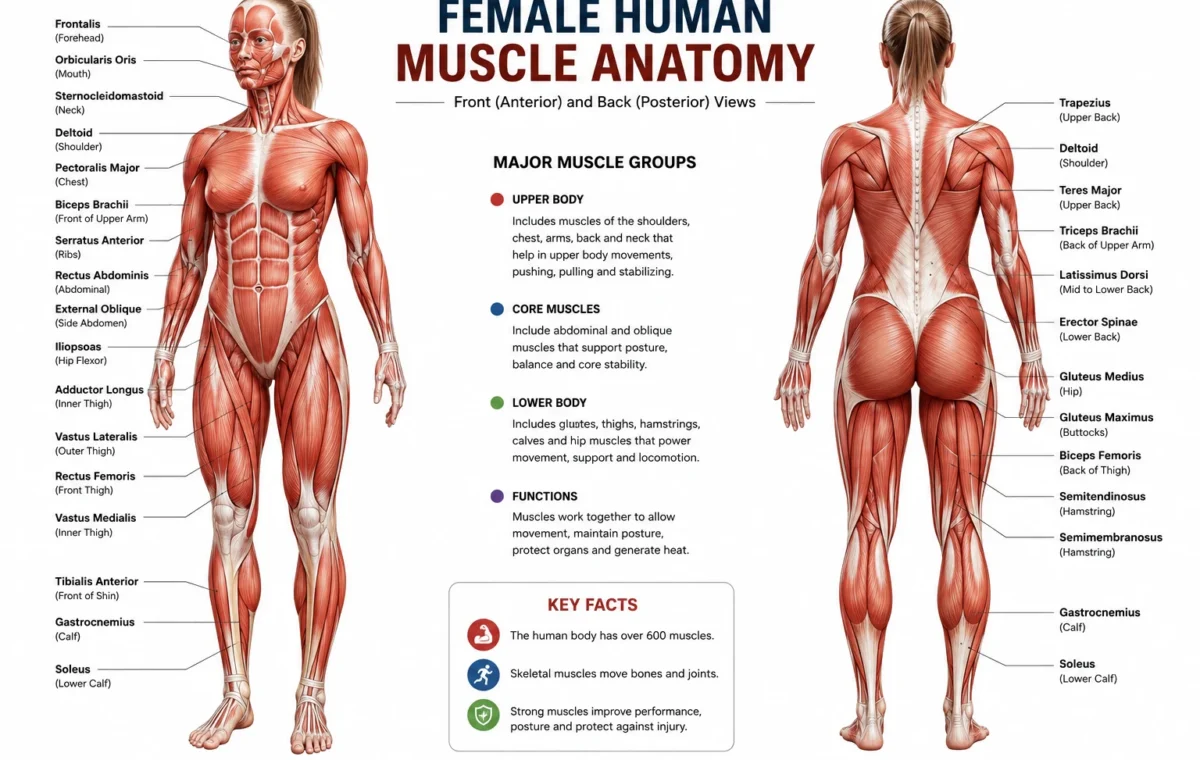
Understanding female human muscle anatomy starts with one simple fact: women and men have the same major muscles. The biggest differences are usually muscle size, body composition, and hormone levels—not the muscles themselves. Every muscle works together to help you move, breathe, maintain posture, and perform everyday tasks.
- Quick Answer
- 1. Skeletal Muscle
- 2. Smooth Muscle
- 3. Cardiac Muscle
- Head and Neck Muscles
- Shoulder Muscles
- Deltoid
- Rotator Cuff
- Pectoralis Major
- Serratus Anterior
- Trapezius
- Latissimus Dorsi
- Rhomboids
- Biceps Brachii
- Triceps Brachii
- Forearm Muscles
- Rectus Abdominis
- Oblique Muscles
- Lower Body Muscles
- Gluteal Muscles
- Why They're Important
- Quadriceps
- Functions
- Hamstrings
- Functions
- Gastrocnemius
- Soleus
- Tibialis Anterior
- Practical Differences
- Do women have the same muscles as men?
- What is the largest muscle in the female body?
- What are the three types of muscle tissue?
- Which muscles make up the core?
- Why is learning muscle anatomy useful?
Whether you’re learning anatomy for school, improving your workouts, or simply curious about how your body works, this guide explains female muscle anatomy in clear, beginner-friendly language. For more insights read here :- Lean and Muscular and how to become lean.
Quick Answer
| Topic | Quick Explanation |
|---|---|
| Number of skeletal muscles | More than 600 muscles work throughout the body. |
| Main muscle types | Skeletal, smooth, and cardiac muscle. |
| Largest muscle | Gluteus maximus. |
| Strongest muscle (by force) | Masseter (jaw muscle). |
| Longest muscle | Sartorius. |
| Main purpose | Movement, posture, joint stability, and heat production. |
| Female vs male muscles | Same muscles; differences mainly involve muscle size and average muscle mass. |
Understanding Female Human Muscle Anatomy
The muscular system contains hundreds of muscles connected to bones through tendons. These muscles contract and relax to produce movement.
Although female bodies typically have a higher percentage of body fat and lower average muscle mass than males, the overall muscular layout is nearly identical.
The muscular system performs several essential jobs:
- Supports posture
- Creates body movement
- Protects internal organs
- Stabilizes joints
- Produces body heat
- Helps maintain balance
Without muscles, even simple activities like walking, smiling, breathing, or standing would not be possible.
The Three Types of Muscle Tissue
Every muscle in the body belongs to one of three categories.
| Muscle Type | Found In | Control |
|---|---|---|
| Skeletal Muscle | Attached to bones | Voluntary |
| Smooth Muscle | Organs and blood vessels | Involuntary |
| Cardiac Muscle | Heart | Involuntary |
1. Skeletal Muscle
Skeletal muscles are the muscles most people think about during exercise.
These muscles:
- Move your arms and legs
- Maintain posture
- Protect joints
- Generate strength
- Respond to voluntary movement
Examples include the:
- Biceps
- Triceps
- Quadriceps
- Hamstrings
- Deltoids
- Gluteus maximus
2. Smooth Muscle
Smooth muscles work automatically without conscious effort.
They’re found inside:
- Stomach
- Intestines
- Bladder
- Blood vessels
- Airways
- Uterus
These muscles help digest food, regulate blood flow, and move substances throughout the body.
3. Cardiac Muscle
Cardiac muscle forms the heart.
Unlike skeletal muscle, cardiac muscle contracts automatically and continuously throughout life, pumping blood around the body.
Major Muscle Groups in the Female Body
Learning muscles becomes much easier when they’re grouped by body region.
Head and Neck Muscles
These muscles control facial expressions, chewing, swallowing, and head movement.
Major examples include:
- Frontalis
- Temporalis
- Masseter
- Orbicularis oculi
- Orbicularis oris
- Sternocleidomastoid
These muscles allow smiling, blinking, speaking, and turning your head.
Shoulder Muscles
The shoulder is one of the body’s most mobile joints.
Key muscles include:
Deltoid
The deltoid lifts the arm in multiple directions.
Functions:
- Shoulder abduction
- Flexion
- Extension
- Rotation
Rotator Cuff
The rotator cuff consists of four muscles:
- Supraspinatus
- Infraspinatus
- Teres minor
- Subscapularis
Together, they stabilize the shoulder joint and assist arm movement.
Chest Muscles
The chest contains muscles responsible for pushing movements and assisting breathing.
Pectoralis Major
Functions:
- Pushes the arms forward
- Rotates the shoulder inward
- Assists lifting
Despite common myths, women have the same pectoral muscles as men. Breast tissue sits above these muscles but is not muscle itself.
Serratus Anterior
Located along the ribs, this muscle:
- Stabilizes the shoulder blade
- Helps lift the arm overhead
- Assists breathing
Back Muscles
The back contains some of the body’s strongest muscles.
Trapezius
The trapezius extends from the neck to the middle back.
Functions include:
- Shoulder elevation
- Neck movement
- Posture support
Latissimus Dorsi
Often called the “lats,” these large muscles help:
- Pull objects
- Climb
- Swim
- Row
- Stabilize the spine
Rhomboids
Located between the shoulder blades, the rhomboids pull the shoulders backward and improve posture.
Arm Muscles
The upper arm contains muscles responsible for lifting and pushing.
Biceps Brachii
Located on the front of the upper arm.
Main jobs:
- Bend the elbow
- Rotate the forearm
- Assist shoulder movement
Triceps Brachii
Located on the back of the upper arm.
Functions:
- Straightens the elbow
- Helps push movements
- Supports shoulder stability
Forearm Muscles
More than a dozen muscles in the forearm control:
- Grip strength
- Finger movement
- Wrist motion
- Hand coordination
These muscles are essential for writing, typing, lifting, and everyday activities.
Core Muscles
The core is much more than the abdominal “six-pack.”
Major core muscles include:
- Rectus abdominis
- External oblique
- Internal oblique
- Transverse abdominis
- Multifidus
- Erector spinae
Together they:
- Protect the spine
- Improve posture
- Support balance
- Transfer force between the upper and lower body
Female Abdominal Muscles Explained
Rectus Abdominis
Often called the “six-pack,” this muscle runs vertically down the front of the abdomen.
Functions include:
- Trunk flexion
- Core stability
- Postural support
Visible abdominal definition depends on both muscle development and body fat percentage.
Oblique Muscles
The internal and external obliques sit along each side of the waist.
They allow you to:
- Twist
- Bend sideways
- Stabilize the spine
- Support breathing
Female Human Muscle Anatomy (2026)
Lower Body Muscles
The lower body contains some of the largest and strongest muscles in the human body. These muscles support walking, running, jumping, climbing stairs, and maintaining balance.
Gluteal Muscles
The gluteal muscles make up the buttocks and are among the body’s most powerful muscles.
| Muscle | Main Function |
|---|---|
| Gluteus Maximus | Hip extension, climbing, standing up |
| Gluteus Medius | Hip stability, balance while walking |
| Gluteus Minimus | Hip rotation and stabilization |
Why They’re Important
Strong glutes help:
- Improve posture
- Reduce lower back pain
- Increase athletic performance
- Stabilize the pelvis
- Support healthy knee movement
Many daily movements—including standing from a chair or climbing stairs—depend on healthy glute muscles.
Thigh Muscles
The thigh contains two major muscle groups.
Quadriceps
The quadriceps sit on the front of the thigh and consist of four muscles:
- Rectus femoris
- Vastus lateralis
- Vastus medialis
- Vastus intermedius
Functions
- Straighten the knee
- Help with walking
- Running
- Jumping
- Squatting
Hamstrings
Located on the back of the thigh, the hamstrings include:
- Biceps femoris
- Semitendinosus
- Semimembranosus
Functions
- Bend the knee
- Extend the hip
- Slow the leg during running
- Improve balance
Strong hamstrings also help protect the knees from injury.
Inner Thigh (Adductors)
The adductor muscles pull the legs toward the body’s midline.
Major muscles include:
- Adductor longus
- Adductor magnus
- Adductor brevis
- Gracilis
- Pectineus
These muscles play a key role in balance and side-to-side movement.
Lower Leg Muscles
The lower leg provides stability and movement during standing and walking.
Gastrocnemius
The gastrocnemius is the large calf muscle visible beneath the skin.
Functions:
- Pushes the foot downward
- Helps jumping
- Helps running
- Supports walking
Soleus
Located underneath the gastrocnemius, the soleus works continuously while standing.
It is especially important for:
- Balance
- Walking
- Maintaining posture
Tibialis Anterior
This muscle runs along the front of the shin.
Its primary functions include:
- Lifting the foot upward
- Preventing toe dragging while walking
- Supporting ankle stability
Female Muscle Anatomy: Front vs. Back
| Front (Anterior) | Back (Posterior) |
|---|---|
| Deltoids | Trapezius |
| Pectorals | Rhomboids |
| Biceps | Triceps |
| Rectus Abdominis | Erector Spinae |
| Quadriceps | Gluteus Maximus |
| Tibialis Anterior | Hamstrings |
| Shin Muscles | Gastrocnemius & Soleus |
Learning muscles by viewing both the front and back of the body makes anatomy much easier to understand.
Female vs. Male Muscle Anatomy
One common question is whether women have different muscles than men.
The answer is no. Women and men have the same major skeletal muscles. The primary differences are related to average muscle size, body composition, and hormones rather than muscle location.
| Feature | Female | Male |
|---|---|---|
| Major muscles | Same | Same |
| Muscle arrangement | Same | Same |
| Average muscle mass | Lower | Higher |
| Body fat percentage | Typically higher | Typically lower |
| Testosterone levels | Lower | Higher |
Practical Differences
Women often:
- Build strength effectively with training
- Gain muscle more gradually due to lower testosterone levels
- Recover well with proper nutrition and rest
- Develop excellent muscular endurance
These are averages, and individual results vary based on genetics, training, nutrition, and lifestyle.
How Muscles Work Together
Muscles rarely work alone. Most movements involve groups of muscles acting together.
For example, when performing a squat:
- Quadriceps straighten the knees.
- Gluteus maximus extends the hips.
- Hamstrings help stabilize the movement.
- Core muscles keep the spine supported.
- Calves maintain balance.
This teamwork allows movements to be smooth, efficient, and coordinated.
Tips for Keeping Your Muscles Healthy
Healthy muscles support everyday movement and long-term mobility. Here are a few simple habits that can help:
- Strength train regularly to maintain muscle mass.
- Eat enough protein to support muscle repair.
- Stay hydrated throughout the day.
- Warm up before exercise.
- Stretch after workouts to maintain flexibility.
- Get enough sleep, as recovery is essential for muscle growth.
- Maintain good posture during daily activities.
Common Mistakes Beginners Make
Avoid these common misconceptions about female muscle anatomy:
- Thinking women have different muscles than men. The muscles are the same; differences are mostly in size and body composition.
- Focusing only on the abs. A strong body requires balanced training across all major muscle groups.
- Ignoring the back and glutes. These muscles are important for posture, balance, and injury prevention.
- Believing lifting weights makes women bulky. Muscle growth depends on many factors, including training, nutrition, and hormones.
Frequently Asked Questions
Do women have the same muscles as men?
Yes. Women and men have the same major skeletal muscles. Differences are mainly related to average muscle mass, hormone levels, and body composition rather than anatomy.
What is the largest muscle in the female body?
The gluteus maximus is the largest muscle in the human body. It helps extend the hip, stabilize the pelvis, and generate power during activities like climbing, running, and standing.
What are the three types of muscle tissue?
The body contains three types of muscle tissue:
- Skeletal muscle
- Smooth muscle
- Cardiac muscle
Each type has a different role, from moving the skeleton to pumping blood and supporting organ function.
Which muscles make up the core?
The core includes:
- Rectus abdominis
- Transverse abdominis
- Internal obliques
- External obliques
- Erector spinae
- Multifidus
Together, these muscles stabilize the spine and help transfer force between the upper and lower body.
Why is learning muscle anatomy useful?
Understanding muscle anatomy can help you:
- Exercise more effectively
- Improve posture
- Reduce injury risk
- Understand how the body moves
- Communicate more clearly with healthcare or fitness professionals
Final Thoughts
Learning female human muscle anatomy doesn’t have to be complicated. While the body contains hundreds of muscles, focusing on the major muscle groups makes it much easier to understand how movement, posture, and strength all work together.
Whether your goal is improving fitness, studying anatomy, or simply understanding your body better, knowing where muscles are located and what they do provides a strong foundation. Start with the largest muscle groups, learn their functions, and gradually build your knowledge over time.