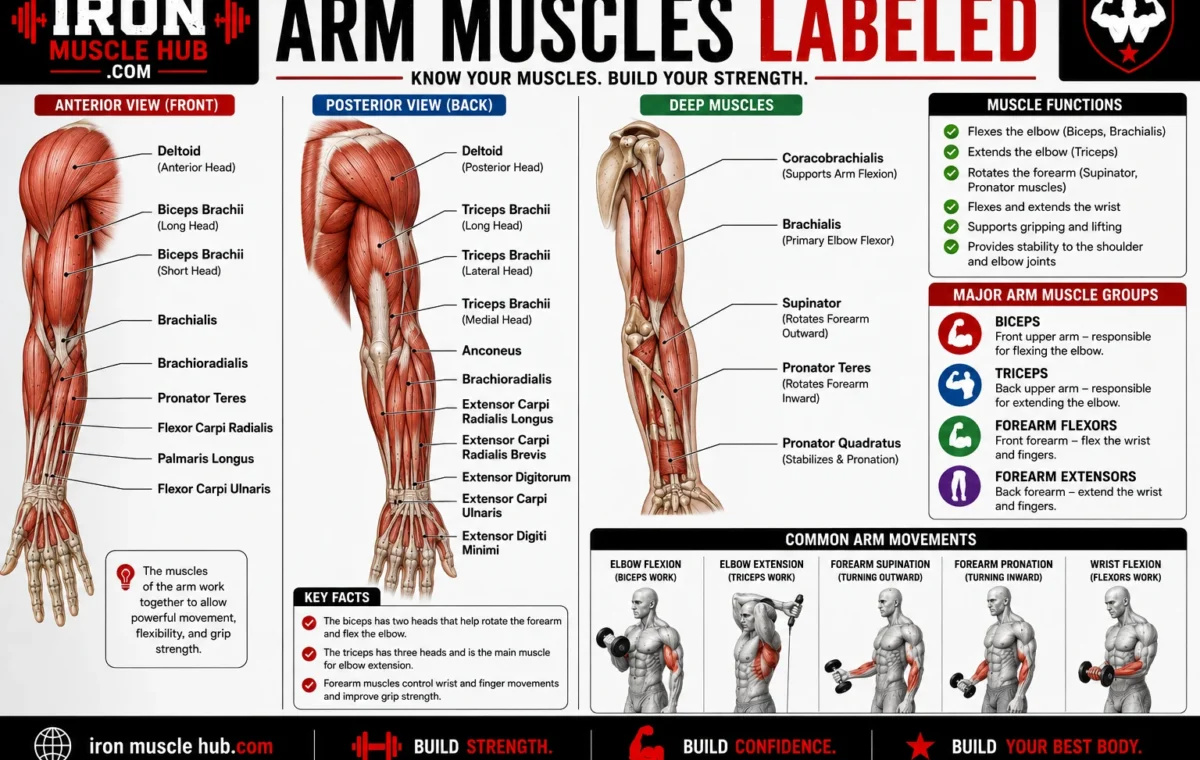
If you’re looking for an arm muscle labeled diagram, the main names to learn are the biceps brachii, brachialis, coracobrachialis, and triceps brachii in the upper arm, along with numerous muscles in the forearm. The biceps are mainly on the front of the upper arm, while the triceps are on the back. The brachialis sits deep to the biceps and is an important elbow flexor.
- Arm Muscle Labeled: Quick Anatomy Guide
- The Main Upper Arm Muscles Labeled
- 1. Biceps Brachii
- 2. Brachialis
- 3. Coracobrachialis
- 4. Triceps Brachii
- What Does a Labeled Arm Muscle Diagram Show?
- Front vs. Back of the Upper Arm
- Front of the upper arm
- Back of the upper arm
- Don't Confuse the Upper Arm With the Forearm
- A Simple Way to Read an Arm Muscle Diagram
- A Useful Labeling Exercise
- How Many Muscles Are in the Arm?
- Common Mistakes When Studying Arm Muscle Anatomy
- Mistake 1: Thinking the biceps is the only muscle that bends the elbow
- Mistake 2: Calling every muscle between the shoulder and hand an "arm muscle"
- Mistake 3: Assuming the triceps is one simple muscle
- Mistake 4: Memorizing names without learning functions
- Where to Find a Copyright-Safe Arm Muscle Diagram
- Internal Link Ideas for Iron Muscle Hub
- Frequently Asked Questions
- What are the main muscles in the arm?
- Which muscle is on the front of the upper arm?
- Which muscle is on the back of the upper arm?
- What is the muscle underneath the biceps called?
- How many muscles are in the upper arm?
- What is the difference between the arm and forearm?
- A Clearer Way to Remember Arm Muscle Anatomy
- Forearm Muscles Labeled: Quick Guide
- 1. Brachioradialis
- 2. Pronator Teres
- 3. Flexor Carpi Radialis
- 4. Flexor Carpi Ulnaris
- 5. Palmaris Longus
- Extensor Muscles of the Forearm
- Extensor Digitorum
- Extensor Carpi Radialis
- Extensor Carpi Ulnaris
- Arm Muscle Diagram: Superficial vs. Deep Muscles
- How to Memorize Labeled Arm Muscles
- Where is it?
- What does it do?
- What is nearby?
- What does its name tell you?
- A Beginner's Arm-Muscle Study Routine
- A Common Diagram Mistake: Left vs. Right Arm
- Upper Arm vs. Forearm: Don't Mix Them Up
- Why Muscle Names Can Seem Difficult
- Final Study Tip
- Frequently Asked Questions
- What are the main muscles of the forearm?
- What muscle helps bend the elbow besides the biceps?
- Which arm muscle straightens the elbow?
- What are the muscles on the front of the forearm called?
- Why are there so many muscles in a detailed arm diagram?
- Final Thoughts
- Quick Guide to Arm Muscles and Their Movements
- Understanding the Biceps in a Labeled Diagram
- A simple example
- Understanding the Triceps
- Brachialis: The Muscle Hidden Beneath the Biceps
- Coracobrachialis: Small but Important
- Arm Muscles by Anatomical Compartment
- Anterior compartment of the upper arm
- Posterior compartment of the upper arm
- What the Forearm Muscles Do
- Flexors
- Extensors
- Rotators
- A Muscle-Name Trick That Actually Helps
- How to Read an Arm Muscle Labeled Diagram
- Step 1: Identify the view
- Step 2: Find the bones
- Step 3: Find the biggest muscles
- Step 4: Identify deeper structures
- Step 5: Connect each muscle with a movement
- A Simple Arm Anatomy Memory Map
- Common Questions About Arm Muscle Labels
- Is the biceps on the front or back of the arm?
- Is the triceps bigger than the biceps?
- What muscle is under the biceps?
- What are the two bones in the forearm?
- Why do some arm diagrams show different muscles?
- How can I memorize arm muscles quickly?
- A Five-Minute Arm Muscle Quiz
- Final Arm Muscle Study Checklist
- More Helpful Anatomy Topics
- The Big Picture
- Final Thoughts
A labeled anatomy guide makes these names much easier to remember because you can connect each muscle with its position and job. Below, we’ll break the arm down into simple sections so you can identify the major muscles without getting buried in complicated anatomy terminology. For more insights read here :- are muscles organs and muscle anatomy .
Quick answer: The upper arm has three muscles in its anterior compartment — biceps brachii, brachialis and coracobrachialis — and the triceps brachii in the posterior compartment. The forearm contains many additional muscles responsible for wrist, hand and finger movement.
Arm Muscle Labeled: Quick Anatomy Guide
| Muscle | Where it is | Main function |
|---|---|---|
| Biceps brachii | Front of upper arm | Bends the elbow and turns the forearm so the palm can face upward |
| Brachialis | Deep to the biceps | Strong elbow flexion |
| Coracobrachialis | Upper front/inner arm | Helps flex and adduct the arm at the shoulder |
| Triceps brachii | Back of upper arm | Straightens the elbow |
| Brachioradialis | Outer forearm | Helps flex the elbow, especially with the forearm in a neutral position |
| Forearm flexors | Front of forearm | Help move the wrist and fingers |
| Forearm extensors | Back of forearm | Help extend the wrist and fingers |
The first four muscles in the table are the major muscles of the anatomical upper arm, meaning the section between the shoulder and elbow. The forearm is the section between the elbow and wrist and contains a much larger collection of muscles.
The Main Upper Arm Muscles Labeled
1. Biceps Brachii
The biceps brachii is the familiar muscle on the front of the upper arm. It has two heads, called the long head and short head, which is why “biceps” refers to its two proximal heads.
Its major jobs include elbow flexion and supination of the forearm. Supination is the movement that turns your forearm so the palm faces upward.
A simple example is bringing your hand toward your shoulder during a traditional curl. The biceps contributes to that movement, although it isn’t the only muscle involved.
2. Brachialis
The brachialis is easy to miss on a basic arm muscle diagram because it lies underneath the biceps. Anatomically, it’s an important elbow flexor and works regardless of whether your forearm is pronated or supinated.
Think of it as a deeper muscle that helps provide the basic force needed to bend your elbow.
This is also a useful reminder that the muscle you can see isn’t always the muscle doing most of the work. The brachialis sits underneath the biceps and contributes strongly to elbow flexion.
3. Coracobrachialis
The coracobrachialis is a smaller muscle in the anterior compartment of the upper arm. It connects the coracoid process of the scapula with the humerus and helps with movement of the arm at the shoulder.
You won’t usually see it prominently in a basic bodybuilding diagram because it is relatively small and lies beneath other structures.
For anatomy students, however, it’s important because it is one of the three muscles in the anterior compartment of the upper arm.
4. Triceps Brachii
The triceps brachii is located on the back of the upper arm. Unlike the biceps, it has three heads: the long, lateral and medial heads.
Its primary action is extension of the elbow, meaning it helps straighten your arm.
For example, pushing an object away from you involves elbow extension, so the triceps plays an important role in that movement.
The three heads eventually join into a common distal tendon that attaches around the olecranon, the prominent part of the ulna at the elbow.
What Does a Labeled Arm Muscle Diagram Show?
A good labeled arm diagram isn’t simply a collection of names. It should help you understand three things:
- Location — where the muscle sits.
- Structure — whether it has multiple heads or lies beneath another muscle.
- Function — what movement it helps produce.
This makes anatomy much easier to study.
For example, if a diagram points to the large muscle on the front of the upper arm, you’re likely looking at the biceps brachii. If it points to the large muscle on the back, you’re looking at the triceps brachii.
If the label points to a deeper muscle beneath the biceps, the brachialis is an important possibility.
Front vs. Back of the Upper Arm
One of the simplest ways to memorize an arm muscle diagram is to split it into front and back.
Front of the upper arm
The anterior compartment contains:
- Biceps brachii
- Brachialis
- Coracobrachialis
These muscles are primarily associated with flexion or related movements of the arm and forearm.
Back of the upper arm
The posterior compartment contains:
- Triceps brachii
The triceps is primarily responsible for extending the forearm at the elbow.
This gives you a simple memory trick:
Front = mainly helps bend the elbow.
Back = mainly helps straighten the elbow.
It’s a useful starting point, although real movement involves several muscles working together.
Don’t Confuse the Upper Arm With the Forearm
A common mistake is using “arm” to describe everything from the shoulder to the hand.
In anatomical terminology, the arm specifically refers to the region between the shoulder and elbow. The forearm is between the elbow and wrist.
That’s why a detailed arm muscle labeled diagram can contain many more names than a basic upper-arm diagram.
The forearm contains numerous muscles arranged in different compartments. Some help flex the wrist and fingers, while others help extend them. Muscles such as the brachioradialis also contribute to elbow movement even though they’re located in the forearm.
A Simple Way to Read an Arm Muscle Diagram
If you’re studying anatomy, don’t try to memorize every label at once.
Use this four-step approach:
- Find the upper arm. Identify the section between the shoulder and elbow.
- Locate the big landmarks. Start with the biceps on the front and triceps on the back.
- Add the deeper muscles. Learn the brachialis and coracobrachialis next.
- Move to the forearm. Learn the larger flexor, extensor and brachioradialis groups before memorizing individual smaller muscles.
This approach gives you a mental map first. Individual names become easier once you know where they belong.
A Useful Labeling Exercise
Here’s a simple self-test you can use with any unlabeled anatomy diagram.
Cover the names and ask yourself:
- Which muscle is on the front of the upper arm?
- Which muscle is on the back?
- Which muscle sits underneath the biceps?
- Which upper-arm muscle has three heads?
- Which muscles continue into the forearm?
- Which muscles are responsible for wrist and finger movement?
Then uncover the labels and check your answers.
For beginners, this is often more useful than repeatedly reading a list of muscle names because you’re practicing identification rather than just recognition.
How Many Muscles Are in the Arm?
The exact answer depends on how “arm” is being defined and how anatomical structures are grouped.
The upper arm itself has four principal muscles: biceps brachii, brachialis, coracobrachialis and triceps brachii. The forearm has many additional muscles; one anatomical overview describes 20 forearm muscles arranged across several compartments.
So a diagram showing only the biceps and triceps isn’t necessarily wrong. It may simply be designed for beginners or focused specifically on the most prominent upper-arm muscles.
Common Mistakes When Studying Arm Muscle Anatomy
Mistake 1: Thinking the biceps is the only muscle that bends the elbow
The biceps is important, but the brachialis is a major elbow flexor and sits underneath it.
Mistake 2: Calling every muscle between the shoulder and hand an “arm muscle”
Anatomically, the upper arm and forearm are different regions. Keeping that distinction straight makes diagrams much easier to understand.
Mistake 3: Assuming the triceps is one simple muscle
The triceps brachii has three heads: long, lateral and medial. They work together to extend the elbow.
Mistake 4: Memorizing names without learning functions
Knowing that a muscle is called “brachialis” isn’t very helpful if you don’t know where it is or what it does. Pair every name with a location and one main action.
Where to Find a Copyright-Safe Arm Muscle Diagram
If you need an image for studying or publishing, don’t simply copy an anatomy illustration from Google Images.
A useful option is the Wikimedia Commons public-domain “Arm muscles front superficial” illustration, which comes from Henry Gray’s Anatomy of the Human Body. Wikimedia Commons identifies the work as public domain.
There’s also a numbered version of the illustration, which can work well as a quiz or labeling exercise. It is likewise identified as public domain.
For a back view, Wikimedia Commons also provides a public-domain illustration of the arm muscles from Gray’s anatomy plates.
Tip: Always review the license information on the specific image page before using an image commercially, and keep a record of the source and license.
Internal Link Ideas for Iron Muscle Hub
Consider linking this article to related beginner-friendly pages such as:
- Muscle Anatomy Chart: A Beginner’s Guide to Major Muscles
- Body Muscle Chart: Muscle Names and Functions Explained
- How the Muscular System Works: A Simple Anatomy Guide
These links can help readers move naturally from the arm to broader muscle anatomy topics.
Frequently Asked Questions
What are the main muscles in the arm?
The main muscles of the upper arm are the biceps brachii, brachialis, coracobrachialis and triceps brachii. The biceps, brachialis and coracobrachialis are in the anterior compartment, while the triceps occupies the posterior compartment. The forearm contains many additional muscles involved in wrist, hand and finger movement.
Which muscle is on the front of the upper arm?
The most visible muscle on the front of the upper arm is the biceps brachii. Beneath it is the brachialis, which is an important elbow flexor. The coracobrachialis is another muscle in the anterior compartment but is smaller and less prominent.
Which muscle is on the back of the upper arm?
The triceps brachii is the major muscle on the back of the upper arm. It has three heads — long, lateral and medial — and its main function is extending the elbow. In simple terms, it helps straighten the arm after the elbow has been bent.
What is the muscle underneath the biceps called?
The muscle underneath the biceps is primarily the brachialis. It is a strong elbow flexor and sits deeper than the biceps brachii. Because it is not as superficial, you may not notice it clearly in a basic arm muscle diagram.
How many muscles are in the upper arm?
The upper arm has four principal muscles: biceps brachii, brachialis, coracobrachialis and triceps brachii. The forearm is a separate anatomical region and contains many more muscles.
What is the difference between the arm and forearm?
The arm is the anatomical region from the shoulder to the elbow. The forearm runs from the elbow to the wrist. The two areas contain different muscle groups and perform different combinations of movements.
A Clearer Way to Remember Arm Muscle Anatomy
You don’t need to memorize a page of Latin names before an arm muscle labeled diagram starts making sense.
Start with four landmarks: biceps on the front, triceps on the back, brachialis underneath the biceps, and coracobrachialis deeper in the front of the upper arm. Then learn the forearm muscles as separate flexor, extensor and supporting groups.
Once those locations are familiar, individual labels become much easier to recognize. For studying, use a labeled diagram first, then switch to an unlabeled version and test yourself. That small change turns passive reading into active recall and can make anatomy practice much more effective.
Deeper Anatomy
If you’re studying an arm muscle labeled diagram, the forearm is the next area to learn after the biceps, brachialis, coracobrachialis, and triceps. Unlike the upper arm, the forearm contains many individual muscles that control movements of the wrist, fingers, thumb, and forearm.
The easiest approach is to learn them by location and function rather than trying to memorize every name at once. The front of the forearm is mainly associated with flexion, while the back is mainly associated with extension.
Forearm Muscles Labeled: Quick Guide
| Muscle or group | General location | Main movement |
|---|---|---|
| Brachioradialis | Lateral forearm | Helps flex the elbow |
| Pronator teres | Upper front forearm | Pronates the forearm |
| Flexor carpi radialis | Front forearm | Flexes and abducts the wrist |
| Flexor carpi ulnaris | Front/ulnar forearm | Flexes and adducts the wrist |
| Palmaris longus | Front forearm | Assists wrist flexion |
| Extensor carpi radialis muscles | Back/lateral forearm | Extend and abduct the wrist |
| Extensor carpi ulnaris | Back/ulnar forearm | Extends and adducts the wrist |
| Extensor digitorum | Back forearm | Extends the fingers |
These are only some of the more recognizable muscles. A detailed anatomical chart will show many additional muscles and smaller structures.
1. Brachioradialis
The brachioradialis is a long muscle running along the lateral side of the forearm. Its position can make it look like an upper-arm muscle in some diagrams, but it belongs to the forearm.
One of its important functions is assisting with elbow flexion. It works particularly effectively when the forearm is positioned between full pronation and full supination.
A simple example is lifting an object with your thumb pointing upward, similar to the hand position used for a neutral-grip curl.
2. Pronator Teres
The pronator teres is located toward the upper part of the anterior forearm.
Its main job is pronation, which means rotating the forearm so the palm turns downward or toward the floor.
Try holding your hand in front of you with the palm facing upward. Rotate your forearm until the palm faces downward. Muscles involved in that rotation include the pronator teres and pronator quadratus.
3. Flexor Carpi Radialis
The flexor carpi radialis is positioned on the anterior side of the forearm.
As its name suggests, it helps with wrist flexion. It also contributes to movement that brings the hand toward the thumb side of the forearm.
Understanding the naming system can make these muscles easier to remember:
- Flexor = generally involved in flexion
- Carpi = associated with the wrist
- Radialis = positioned toward the radius side
You don’t need to memorize the Latin terminology immediately. Use the name as a clue about the muscle’s location and movement.
4. Flexor Carpi Ulnaris
The flexor carpi ulnaris is another major muscle on the front of the forearm.
It helps flex the wrist and contributes to movement toward the little-finger side of the hand.
The word “ulnaris” is a useful location clue because the muscle is associated with the ulna side of the forearm.
This is one reason anatomical naming becomes easier with practice: many muscle names contain information about what the muscle does or where it sits.
5. Palmaris Longus
The palmaris longus is a relatively small forearm muscle that assists with wrist flexion.
Not everyone has a palmaris longus muscle. Anatomical variation means some people naturally lack it, and its absence generally doesn’t prevent normal hand function.
If you’re looking at an anatomy diagram and don’t see it clearly, that doesn’t mean you’re necessarily looking at the wrong structure.
Extensor Muscles of the Forearm
The back of the forearm contains muscles that help extend the wrist and fingers.
Extensor Digitorum
The extensor digitorum is an important muscle associated with extension of the fingers.
If you straighten your fingers after making a fist, muscles on the posterior side of the forearm help produce that movement.
This is why the back of the forearm can become especially noticeable when you open and spread your fingers against resistance.
Extensor Carpi Radialis
The extensor carpi radialis muscles help extend the wrist and contribute to movement toward the radial, or thumb, side.
They’re positioned toward the lateral side of the posterior forearm.
Extensor Carpi Ulnaris
The extensor carpi ulnaris helps extend the wrist and contributes to movement toward the ulnar, or little-finger, side.
Together with other forearm muscles, it helps provide controlled wrist movement during everyday tasks.
Arm Muscle Diagram: Superficial vs. Deep Muscles
One reason arm anatomy diagrams can look confusing is that not every muscle sits directly on the surface.
Some muscles are superficial, meaning they’re closer to the skin. Others are deeper and may only become visible when superficial structures are removed in an anatomical illustration.
For example, the brachialis sits deep to the biceps brachii. A basic diagram may therefore show the biceps prominently while a deeper anatomical plate reveals the brachialis underneath.
This is important when comparing two diagrams that appear to show different muscles. They may simply be displaying different anatomical layers.
How to Memorize Labeled Arm Muscles
A useful study system is to organize muscles into four questions:
Where is it?
Is the muscle in the:
- Upper arm
- Anterior forearm
- Posterior forearm
- Lateral side of the forearm?
What does it do?
Look for a basic movement such as:
- Elbow flexion
- Elbow extension
- Wrist flexion
- Wrist extension
- Finger flexion
- Finger extension
- Forearm pronation
- Forearm supination
What is nearby?
Muscles become easier to identify when you learn neighboring structures.
For example, knowing that the biceps is superficial to the brachialis gives you a useful three-dimensional picture instead of two disconnected names.
What does its name tell you?
Muscle names often contain clues about:
- Location
- Direction
- Number of heads
- Size
- Function
- Attachment
You don’t need to understand every part of a name on your first attempt. Pick out the pieces you recognize and use them as memory clues.
A Beginner’s Arm-Muscle Study Routine
If you have an anatomy exam or simply want to understand a labeled diagram, try this routine.
Step 1: Learn the four major upper-arm muscles.
Start with:
- Biceps brachii
- Brachialis
- Coracobrachialis
- Triceps brachii
Step 2: Separate the forearm into front and back.
Think of the anterior side primarily in terms of flexor muscles and the posterior side primarily in terms of extensor muscles.
Step 3: Add the larger named muscles.
Learn muscles such as the brachioradialis, pronator teres, flexor carpi radialis, flexor carpi ulnaris and extensor digitorum.
Step 4: Test yourself without labels.
Look at an unlabeled diagram and point to each muscle before checking the answers.
Step 5: Connect anatomy to movement.
Instead of asking only “What’s this muscle called?”, ask “What happens when this muscle contracts?”
That second question helps turn memorization into understanding.
A Common Diagram Mistake: Left vs. Right Arm
Another source of confusion is orientation.
Anatomical diagrams may show a person’s left arm or right arm, and the viewer’s perspective can make the sides seem reversed.
Before memorizing labels, check whether the illustration is:
- A front view
- A back view
- The body’s left side
- The body’s right side
- A lateral view
- A medial view
This small check can prevent you from memorizing a correct muscle name in the wrong location.
Upper Arm vs. Forearm: Don’t Mix Them Up
Here’s the simplest distinction to keep in mind:
| Region | Between | Examples |
| Upper arm | Shoulder and elbow | Biceps, brachialis, coracobrachialis, triceps |
| Forearm | Elbow and wrist | Brachioradialis, flexors, extensors, pronator muscles |
If a diagram labels a muscle below the elbow, you’re generally looking at the forearm, not the upper arm.
This distinction is particularly useful when searching for an “arm muscle labeled” image because many websites use the word arm casually to describe the entire upper limb.
Why Muscle Names Can Seem Difficult
Some muscle names look intimidating because they combine several anatomical terms.
Take flexor carpi ulnaris as an example.
You can break it into:
- Flexor → helps with flexion
- Carpi → relates to the wrist
- Ulnaris → associated with the ulna side
Suddenly, the name gives you useful information instead of being a random word to memorize.
The same approach works with many other anatomical names.
Final Study Tip
Don’t try to memorize a detailed arm muscle chart in one sitting.
Learn the large landmarks first, then work toward smaller muscles. Start with the biceps and triceps, add the brachialis and coracobrachialis, and then divide the forearm into flexor, extensor and rotational groups.
After that, practice with an unlabeled image.
The goal isn’t simply to recognize a muscle when someone gives you the answer. You want to be able to look at an arm muscle labeled diagram, identify the structure yourself, and explain its basic location and function.
Frequently Asked Questions
What are the main muscles of the forearm?
The forearm contains many muscles rather than just one or two major muscles. They include flexors, extensors, pronation muscles, supination muscles and muscles that assist elbow movement. Commonly illustrated examples include the brachioradialis, pronator teres, flexor carpi radialis, flexor carpi ulnaris and extensor digitorum.
What muscle helps bend the elbow besides the biceps?
The brachialis is an important elbow flexor located underneath the biceps brachii. The brachioradialis, which is located in the forearm, can also assist with elbow flexion. Several muscles can therefore contribute to the same movement rather than one muscle working alone.
Which arm muscle straightens the elbow?
The triceps brachii is the primary muscle responsible for elbow extension. It has three heads: the long head, lateral head and medial head. Together, these parts help straighten the forearm at the elbow.
What are the muscles on the front of the forearm called?
The front, or anterior, forearm contains several muscles that participate in wrist and finger flexion and forearm movements. These include muscles such as the flexor carpi radialis, flexor carpi ulnaris, palmaris longus and pronator teres. A detailed anatomy chart will show additional muscles.
Why are there so many muscles in a detailed arm diagram?
The upper limb needs to perform many precise movements. The hand and wrist require coordinated control, so the forearm contains numerous muscles and tendons. A basic diagram may show only the largest or most recognizable muscles, while a detailed anatomical illustration displays deeper and smaller structures.
Final Thoughts
Learning an arm muscle labeled diagram becomes much easier once you stop treating every muscle name as a separate fact. Start with the large regions, understand what each muscle generally does, and then add smaller structures.
The most useful foundation is simple: know the four principal muscles of the upper arm, understand the difference between the upper arm and forearm, and learn the forearm’s major flexor and extensor groups. From there, detailed anatomy charts become far less overwhelming.
Use both labeled and unlabeled diagrams during revision. If you can identify the muscle without seeing its name and explain its basic movement, you’ve moved beyond memorization and started understanding the anatomy.
Understanding an arm muscle labeled diagram is easier when you connect each muscle to a specific movement. Instead of memorizing a long list of unfamiliar names, think about what the muscle does, where it sits, and which nearby muscles work with it.
The upper arm contains four principal muscles, while the forearm contains many more muscles involved in movement of the wrist, fingers, thumb, and forearm. This guide brings those ideas together so you can read a detailed arm anatomy diagram with more confidence.
Quick Guide to Arm Muscles and Their Movements
| Movement | Important muscles | What the movement means |
|---|---|---|
| Elbow flexion | Biceps brachii, brachialis, brachioradialis | Bending the elbow |
| Elbow extension | Triceps brachii | Straightening the elbow |
| Forearm supination | Biceps brachii, supinator | Turning the palm upward |
| Forearm pronation | Pronator teres, pronator quadratus | Turning the palm downward |
| Wrist flexion | Flexor carpi radialis, flexor carpi ulnaris | Bending the wrist forward |
| Wrist extension | Extensor carpi muscles | Bending the wrist backward |
| Finger extension | Extensor digitorum | Straightening the fingers |
The table is a study shortcut rather than a complete list. Human movement normally involves several muscles working together, and the exact contribution of a muscle depends on the position and task.
Understanding the Biceps in a Labeled Diagram
The biceps brachii is one of the easiest arm muscles to recognize because it sits prominently on the anterior upper arm.
It has two proximal heads:
- Long head
- Short head
Both contribute to the muscle’s actions, although they have different origins.
The biceps helps with elbow flexion and forearm supination. Supination is particularly important because it explains why the biceps is involved in more than simply “curling” the arm.
A simple example
Hold your elbow near your side with your palm facing downward. Slowly rotate your hand so your palm faces upward.
That rotation is forearm supination.
The biceps contributes strongly to this movement, particularly when the elbow is flexed.
Understanding the Triceps
The triceps brachii sits on the posterior upper arm and has three heads:
- Long head
- Lateral head
- Medial head
Its primary action is extension of the elbow.
If the biceps helps bend your elbow, the triceps helps straighten it.
That doesn’t mean the two muscles always work as simple opposites. Movement depends on the task, joint position, and coordination of multiple muscles.
Brachialis: The Muscle Hidden Beneath the Biceps
The brachialis is particularly useful to remember because it isn’t as obvious in a superficial diagram.
It lies deep to the biceps brachii and is a major muscle involved in elbow flexion.
This gives you a useful anatomy lesson:
A muscle doesn’t have to be visible on the surface to play an important role.
If you see a labeled diagram showing the biceps removed or reflected, the brachialis may suddenly become much more obvious.
Coracobrachialis: Small but Important
The coracobrachialis belongs to the anterior compartment of the upper arm.
It helps move the arm at the shoulder, including flexion and adduction.
Because it’s smaller and deeper than the most recognizable arm muscles, beginners sometimes skip it. For basic anatomy study, however, it’s useful to remember that the anterior upper arm contains three muscles rather than only the biceps.
Arm Muscles by Anatomical Compartment
Anatomists often organize muscles according to compartments.
Anterior compartment of the upper arm
The principal muscles are:
- Biceps brachii
- Brachialis
- Coracobrachialis
These muscles are primarily associated with flexion-related actions.
Posterior compartment of the upper arm
The principal muscle is:
- Triceps brachii
Its primary action is elbow extension.
This front-versus-back organization gives you a much easier mental map than trying to remember four unrelated names.
What the Forearm Muscles Do
The forearm is considerably more complicated.
Instead of trying to memorize every muscle immediately, start with broad functions.
Flexors
Many muscles on the anterior forearm help flex the wrist and fingers.
For example, flexor carpi radialis and flexor carpi ulnaris contribute to wrist flexion.
Other muscles are involved in flexing individual fingers or the thumb.
Extensors
Muscles on the posterior forearm help extend the wrist and fingers.
The extensor digitorum, for example, contributes to extension of the fingers.
Rotators
The forearm also contains muscles involved in rotation.
The pronator teres and pronator quadratus help pronate the forearm.
The supinator assists with supination.
This explains why a detailed arm muscle diagram can contain a surprising number of labels even though the basic upper-arm diagram looks relatively simple.
A Muscle-Name Trick That Actually Helps
Many anatomical muscle names contain clues.
Consider these examples:
Biceps brachii
- “Bi” suggests two.
- “Ceps” relates to heads.
- “Brachii” relates to the arm.
Triceps brachii
- “Tri” suggests three.
- “Ceps” relates to heads.
- “Brachii” relates to the arm.
Flexor carpi radialis
- “Flexor” tells you about the action.
- “Carpi” refers to the wrist region.
- “Radialis” indicates the radial side.
Extensor carpi ulnaris
- “Extensor” gives an action clue.
- “Carpi” points toward the wrist.
- “Ulnaris” indicates the ulna side.
You don’t need to memorize every Latin root. Even recognizing a few can make a complicated anatomy chart much easier to decode.
How to Read an Arm Muscle Labeled Diagram
When you open a detailed diagram, use this order.
Step 1: Identify the view
Ask whether you’re looking at the:
- Front
- Back
- Inner side
- Outer side
- Superficial layer
- Deep layer
This matters because the same muscle can look completely different from another viewing angle.
Step 2: Find the bones
The humerus is in the upper arm.
The radius and ulna are in the forearm.
Knowing the bones gives you an anatomical framework for locating the muscles.
Step 3: Find the biggest muscles
Start with:
- Biceps
- Triceps
These are your landmarks.
Step 4: Identify deeper structures
Look for:
- Brachialis
- Coracobrachialis
- Smaller forearm muscles
Step 5: Connect each muscle with a movement
Don’t stop at the name.
Ask:
“What movement would happen if this muscle contracted?”
That question helps you build a functional understanding of the diagram.
A Simple Arm Anatomy Memory Map
Here’s a compact way to organize the information:
Front of upper arm
→ Biceps
→ Brachialis
→ Coracobrachialis
Back of upper arm
→ Triceps
Front of forearm
→ Flexors
→ Pronators
Back of forearm
→ Extensors
Lateral forearm
→ Brachioradialis and other associated muscles
This isn’t a substitute for a complete anatomical chart, but it’s a useful starting framework.
Common Questions About Arm Muscle Labels
Is the biceps on the front or back of the arm?
The biceps brachii is on the front, or anterior side, of the upper arm. It helps flex the elbow and contributes to forearm supination. The triceps brachii is positioned on the back, or posterior side, of the upper arm.
Is the triceps bigger than the biceps?
The triceps is the large muscle group on the posterior upper arm, while the biceps is on the anterior side. Comparing their size depends on how the muscles are measured and what anatomical structures are included, so a simple visual comparison isn’t always reliable.
What muscle is under the biceps?
The brachialis lies deep to the biceps brachii. It is an important elbow flexor. When the biceps is removed or reflected in a deeper anatomical illustration, the brachialis becomes easier to see.
What are the two bones in the forearm?
The forearm contains two bones: the radius and the ulna. Their positions change relative to each other during pronation and supination, which helps explain why the forearm can rotate.
Why do some arm diagrams show different muscles?
Different diagrams may show different anatomical layers, views, or levels of detail. A superficial illustration may show muscles close to the skin, while a deep-muscle diagram may remove or hide those structures to reveal muscles underneath.
How can I memorize arm muscles quickly?
Start with the major landmarks instead of memorizing every name. Learn the biceps and triceps first, then add the brachialis and coracobrachialis. For the forearm, organize muscles by broad function such as flexors, extensors, pronators, and supinators. Practice using unlabeled diagrams afterward.
A Five-Minute Arm Muscle Quiz
Try answering these without looking back.
1. Which muscle is on the front of the upper arm?
Answer: Biceps brachii is the prominent anterior muscle.
2. Which muscle is on the back?
Answer: Triceps brachii.
3. Which muscle lies deep to the biceps?
Answer: Brachialis.
4. Which upper-arm muscle has three heads?
Answer: Triceps brachii.
5. What movement does the triceps primarily produce?
Answer: Elbow extension.
6. What movement turns the palm upward?
Answer: Supination.
7. What movement turns the palm downward?
Answer: Pronation.
If you can answer those questions comfortably, you’ve already built a useful foundation for reading a more detailed arm anatomy chart.
Final Arm Muscle Study Checklist
Before moving on to a more advanced anatomy chart, make sure you can:
- Identify the upper arm and forearm.
- Locate the biceps brachii.
- Locate the triceps brachii.
- Explain the basic function of the brachialis.
- Recognize the coracobrachialis.
- Distinguish anterior and posterior compartments.
- Explain elbow flexion and extension.
- Explain pronation and supination.
- Recognize the basic difference between forearm flexors and extensors.
- Read an unlabeled diagram and identify the major muscles.
Once these basics are familiar, more detailed diagrams become much easier to understand.
More Helpful Anatomy Topics
If you’re building a beginner-friendly anatomy section on your site, natural follow-up articles could include:
- Body Muscle Chart: Complete Beginner’s Guide
- Muscle Anatomy Chart: Names, Locations and Functions
- Muscular System Diagram: A Simple Visual Guide
- Body Diagram of Muscles: Major Muscle Groups Explained
These topics can also be linked together so readers can move from the arm to the rest of the muscular system without having to search again.
The Big Picture
A detailed arm muscle labeled diagram can look complicated, but the basic structure is surprisingly manageable.
Start with the four principal muscles of the upper arm: biceps brachii, brachialis, coracobrachialis, and triceps brachii. Then treat the forearm as its own region and organize its muscles according to their broad actions.
The biggest improvement comes from connecting name + location + movement. Once those three pieces fit together, anatomy stops feeling like a random vocabulary test and starts looking like a connected system.
For revision, alternate between labeled and unlabeled diagrams. Use the labeled version to learn, cover the labels to test yourself, and then explain each muscle’s basic action in your own words. That’s a simple way to turn an anatomy picture into active study practice.
Final Thoughts
An arm muscle labeled diagram is much easier to understand once you stop trying to memorize every name at the same time. Start with the main landmarks: the biceps brachii on the front of the upper arm, the triceps brachii on the back, and the brachialis underneath the biceps. Then gradually learn the smaller muscles of the forearm.
The most useful study method is to connect each muscle with three things: where it is, what it does, and what muscles are nearby. This gives you a mental map instead of a collection of isolated terms.
If you’re studying anatomy, practice with both labeled and unlabeled diagrams. First use the labels to learn the structures, then cover them and test yourself. With regular practice, you’ll be able to identify the major arm muscles and explain their basic functions without relying on the labels.