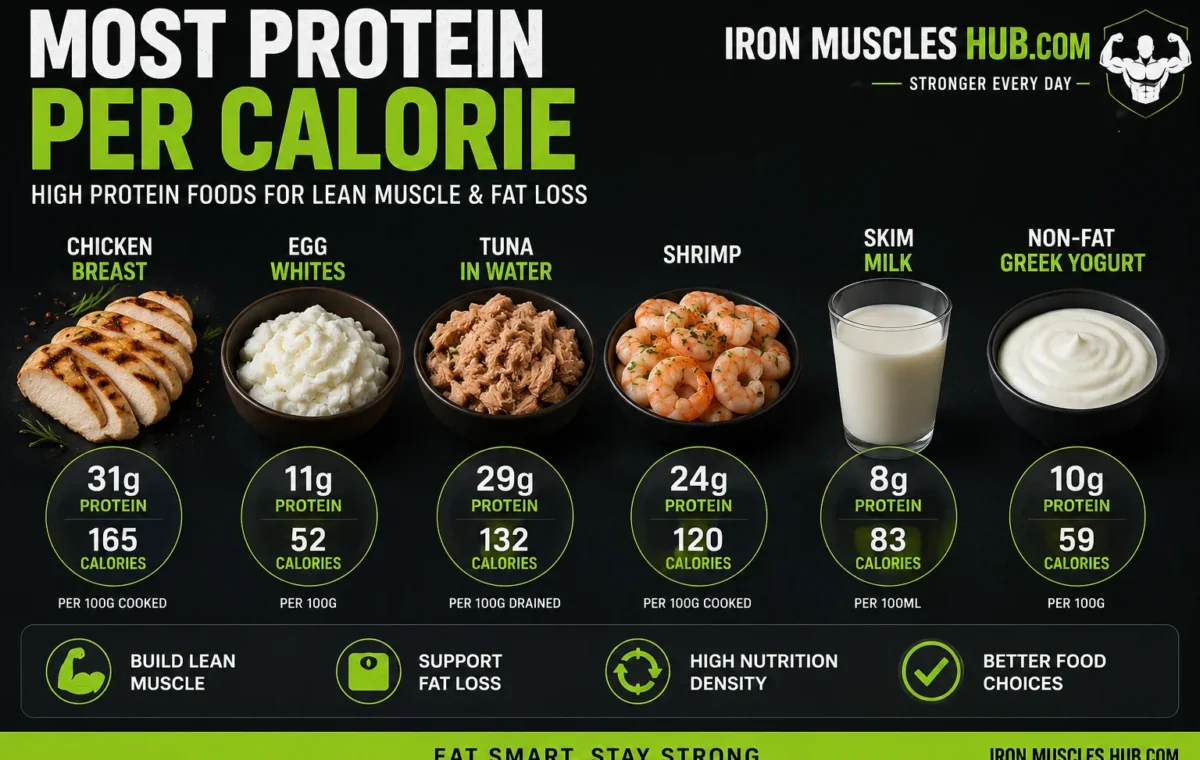
If you want the most protein per calorie, focus on lean foods such as shrimp, white fish, tuna, egg whites, chicken breast and nonfat Greek yogurt. These foods give you a large amount of protein without using many calories.
- Quick Answer
- What Food Has the Most Protein Per Calorie?
- What Does “Protein Per Calorie” Mean?
- 15 Foods With the Most Protein Per Calorie
- 1. Shrimp
- 2. Cod
- 3. Haddock
- 4. Egg Whites
- 5. Tuna
- 6. Turkey Breast
- 7. Chicken Breast
- 8. Tilapia
- 9. Scallops
- 10. Pork Tenderloin
- 11. Nonfat Greek Yogurt
- 12. Skyr
- 13. Cottage Cheese
- 14. Tofu
- 15. Lentils
- Why Protein Per Calorie Matters for Fat Loss
- Protein Per Calorie vs Protein Per 100 Grams
- Example
- Worked Example: 160 lb / 73 kg Beginner
- How Much Protein Do You Actually Need?
- Common Mistakes → Why → Fix
- Mistake 1: Only eating the “leanest” foods
- Mistake 2: Ranking foods by protein per 100 grams
- Mistake 3: Forgetting cooking oil
- Mistake 4: Eating huge amounts of protein but ignoring training
- Mistake 5: Assuming more protein always means more muscle
- A 30-Second Protein Decision Rule
- What About Plant-Based Foods?
- Who This Is NOT For
- Can High-Protein Foods Help With Muscle Gain?
- Best High-Protein Foods for Different Goals
- FAQ
- What food has the most protein per calorie?
- What has 20 g of protein with the least calories?
- Is chicken the highest protein per calorie food?
- What are the best high-protein low-calorie foods for weight loss?
- How much protein should I eat to build muscle?
- Final Takeaway
The key measurement is grams of protein per 100 calories, not simply protein per 100 grams. That difference matters because foods such as nuts and seeds can contain plenty of protein by weight but also bring substantially more calories. For more insights read here :- lean muscle and how to get bigger .
Quick Answer
- Shrimp and very lean white fish are among the strongest whole-food choices for protein per calorie.
- Egg whites are exceptionally lean and can provide a lot of protein for relatively few calories.
- Chicken breast, tuna, turkey breast and nonfat Greek yogurt are practical choices for everyday meals.
- For muscle gain or maintenance, protein density is useful, but your total daily protein, overall calorie intake and resistance training matter more than choosing one “perfect” food.
What Food Has the Most Protein Per Calorie?
Among common whole foods, very lean seafood and egg whites consistently rank near the top for protein per calorie. Current food-composition comparisons put foods such as shrimp, cod, haddock, tuna and egg whites roughly around the low-20s grams of protein per 100 calories, although the exact ranking changes with species, cooking method and database entry.
There isn’t one universal winner for every database. A food can also rank differently depending on whether it’s raw, cooked, drained, skinless, or prepared with oil.
That’s why I wouldn’t obsess over a single number.
As a beginner, use protein per calorie as a decision-making tool. If two foods provide a similar amount of protein, the leaner option gives you more room for carbohydrates, fats, fruit, vegetables and other foods you enjoy.
What Does “Protein Per Calorie” Mean?
Protein per calorie tells you how much protein you get for a fixed amount of energy.
A simple formula is:
Protein per 100 calories = grams of protein ÷ calories × 100
For example, if a serving contains 24 g of protein and 100 calories:
24 ÷ 100 × 100 = 24 g protein per 100 calories
That’s a very protein-dense food.
Compare that with a food containing 20 g of protein and 300 calories:
20 ÷ 300 × 100 = 6.7 g protein per 100 calories
Both foods contain protein, but the first one is much more efficient if you’re trying to keep calories under control.
15 Foods With the Most Protein Per Calorie
The table below is designed as a practical comparison rather than a claim that every food has one fixed nutritional value. Values vary between species, brands, cooking methods and databases.
| Food | Approx. protein | Approx. calories | Approx. protein / 100 kcal |
|---|---|---|---|
| Shrimp, cooked | 24 g / 100 g | 99 kcal | 24 g |
| Cod, cooked | 24 g / 100 g | 100 kcal | 24 g |
| Haddock, cooked | 24 g / 100 g | 98 kcal | 24 g |
| Egg whites | 11 g / 100 g | 52 kcal | 21 g |
| Tuna in water | 25 g / 100 g | 116 kcal | 22 g |
| Turkey breast | 22 g / 100 g | 114 kcal | 19 g |
| Chicken breast, skinless | 30–31 g / 100 g | 150–165 kcal | 19–20 g |
| Tilapia | 20 g / 100 g | 95–100 kcal | 20–21 g |
| Scallops | 20 g / 100 g | roughly 100 kcal | ~20 g |
| Pork tenderloin | 22 g / 100 g | roughly 120 kcal | ~18 g |
| Nonfat Greek yogurt | 10–11 g / 100 g | roughly 60 kcal | ~17 g |
| Skyr | 10–11 g / 100 g | roughly 65–75 kcal | ~15–17 g |
| Low-fat cottage cheese | 11–13 g / 100 g | roughly 80–100 kcal | ~12–16 g |
| Tofu | 8–10 g / 100 g | roughly 75–100 kcal | ~10–13 g |
| Lentils, cooked | 9 g / 100 g | roughly 115 kcal | ~8 g |
These values are representative rather than universal. Current comparisons using USDA-derived food data similarly place shrimp, lean white fish, tuna, egg whites, turkey and chicken among the strongest everyday options.
1. Shrimp
Shrimp is one of the best choices when the goal is a high protein intake with relatively few calories.
A typical 100 g portion of cooked shrimp provides roughly 24 g of protein for around 100 calories, although the exact value varies with species and preparation. Current food-composition comparisons place shrimp at or very near the top among common whole foods.
It’s also easy to use in meals.
Try shrimp with:
- Rice and vegetables
- Potatoes and salad
- Whole-grain wraps
- Stir-fried vegetables
- A simple pasta dish
The main calorie trap is preparation. Deep-frying shrimp or coating it in calorie-heavy sauces can dramatically change the energy content.
2. Cod
Cod is another excellent protein-per-calorie choice.
Lean white fish generally contains a lot of protein relative to its calorie content because it contains comparatively little fat. Current food databases place cooked cod around 24 g protein per 100 g and roughly 100 calories, depending on the specific entry and preparation.
For a beginner, baked cod with potatoes and vegetables is an easy high-protein meal.
3. Haddock
Haddock has a similar profile to cod.
It is a lean white fish that can provide roughly 24 g of protein per 100 calories in some food-composition databases.
You don’t need to eat haddock specifically. The bigger lesson is to look for lean white fish rather than believing one particular species is magical.
4. Egg Whites
Egg whites are unusually protein-dense because most of the egg’s fat is found in the yolk.
One research intervention used six egg whites containing 24 g protein and 96 calories, illustrating how much protein can be supplied by a very lean serving.
Whole eggs are still nutritious and can absolutely fit into a muscle-building diet. Egg whites simply make it easier to increase protein without adding as many calories.
A practical option is:
2 whole eggs + additional egg whites + vegetables
That gives you the taste and nutrients of whole eggs while increasing the protein content of the meal.
5. Tuna
Tuna is another convenient option, especially when you don’t have time to cook.
Tuna canned in water is commonly listed around 20–25 g of protein per 100 g, with relatively few calories. The exact amount depends on species, whether the tuna is packed in water or oil, and how much liquid is drained.
For a quick lunch, combine tuna with:
- Whole-grain bread
- Potatoes
- Salad
- Rice
- Beans
- Greek yogurt-based dressing
If you’re eating tuna regularly, vary your seafood choices rather than relying on one food every day.
6. Turkey Breast
Turkey breast is a useful lean poultry option.
A typical raw turkey-breast entry provides roughly 22 g protein per 100 g and around 114 calories, producing a strong protein-to-calorie ratio.
Choose skinless preparations when your priority is keeping calories lower.
7. Chicken Breast
Chicken breast is popular for a reason.
A 100 g cooked skinless portion commonly provides around 30 g of protein, with calories varying according to cooking method and the amount of fat retained.
Chicken isn’t necessarily the absolute winner for protein per calorie. Some lean fish and egg whites can be even more protein-dense.
Its advantage is practicality.
You can buy it almost anywhere, cook a large batch and use it in several meals.
8. Tilapia
Tilapia is another lean fish that works well for beginners.
Food databases commonly place it around 20 g protein per 100 g with roughly 95–100 calories, giving approximately 20 g of protein per 100 calories.
Bake it with herbs and lemon, then serve it with rice, potatoes or vegetables.
9. Scallops
Scallops are a less common but very lean seafood choice.
Their protein density is high because they provide substantial protein without the calorie load found in many fattier foods. Current food comparisons place scallops among the higher-protein-per-calorie seafood choices.
The catch is cost and availability. You don’t need scallops to hit your protein target.
10. Pork Tenderloin
Pork gets a bad reputation in some fitness circles, but the cut matters.
Pork tenderloin is much leaner than many processed or fatty pork products. Current comparisons place it around the high teens in grams of protein per 100 calories.
The lesson is simple: don’t judge an entire food category by its fattiest version.
11. Nonfat Greek Yogurt
Greek yogurt is one of the easiest protein foods for beginners.
A plain nonfat version can provide around 10 g protein per 100 g with relatively few calories, although brands differ. The British Heart Foundation lists a 150 g serving of 0% Greek yogurt at 15 g protein and 97 calories.
Greek yogurt works especially well at breakfast or as a snack.
Add berries and a small amount of oats if you want carbohydrates, or use it as a base for a savory sauce.
12. Skyr
Skyr has a similar role to Greek yogurt.
The British Heart Foundation lists 150 g of Skyr at 13.5 g protein and 76 calories, making it a highly protein-dense dairy option.
Check the label because flavored versions can contain considerably more sugar and calories than plain versions.
13. Cottage Cheese
Low-fat cottage cheese is another useful dairy food.
It doesn’t compete with shrimp or egg whites for the top spot, but it gives you a convenient combination of protein and relatively moderate calories.
It’s particularly useful when you want a quick snack that requires almost no preparation.
14. Tofu
Tofu is a practical plant-based option.
The British Heart Foundation lists 100 g of tofu at 8 g protein and 73 calories in its example food table, although tofu varies considerably by firmness and brand.
Plant-based foods don’t need to win the protein-per-calorie contest to be useful.
Tofu can help you build a varied diet while providing protein alongside other nutrients.
15. Lentils
Lentils aren’t as protein-dense as lean fish or egg whites because they also provide carbohydrates.
That’s not a problem.
A food doesn’t have to be number one on a ranking to be healthy or useful. Lentils provide protein plus carbohydrate and fiber, making them particularly helpful for meals where you want more than just a protein source.
Why Protein Per Calorie Matters for Fat Loss
Protein per calorie becomes especially useful when you’re trying to reduce calorie intake while keeping protein high.
Suppose two foods both provide about 25 g of protein.
If one requires roughly 120 calories and the other requires 300 calories, the leaner food leaves you with more calories for the rest of your meal.
That doesn’t mean you should eliminate higher-calorie protein foods.
Foods such as salmon, whole eggs, nuts, seeds, cheese and fattier cuts of meat can still have a place in a balanced diet.
The goal isn’t to make every calorie come from the most protein-dense food possible.
Instead, use protein density to make smarter choices when calories are limited.
Protein Per Calorie vs Protein Per 100 Grams
This is one of the biggest points beginners miss.
A food can rank highly for protein per 100 g but poorly for protein per calorie.
Example
Peanuts contain substantial protein by weight, but they’re also calorie-dense because they contain a significant amount of fat.
Shrimp contains less protein per 100 g than some concentrated plant foods, but its very low calorie content gives it a much stronger protein-per-calorie ratio. Current comparisons show this difference clearly.
So ask:
“How much protein does this food contain?”
and then ask:
“How many calories do I have to eat to get that protein?”
For cutting, the second question can be very useful.
Worked Example: 160 lb / 73 kg Beginner
Let’s say you’re a 160 lb (73 kg) beginner who lifts weights and wants to improve body composition.
A research-based protein target for resistance-training adults is often higher than the basic adult RDA. A large meta-analysis found that benefits for resistance-training-related fat-free mass generally levelled off around 1.6 g/kg/day when protein supplementation was included.
At 73 kg:
73 × 1.6 = 116.8 g protein/day
So roughly 117 g protein per day would be an evidence-based reference point for this example.
Now imagine getting much of that protein from lean foods:
- 150 g chicken breast: roughly 45 g protein
- 150 g shrimp: roughly 36 g protein
- 200 g nonfat Greek yogurt: roughly 20 g protein
- 2 whole eggs + egg whites: roughly 20–25 g protein
That can put you around the target while leaving plenty of room for carbohydrates, fats, fruit and vegetables.
The calculation is only an example, not a prescription. Your age, training, body composition, total calories, food preferences and health status can change what makes sense.
How Much Protein Do You Actually Need?
The basic adult protein RDA is 0.8 g/kg/day, but that is a general minimum rather than a specific muscle-building target.
For routinely active adults and athletes, an ACSM educational resource gives a broader range of approximately 1.2–2.0 g/kg/day.
For people doing resistance training, research has found that increasing protein intake can support modest additional gains in lean mass and strength, with the benefit tending to diminish at higher intakes.
You don’t need to immediately chase the top end of a range.
For a beginner, the practical priority is:
- Eat enough total food for your goal.
- Get a consistent protein source at meals.
- Train progressively.
- Sleep adequately.
- Adjust your intake based on progress.
Common Mistakes → Why → Fix
Mistake 1: Only eating the “leanest” foods
Why: You can turn healthy eating into an unnecessarily restrictive diet.
Fix: Use lean protein foods as your foundation, but include other nutritious foods too. Your diet still needs carbohydrates, fats, fiber, micronutrients and enough total energy.
Mistake 2: Ranking foods by protein per 100 grams
Why: This ignores calories.
Fix: If your priority is calorie efficiency, compare protein per 100 calories.
Mistake 3: Forgetting cooking oil
Why: A lean food can become much more calorie-dense after frying or adding large amounts of oil.
Fix: Measure cooking fats when calorie control matters. Grilling, baking, steaming and air-frying can make calorie tracking easier.
Mistake 4: Eating huge amounts of protein but ignoring training
Why: Protein provides raw materials, but resistance training is the stimulus for muscle adaptation.
Fix: Pair adequate protein with a progressive resistance-training program. A large meta-analysis found that the muscle-related benefit of additional protein occurred in the context of resistance training.
Mistake 5: Assuming more protein always means more muscle
Why: Protein isn’t magic.
Fix: Think of muscle growth as a combination of training, adequate nutrition, recovery and time. More protein beyond useful levels isn’t guaranteed to produce additional muscle.
A 30-Second Protein Decision Rule
When you’re standing in the supermarket, use this simple test:
Step 1: Look at the protein grams.
Step 2: Look at the calories.
Step 3: Ask whether you can get similar protein with fewer calories.
Step 4: Choose based on your overall meal, not the ranking alone.
For example, if you’re choosing between two yogurts, don’t automatically buy the one with the biggest “high protein” label.
Check:
- Protein
- Calories
- Added sugar
- Fat
- Serving size
- Ingredients
- Price
The highest protein number isn’t automatically the best product.
What About Plant-Based Foods?
Plant foods can absolutely contribute to a high-protein diet.
However, many plant foods provide protein alongside carbohydrates or fats, which can lower their protein-per-calorie ranking.
Examples include:
- Lentils
- Beans
- Tofu
- Tempeh
- Soy foods
- Seitan
- Peas
Soy-based foods are particularly useful because they can provide substantial protein without requiring you to rely entirely on animal foods.
If you’re vegetarian or vegan, don’t judge your diet by whether one food beats shrimp on a protein-per-calorie leaderboard.
Build meals around several protein sources and pay attention to your overall daily intake.
Who This Is NOT For
Protein-per-calorie rankings aren’t something you need to obsess over if:
- You’re struggling to eat enough food.
- You’re trying to gain weight and have a high calorie requirement.
- You already have a balanced diet with sufficient protein.
- You have a medical condition that requires a specific diet.
- Your food choices are becoming overly restrictive.
- You have been advised by a healthcare professional to follow a particular nutrition plan.
If you have kidney disease, liver disease, digestive problems or another condition affected by protein or calorie intake, speak with your healthcare professional before making major dietary changes.
Can High-Protein Foods Help With Muscle Gain?
Yes, but the food itself isn’t what builds muscle by itself.
Resistance training provides the training stimulus, while dietary protein supplies amino acids used in tissue maintenance and adaptation.
A meta-analysis of 49 studies involving 1,863 participants found that protein supplementation during prolonged resistance training increased changes in strength and fat-free mass, with no further fat-free-mass benefit observed above approximately 1.62 g/kg/day in its dose-response analysis.
Another systematic review found small additional improvements in lean body mass and some strength outcomes with higher protein intake during resistance exercise.
The takeaway for a beginner is simple:
Don’t spend all your attention trying to find the single food with the highest protein-per-calorie ratio. Get enough total protein, train consistently and build a diet you can actually maintain.
Best High-Protein Foods for Different Goals
| Goal | Good choices |
|---|---|
| Maximum protein per calorie | Shrimp, cod, haddock, egg whites |
| Easy meal prep | Chicken breast, turkey, tuna |
| Fast breakfast | Egg whites, Greek yogurt, Skyr |
| Quick snack | Greek yogurt, cottage cheese, Skyr |
| Plant-based | Tofu, tempeh, lentils, soy foods |
| Higher-calorie muscle gain | Whole eggs, salmon, dairy, lean meat |
| Budget-friendly | Eggs, lentils, canned tuna, chicken, yogurt |
This is where the protein-per-calorie concept becomes useful.
You don’t need the same food at every meal.
Choose based on your calorie needs, protein target, budget and preferences.
FAQ
What food has the most protein per calorie?
Among common whole foods, very lean seafood such as shrimp, cod and haddock, along with egg whites, consistently rank near the top for protein per calorie. Exact rankings vary because food databases use different species, serving conditions and cooking methods.
If you’re looking for a practical everyday answer rather than a laboratory leaderboard, shrimp, white fish, tuna, egg whites and skinless poultry are excellent places to start.
What has 20 g of protein with the least calories?
Lean seafood and egg whites are among the most calorie-efficient options. Depending on the specific food and preparation, a serving supplying about 20 g of protein can be around 80–100 calories for some very lean seafood, while chicken breast generally requires more calories.
Remember that exact numbers vary by product and cooking method, so check the nutrition label or food database for the food you’re actually eating.
Is chicken the highest protein per calorie food?
Not necessarily. Chicken breast is an excellent high-protein, relatively low-calorie food, but very lean seafood and egg whites can provide even more protein for the same number of calories. Current food comparisons place shrimp, cod, haddock and similar lean foods near the top.
Chicken’s real advantage is convenience: it’s affordable, widely available and easy to meal prep.
What are the best high-protein low-calorie foods for weight loss?
Good options include shrimp, white fish, tuna packed in water, egg whites, skinless chicken breast, turkey breast, nonfat Greek yogurt and Skyr. These foods can make it easier to increase protein without using a large portion of your calorie budget.
You don’t need to eat only these foods. A sustainable diet can include higher-calorie protein sources too.
How much protein should I eat to build muscle?
Your ideal intake depends on factors such as body weight, training, age, diet and health status. The general adult RDA is 0.8 g/kg/day, while ACSM educational guidance gives approximately 1.2–2.0 g/kg/day for athletes and routinely active adults.
For resistance training, a large meta-analysis found diminishing returns around 1.6 g/kg/day for fat-free-mass gains.
That doesn’t mean everyone needs exactly that amount.
Final Takeaway
If you’re searching for the most protein per calorie, start with lean seafood, egg whites, tuna, skinless poultry and low-fat dairy. They make it easier to get substantial protein without spending a large share of your calorie budget.
But don’t turn the ranking into a rigid diet.
The best protein food is one that fits your protein target, calorie needs, budget, preferences and normal eating habits. Use protein-per-calorie as a tool rather than a rule. Combine good food choices with progressive resistance training and adequate recovery, and you’ll have a much stronger foundation for improving body composition and building muscle.
For beginners, consistency beats chasing the perfect food.