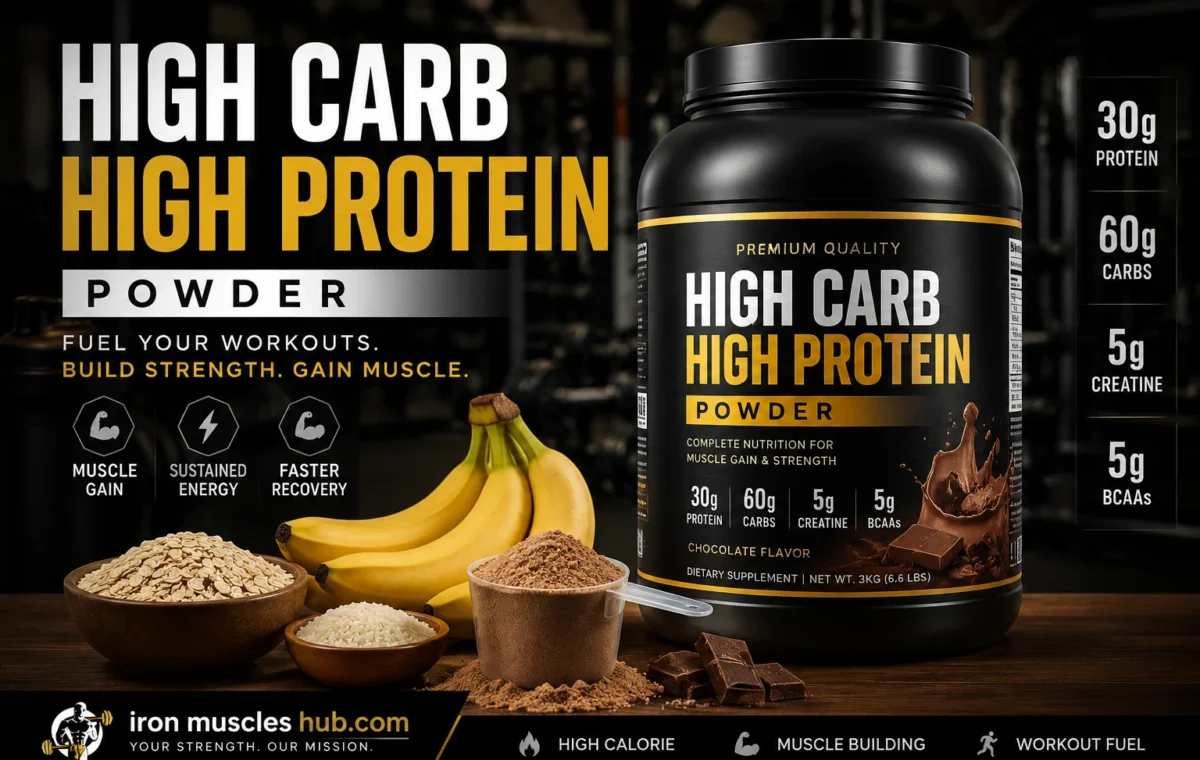
If you’re looking for a high carb high protein powder, you’re usually trying to solve one of two problems: getting enough protein, or getting enough total calories to support training and weight gain. These powders combine substantial carbohydrate with protein in a convenient shake.
- Quick Answer
- What Is High Carb High Protein Powder?
- High Carb vs. Standard Protein Powder
- How Much Protein Do You Actually Need?
- How Much Carbohydrate Do You Need?
- Who Benefits Most From a High Carb High Protein Powder?
- Who This Is NOT For
- How to Choose a High Carb High Protein Powder
- 1. Check Protein Per Serving
- 2. Check Total Carbohydrates
- 3. Check Serving Size
- 4. Check Added Sugar
- 5. Check the Protein Sources
- 6. Check the Carbohydrate Sources
- High Carb High Protein Powder Comparison
- Worked Example: 70 kg (154 lb) Beginner
- A Simple 30-Second Decision Rule
- When Should You Take High Carb High Protein Powder?
- Before or After a Workout?
- Before Training
- After Training
- Common Mistakes → Why → Fix
- Mistake 1: Treating the Full Serving as Mandatory
- Mistake 2: Using a Gainer When You Only Need Protein
- Mistake 3: Replacing Real Food
- Mistake 4: Expecting the Powder to Build Muscle by Itself
- Can High Carb High Protein Powder Help Build Muscle?
- Can It Make You Gain Fat?
- High Carb High Protein Powder vs. Homemade Shake
- How to Use It Without Overdoing Calories
- Example
- Does More Protein Mean More Muscle?
- What About Carbs for Strength Training?
- Should Beginners Use a Mass Gainer?
- FAQ
- Is high carb high protein powder good for muscle gain?
- Is high carb high protein powder the same as mass gainer?
- How much protein should I get from a high carb protein powder?
- When should I take high carb high protein powder?
- Can high carb protein powder make you gain fat?
- Final Takeaway
For beginners, the key is not choosing the powder with the biggest calorie number. Choose a serving that fills the nutritional gap left by your normal diet. Research supports adequate daily protein for resistance training, while carbohydrate can be useful for supporting higher-volume training. For more insights read here :- male gym body and person working out.
Quick Answer
- High carb high protein powder is usually a mass-gainer-style supplement containing both protein and a large amount of carbohydrate.
- It can be useful if eating enough food is difficult or your training creates a large energy demand.
- Protein should be judged against your total daily intake, not simply the grams in one scoop.
- A powder isn’t required to build muscle. Whole foods, progressive resistance training and adequate recovery remain the foundation.
- Start with a smaller serving if a full serving gives you far more calories than you need.
What Is High Carb High Protein Powder?
A high carb high protein powder is a powdered supplement that provides significant amounts of both carbohydrates and protein. It is different from a standard whey protein powder, which generally focuses on delivering protein without a large carbohydrate or calorie load.
Many products in this category are sold as mass gainers, weight gainers or high-calorie protein powders. Their purpose is mainly convenience: you can consume a substantial amount of carbohydrate and protein without having to prepare another full meal.
Commercial products vary widely. For example, the NIH Dietary Supplement Label Database lists a Dymatize Super Mass Gainer serving containing 52 g of protein and 252 g of carbohydrate, showing just how large the serving sizes can become in this category.
That does not mean you need those amounts.
Your requirements depend on your body size, training, normal diet, appetite and overall goal.
High Carb vs. Standard Protein Powder
A standard protein powder is mainly useful when your diet is short on protein.
A high-carb, high-protein powder does two jobs:
- Adds protein.
- Adds a substantial amount of carbohydrate and calories.
That distinction matters.
If you already eat enough calories but struggle to reach your protein target, a high-carb powder may simply give you calories you don’t need.
If you struggle to eat enough food and need both protein and energy, the combination can be much more practical.
How Much Protein Do You Actually Need?
For most people who regularly perform resistance training, a useful evidence-based target is around 1.4–2.0 g of protein per kg of body weight per day. The ISSN position stand places most exercising individuals in this range.
A large meta-analysis of resistance-training studies found that protein supplementation improved gains in muscle size and strength, with no additional fat-free-mass benefit observed beyond roughly 1.6 g/kg/day in its analysis.
That gives beginners a practical starting point.
| Body weight | Approx. weight | 1.6 g/kg protein |
|---|---|---|
| 60 kg | 132 lb | 96 g/day |
| 70 kg | 154 lb | 112 g/day |
| 80 kg | 176 lb | 128 g/day |
| 90 kg | 198 lb | 144 g/day |
| 100 kg | 220 lb | 160 g/day |
These are daily totals, not powder targets.
Your food already contributes protein. Eggs, dairy, meat, fish, poultry, beans, lentils, soy foods and other protein-rich foods all count.
So if a 70 kg (154 lb) beginner gets 85 g of protein from food, they don’t automatically need a powder containing another 100 g.
A shake containing 25–40 g of protein may be enough to close the gap.
How Much Carbohydrate Do You Need?
Carbohydrate requirements are less straightforward than protein requirements.
Research on resistance training doesn’t support one universal carbohydrate number for every lifter. A review notes that traditional recommendations around 3–7 g/kg/day have been suggested for resistance-trained people, while also pointing out that the evidence does not establish one mandatory carbohydrate target for everyone.
Another systematic review found that carbohydrate intake doesn’t consistently improve resistance-training performance in fed workouts, particularly when training volume is modest. Benefits appear more likely in certain situations, such as longer, higher-volume sessions or training after a prolonged fast.
So don’t assume that more carbs automatically means more muscle.
Think of carbohydrate as training fuel and a convenient calorie source.
If you train hard, perform a lot of sets, play sport alongside lifting, or struggle to eat enough, higher carbohydrate intake may be useful.
If you have a sedentary lifestyle and only lift a few times per week, you may have little reason to drink a massive carbohydrate-heavy shake.
Who Benefits Most From a High Carb High Protein Powder?
This type of supplement can make sense for people who:
- Have difficulty eating enough calories from normal meals.
- Have a low appetite.
- Train frequently or perform high-volume resistance workouts.
- Need a convenient meal addition around work, school or training.
- Are trying to gain body weight and have established a reason to increase calorie intake.
- Need both protein and carbohydrates rather than protein alone.
It can also be useful for people who simply prefer liquid calories.
A shake can be easier to consume than another large plate of rice, potatoes, pasta or other carbohydrate-rich foods.
But convenience is the main advantage.
The powder isn’t inherently more muscle-building than an appropriately structured diet that supplies the same nutrients.
Who This Is NOT For
A high carb high protein powder may be a poor fit if:
- You’re already gaining weight faster than you want.
- You have no problem meeting calorie and protein needs with food.
- Your primary goal is fat loss.
- Large shakes cause digestive discomfort.
- You regularly replace several balanced meals with powder.
- You choose a huge serving simply because the label advertises more calories.
- You haven’t established what your normal calorie and protein intake looks like.
If you don’t need the extra calories, a standard protein powder or whole-food protein source may be more appropriate.
How to Choose a High Carb High Protein Powder
Don’t start with the front of the tub.
Start with the nutrition label.
1. Check Protein Per Serving
Look at how much actual protein you receive.
Then compare it with your daily requirement.
A product providing 30 g of protein can be useful. But a 30 g serving doesn’t automatically make the product better than one providing 25 g.
Your total daily intake matters more than small differences between products.
2. Check Total Carbohydrates
This is especially important with mass gainers.
Two powders can both contain 30 g of protein but provide dramatically different amounts of carbohydrate.
One might give you a moderate shake.
Another might deliver several hundred grams of carbohydrate in its full labeled serving.
That difference can have a major effect on your daily calorie intake.
3. Check Serving Size
This is one of the easiest things for beginners to miss.
A tub may advertise an impressive number of calories and protein, but the serving might require several large scoops.
Always compare products using:
Protein per serving + carbohydrate per serving + calories per serving + serving size
Don’t compare the headline number alone.
4. Check Added Sugar
Carbohydrate isn’t automatically bad.
Oats, rice, fruit, cereal and other carbohydrate-rich foods can all be useful.
Still, check the label for added sugars and decide whether the product fits your overall diet.
A high-carbohydrate product doesn’t need to be extremely sweet to be useful.
5. Check the Protein Sources
Look for recognizable protein sources such as:
- Whey protein concentrate
- Whey protein isolate
- Milk protein
- Casein
- Soy protein
- Pea protein
- Other complete or complementary protein blends
If you have allergies, intolerances or dietary restrictions, read the ingredient and allergen information carefully.
6. Check the Carbohydrate Sources
Products may use ingredients such as:
- Oat flour
- Maltodextrin
- Rice-based carbohydrates
- Dextrin
- Starches
- Powdered grains
The carbohydrate source can affect taste, texture, digestion and how quickly the shake is consumed.
You don’t need to fear a particular carbohydrate ingredient simply because it’s used in a supplement. Instead, judge the entire product and how it fits your diet.
High Carb High Protein Powder Comparison
| Type | Protein | Carbohydrate | Calories | Best use |
| Standard whey | High | Low | Low–moderate | Protein gap |
| High-protein shake | Moderate–high | Moderate | Moderate | Protein + some carbs |
| Mass gainer | High | High | High | Large calorie gap |
| Homemade shake | Adjustable | Adjustable | Adjustable | Flexible calorie control |
| Whole-food meal | Adjustable | Adjustable | Adjustable | Main nutrition foundation |
The homemade shake is often the easiest option to customize.
You can change the carbohydrate and protein amounts without being locked into a huge manufacturer serving.
For example, whey protein plus oats, milk and a banana can provide protein and carbohydrate while allowing you to adjust the quantities.
Worked Example: 70 kg (154 lb) Beginner
Let’s say a beginner weighs 70 kg (154 lb) and resistance trains three to four days per week.
Using 1.6 g/kg as a practical protein reference:
70 × 1.6 = 112 g protein/day
Suppose their normal meals provide approximately 80–90 g.
They may only need another 20–30 g of protein to reach that reference point.
Now imagine they also have trouble eating enough total calories.
A powder providing approximately:
- 30 g protein
- 60 g carbohydrate
would provide about 360 kcal from protein and carbohydrate alone using the standard 4 kcal/g conversion for each macronutrient.
The exact calories on the product label may be higher because products can also contain fat, fiber and other ingredients.
The important lesson is this:
They don’t need to automatically drink the manufacturer’s largest serving.
If a full serving contains 1,000+ calories, but the person only needs a few hundred extra calories, a smaller portion may make more sense.
Always follow the product label and adjust your overall diet rather than treating the full serving as a required dose.
A Simple 30-Second Decision Rule
Ask yourself these three questions:
1. Am I consistently eating enough protein?
If no, increase protein-rich foods or consider a protein powder.
2. Am I consistently eating enough calories for my goal?
If no, a high-carb, high-protein powder may be useful.
3. Do I actually need both?
If yes, a mass-gainer-style powder can be convenient.
If your answer is no to the third question, you may be better served by a simpler protein powder or whole foods.
This prevents a common beginner mistake: buying the biggest gainer simply because the label promises the most calories.
When Should You Take High Carb High Protein Powder?
There isn’t one magic time.
You can use it:
- Between meals.
- After training.
- Before training when it fits your digestion and schedule.
- As part of breakfast.
- During a busy day when preparing food is difficult.
For resistance training, carbohydrate ingestion appears most useful in specific situations rather than being universally necessary. A systematic review and meta-analysis found improved training volume with carbohydrate intake particularly during sessions lasting longer than 45 minutes and after fasting periods of 8 hours or more.
Protein timing is also less important than getting enough protein across the entire day.
Research reviewing protein distribution suggests that spreading protein across multiple meals can be a practical approach, with approximately 0.4 g/kg per meal discussed as a target when aiming for at least 1.6 g/kg/day across four meals.
So you don’t need to panic if your shake isn’t consumed within a tiny post-workout window.
Before or After a Workout?
Both can work.
Before Training
A high-carb shake can make sense if:
- You haven’t eaten for several hours.
- Your workout is long.
- You train at high volume.
- You tolerate liquid food well.
If a large shake makes you feel heavy, don’t force it.
After Training
A shake can be convenient after training because you’re already carrying the powder and can quickly get protein and carbohydrate.
But the bigger priority remains your overall daily nutrition.
The evidence does not support treating a post-workout shake as a magical muscle-building requirement.
Common Mistakes → Why → Fix
| Common mistake | Why it can be a problem | Better fix |
| Taking a full serving immediately | Some servings contain a very large calorie load | Start with a portion that matches your calorie gap |
| Chasing maximum protein | More protein isn’t automatically more muscle | Track total daily protein |
| Ignoring carbohydrates | The product may add far more calories than expected | Check total carbs and calories |
| Replacing most meals | You lose dietary variety | Use shakes as supplements to meals |
| Drinking it despite poor appetite | Large shakes can make normal meals harder | Reduce portion size |
| Choosing by marketing claims | Front labels don’t show the whole formula | Read the nutrition panel |
| Assuming carbs equal muscle | Extra calories can also increase body fat | Match intake to your goal |
| Ignoring digestion | Large shakes may cause bloating or discomfort | Try a smaller serving and assess ingredients |
Mistake 1: Treating the Full Serving as Mandatory
Manufacturers create serving sizes for their product.
That doesn’t mean your body requires that exact quantity.
A person who needs an additional 300–400 calories has a very different requirement from someone who struggles to eat 1,000 additional calories.
Fix: Match the serving to the nutritional gap.
Mistake 2: Using a Gainer When You Only Need Protein
If your meals already provide enough calories, adding a huge carbohydrate-heavy shake may push your intake well beyond your needs.
Fix: If calories are already adequate, use a simpler protein source when appropriate.
Mistake 3: Replacing Real Food
Powder is convenient, but a balanced diet offers far more variety.
Whole foods can supply protein, carbohydrates, fats, fiber, vitamins and minerals in different combinations.
Fix: Build your diet around normal meals first. Use powder to fill a specific gap.
Mistake 4: Expecting the Powder to Build Muscle by Itself
A supplement doesn’t replace resistance training.
The research on protein supplementation is clear that its benefits occur in the context of resistance training, and the training stimulus itself remains a major driver of adaptation.
Fix: Pair adequate nutrition with a progressive training program.
Can High Carb High Protein Powder Help Build Muscle?
Yes, it can support a muscle-building diet, but it doesn’t directly guarantee muscle growth.
Muscle gain requires a training stimulus plus sufficient energy, protein and recovery.
Protein provides amino acids needed for tissue maintenance and adaptation. Resistance training provides the stimulus. Carbohydrate can help supply energy and, in some training situations, support training volume.
A powder simply makes those nutrients easier to consume.
If you already get enough calories and protein from food, adding more powder won’t necessarily improve your results.
Can It Make You Gain Fat?
It can contribute to fat gain if it pushes your total energy intake above what your body needs by a substantial amount.
That doesn’t make the powder inherently bad.
The same principle applies to normal food.
If your goal is gaining muscle while controlling unnecessary fat gain, avoid treating a massive calorie surplus as the objective.
Monitor your body weight, gym performance, appetite and how your clothes fit.
If weight is increasing faster than intended, reassess the amount of supplemental calories you’re adding.
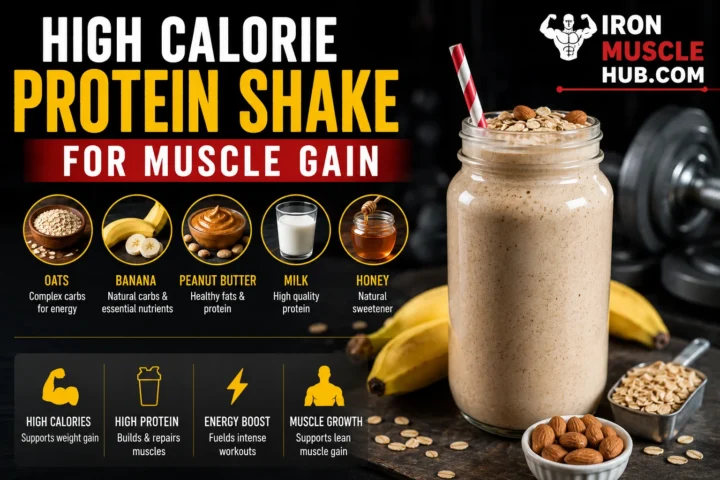
High Carb High Protein Powder vs. Homemade Shake
A homemade shake gives you more control.
For example, you could combine:
- Milk or a dairy-free alternative
- Whey or plant protein
- Oats
- Banana
- Greek yogurt
- Peanut butter, if desired
You can then adjust the portions.
Need more protein?
Increase the protein source.
Need more carbohydrate?
Increase oats or fruit.
Need fewer calories?
Reduce the oats, nut butter or liquid calorie source.
That flexibility can be useful for beginners because nutrition requirements aren’t identical from person to person.
How to Use It Without Overdoing Calories
Start by tracking your normal diet for several days.
You don’t need perfect precision.
Look for patterns.
If you’re regularly eating enough protein but consistently falling short on calories, you need a different solution from someone who is short on both.
Then choose a serving that fills the gap.
Example
A person needs an additional 300–400 calories per day.
Instead of automatically drinking a full 1,000+ calorie serving, they could use a smaller amount of a suitable product or make a smaller homemade shake.
The goal is controlled supplementation, not maximum supplementation.
Does More Protein Mean More Muscle?
Not indefinitely.
The resistance-training meta-analysis discussed earlier found that increasing protein intake above roughly 1.6 g/kg/day did not provide additional fat-free-mass gains in its analysis.
Other sports-nutrition guidance gives a broader practical range of 1.4–2.0 g/kg/day for exercising people.
These figures should be treated as evidence-based reference points, not a requirement to hit one exact number every day.
Your total diet, training quality, sleep, experience and goal all matter.
What About Carbs for Strength Training?
Carbohydrate isn’t simply “good” or “bad” for lifters.
The amount that makes sense depends on training demand.
A systematic review of 49 studies found mixed results from carbohydrate manipulation in resistance training. Higher carbohydrate intake was not consistently beneficial in fed-state workouts with moderate volume, while higher-volume training may benefit more.
A separate meta-analysis found that carbohydrate ingestion improved resistance-training volume under certain conditions, especially sessions longer than 45 minutes and after an 8-hour or longer fast.
That gives beginners a useful rule:
Use carbohydrate to support the training you actually perform, not simply because a powder contains a lot of it.
Should Beginners Use a Mass Gainer?
Beginners can use one, but they don’t automatically need one.
First, establish the basics:
- Eat regular balanced meals.
- Get sufficient protein.
- Train consistently.
- Sleep adequately.
- Monitor your progress.
- Identify whether you actually struggle to consume enough calories.
If the problem is simply convenience, a high carb high protein powder can be useful.
If you’re already gaining weight comfortably from food, spending money on a giant gainer may not solve a real problem.
FAQ
Is high carb high protein powder good for muscle gain?
It can be useful for supporting a muscle-building diet because it supplies protein and carbohydrate in a convenient form. Protein supports resistance-training adaptations, while carbohydrate can help support training energy and volume in certain situations. However, the powder itself isn’t responsible for muscle growth. Your resistance-training program, total nutrition and recovery remain the foundation.
Is high carb high protein powder the same as mass gainer?
They’re closely related, and many products marketed as mass gainers fit this description. A mass gainer typically combines substantial carbohydrate with protein and provides considerably more calories than a standard whey powder. The exact nutrition varies between products, so check the serving size, protein, carbohydrate, fat and total calories rather than relying only on the product category.
How much protein should I get from a high carb protein powder?
There is no universal amount you need from the powder. A practical target is to first estimate your total daily protein requirement, then use the supplement only to fill the gap left by food. For many resistance-trained adults, around 1.4–2.0 g/kg/day is a useful evidence-based range, with research finding little additional benefit beyond about 1.6 g/kg/day in many resistance-training contexts.
When should I take high carb high protein powder?
Take it at a time that helps you meet your overall nutrition needs. Between meals can work well if you’re trying to add calories without making your main meals enormous. After training is also convenient. Before training may work when you’ve gone several hours without eating and tolerate the shake well. There is no requirement to consume it at one exact minute after lifting.
Can high carb protein powder make you gain fat?
It can if the added calories consistently exceed your body’s energy needs. The issue isn’t that carbohydrate powder automatically becomes body fat; the important factor is your overall energy balance and goal. If you’re trying to gain muscle while limiting unnecessary fat gain, use a portion appropriate to your calorie needs rather than automatically consuming the largest serving listed on the tub.
Final Takeaway
A high carb high protein powder is best viewed as a convenient nutrition tool, not a shortcut to muscle growth. It can be useful when you need both protein and additional carbohydrate but struggle to get enough from normal meals.
Start with your diet, not the supplement label. Estimate your protein needs, look at your usual calorie intake and decide what gap you’re actually trying to fill. For resistance training, roughly 1.4–2.0 g/kg/day of protein is a useful evidence-based range, while carbohydrate needs vary with training volume and overall activity.
Choose a serving that fits your needs, monitor how you respond and keep most of your diet based on varied whole foods.