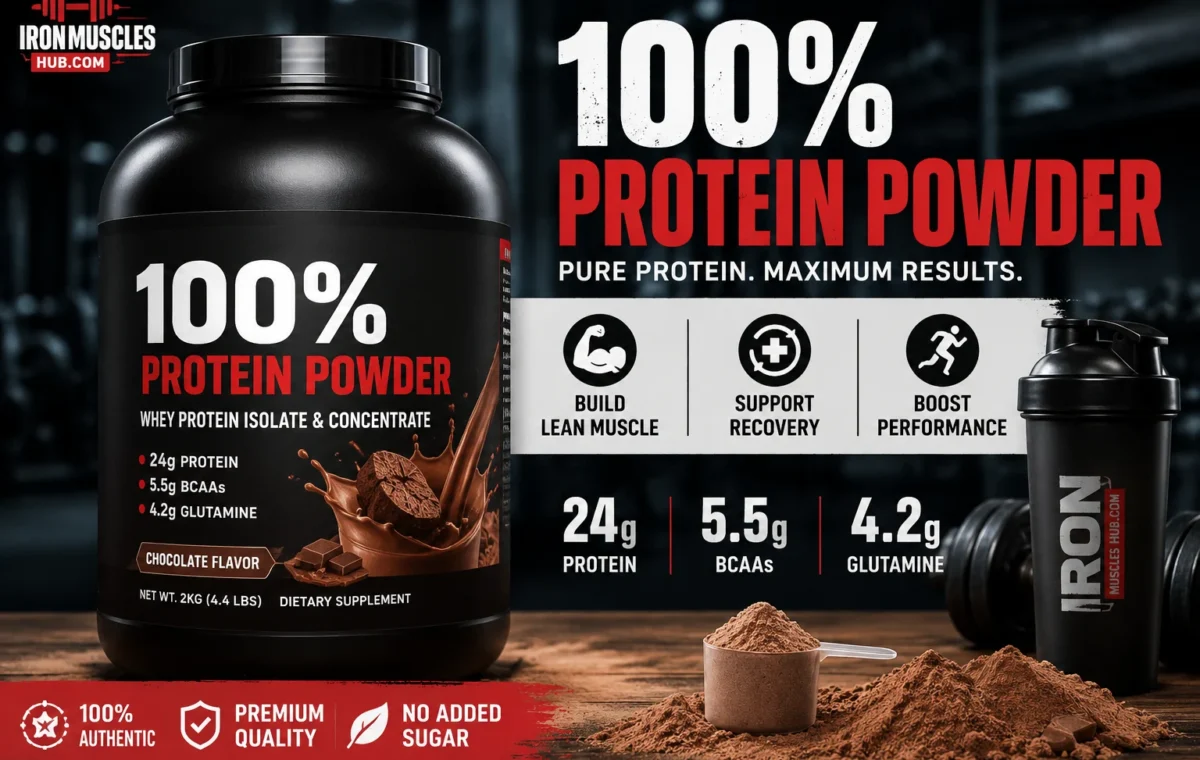
If you’re searching for 100 protein powder, you’re probably looking for a high-quality 100% whey protein powder that makes it easier to hit your daily protein target. The key is not finding the powder with the biggest marketing claim; it’s choosing one with an appropriate protein source, sensible serving size, and nutrition label that fits your diet.
- Quick Answer
- What Is 100 Protein Powder?
- Do You Need 100% Protein Powder to Build Muscle?
- How Much Protein Do You Need?
- Worked Example: 70 kg Beginner
- 100% Whey Protein vs Whey Isolate vs Whey Concentrate
- How to Choose a Good 100 Protein Powder
- 1. Check Protein Per Serving
- 2. Check the Serving Size
- 3. Check Calories
- 4. Check the Ingredient List
- 5. Check Allergens
- Whey Concentrate or Isolate: Which Should a Beginner Buy?
- Is ISO100 the Same as 100% Protein Powder?
- Comparison: Common 100% Whey-Style Options
- When Should You Take 100 Protein Powder?
- How to Use Protein Powder as a Beginner
- Option 1: Water
- Option 2: Milk
- Option 3: Smoothie
- Option 4: Protein Breakfast
- Common Mistakes → Why → Fix
- Mistake 1: Thinking “100%” Means 100 g Protein Per Scoop
- Mistake 2: Taking Protein Powder Instead of Eating Proper Meals
- Mistake 3: Drinking Multiple Shakes Without Counting Total Protein
- Mistake 4: Choosing by Marketing Instead of the Label
- Mistake 5: Assuming Expensive Isolate Is Always Better
- 30-Second Protein Powder Decision Rule
- Who Is 100 Protein Powder NOT For?
- Do Protein Powders Make You Gain Muscle?
- Can You Take Protein Powder Every Day?
- Does Protein Powder Need to Be Taken After a Workout?
- Is 100 protein powder good for muscle gain?
- Is 100% whey protein the same as whey isolate?
- How much 100 protein powder should I take per day?
- Is ISO100 a good protein powder for beginners?
- What is better: whey concentrate or whey isolate?
- Final Takeaway
For most beginners, whey concentrate, whey isolate, or a blend can all work. Your total daily protein intake matters more than taking a specific powder at a specific time. For more insights read here :- types of bodybuilding and different types of bodybuilding.
Quick Answer
- 100% whey protein powder is a supplement, not a replacement for a balanced diet.
- Most exercising adults can meet muscle-building protein needs with roughly 1.4–2.0 g of protein per kg of body weight per day.
- A powder is most useful when normal food doesn’t conveniently provide enough protein.
- Check the actual protein grams per serving, ingredients, calories, allergens, and serving size instead of judging a product by the word “100%.”
- Whey concentrate and whey isolate are both complete dairy proteins; isolate is generally processed to contain less lactose, fat, and carbohydrate.
What Is 100 Protein Powder?
“100 protein powder” usually refers to a product marketed as 100% whey protein or a similarly high-purity protein supplement. The important detail is that “100%” doesn’t necessarily mean every gram in the tub is protein.
For example, a product can be called 100% Whey while each scoop contains other ingredients such as flavourings, sweeteners, emulsifiers, or small amounts of carbohydrate and fat.
That’s why I want beginners to ignore the front of the tub for a moment and turn it around.
The Nutrition Facts panel tells you much more than the product name.
Look for:
- Serving size
- Protein per serving
- Calories
- Carbohydrate
- Fat
- Added sugar, where listed
- Protein source
- Allergens
- Ingredient list
- Third-party testing or banned-substance testing where relevant
The actual numbers can vary considerably between products and even between flavours of the same product.
For example, Dymatize currently lists ISO100 at 25 g protein and no more than 120 calories per serving, while Optimum Nutrition’s UK Gold Standard 100% Whey lists 24 g protein and less than 120 calories per serving.
That illustrates an important point:
“100% whey” isn’t a standardized promise that every product has the same nutrition profile.
Do You Need 100% Protein Powder to Build Muscle?
No. You don’t need protein powder to build muscle.
You need adequate nutrition, progressive resistance training, recovery, and enough total protein. Protein powder simply gives you a convenient way to add protein when food alone isn’t practical.
Research supports the role of adequate protein alongside resistance training. A large meta-analysis involving 49 studies and 1,863 participants found that protein supplementation increased gains in strength and fat-free mass during prolonged resistance training. The analysis found that benefits to fat-free mass did not continue increasing once total protein intake reached about 1.6 g/kg/day.
A separate sports-nutrition position stand gives a broader practical range of 1.4–2.0 g/kg/day for most exercising individuals.
So think about protein powder as a tool.
If you’re already eating enough protein from foods such as:
- Eggs
- Chicken
- Fish
- Lean beef
- Greek yogurt
- Milk
- Cottage cheese
- Beans
- Lentils
- Tofu
- Other protein-rich foods
you may not need a powder every day.
If breakfast contains almost no protein and you’re rushing to work or university, however, a shake can be an easy solution.
How Much Protein Do You Need?
For a beginner doing regular resistance training, a practical evidence-based range is approximately 1.4–2.0 g/kg of body weight per day.
That range isn’t a requirement to hit perfectly every day.
Your body weight also doesn’t tell us everything about your training, age, diet, health, or goals. Use the range as a starting framework rather than a prescription.
Worked Example: 70 kg Beginner
Suppose you weigh:
70 kg (154 lb)
Using a daily target of 1.4–2.0 g/kg:
- 70 × 1.4 = 98 g protein/day
- 70 × 2.0 = 140 g protein/day
So a reasonable general training range would be about 98–140 g per day.
Now imagine your normal meals already provide around 110 g.
You don’t automatically need three protein shakes.
One scoop containing around 20–25 g protein could simply help you reach the upper end of your target on a busy day.
That’s the smarter way to use protein powder:
Fill a dietary gap instead of treating the powder as the foundation of your diet.
100% Whey Protein vs Whey Isolate vs Whey Concentrate
The label can become confusing quickly, especially if you’re buying your first tub.
Here’s the simple breakdown.
| Protein type | What it is | Beginner-friendly? | Typical reason to choose it |
|---|---|---|---|
| Whey concentrate | Less processed whey containing protein plus some lactose, carbohydrate and fat | Yes | Usually a straightforward everyday option |
| Whey isolate | More extensively filtered whey with less lactose, carbohydrate and fat | Yes | Useful when you want a leaner protein powder or tolerate concentrate poorly |
| Hydrolyzed whey | Whey protein that has been partially broken into smaller protein fragments | Yes | Often chosen for digestion or formulation preferences |
| Casein | Slow-digesting milk protein | Yes | Useful as another protein option, especially around longer periods without food |
| Plant protein | Protein from sources such as peas, rice or soy | Yes | Useful for people avoiding dairy |
There’s no rule saying isolate automatically builds more muscle than concentrate.
The biggest practical difference is often the nutrition profile, ingredients, digestion, taste, and price.
Dymatize, for example, describes ISO100 as hydrolyzed whey protein isolate and currently lists 25 g protein per serving with no more than 120 calories.
Optimum Nutrition’s Gold Standard 100% Whey, by comparison, uses a whey blend with whey protein isolate as the primary ingredient and lists 24 g protein per serving.
Both demonstrate that a beginner doesn’t need to chase one magic type of protein.
How to Choose a Good 100 Protein Powder
When I’m helping a beginner choose a protein powder, I don’t start with the flavour.
I start with the label.
1. Check Protein Per Serving
Look at the actual protein number.
A product might have a large tub and impressive branding, but the useful question is:
How many grams of protein do I get from one serving?
Current examples include 24 g per serving for Optimum Nutrition Gold Standard 100% Whey and 25 g for Dymatize ISO100.
Don’t compare tubs by size alone.
Compare:
total protein provided ÷ total servings ÷ price
That gives you a much more useful picture of value.
2. Check the Serving Size
Two products may both advertise 25 g protein but use different serving weights.
For example, one flavour of ISO100 lists a serving size of approximately 32 g and provides 25 g protein.
That’s very different from saying the powder itself is 100% protein.
The remaining weight can come from flavouring ingredients and other components.
3. Check Calories
Calories matter because your goal determines how much room you have for a supplement.
If you’re trying to gain weight, a few extra calories may be useful.
If you’re trying to keep calories controlled, a lower-calorie protein powder may be more convenient.
Don’t automatically assume fewer calories means a better product.
4. Check the Ingredient List
A short ingredient list isn’t automatically superior, but it’s useful to understand what you’re consuming.
Look for the primary protein source near the beginning of the list.
Then check sweeteners, flavours, emulsifiers, and allergens.
5. Check Allergens
Whey is derived from milk.
Some products can also contain ingredients such as soy, peanut, or other allergens depending on the flavour and manufacturing process.
For example, Dymatize’s Chocolate Peanut Butter ISO100 lists milk, peanut and soy as allergens.
Always read the label on your exact flavour.
Whey Concentrate or Isolate: Which Should a Beginner Buy?
Choose concentrate if you tolerate dairy well and want a simple everyday protein powder.
Choose isolate if you prefer a product with less lactose, carbohydrate and fat, or if concentrate doesn’t sit well with you.
Neither choice needs to become complicated.
A beginner who eats a normal diet and has no issue with dairy can usually focus on:
- Protein per serving
- Taste
- Price
- Digestibility
- Ingredients
- Availability
rather than assuming isolate is automatically superior.
A more expensive powder isn’t necessarily more effective.
Your training program and overall diet still do the heavy lifting.
Is ISO100 the Same as 100% Protein Powder?
Not exactly.
ISO100 is a specific Dymatize product, while “100% protein powder” is a broader description used by different brands.
Dymatize currently describes ISO100 as a hydrolyzed whey protein product made from whey protein isolate. Its current product information lists 25 g protein, up to 120 calories, up to 1 g sugar, 5.5 g BCAAs, and 2.6 g leucine per serving on the main product page.
Specific flavours can have slightly different nutrition information, so check the flavour you’re buying.
For example, the current Mint Chocolate Chip version lists 25 g protein, 120 calories and 1 g sugar in a roughly 32 g serving.
So if someone searches for “100 protein powder” but actually means ISO100, they’re looking for a specific brand/product rather than the general category.
Comparison: Common 100% Whey-Style Options
| Product/example | Protein per serving | Protein type | Best fit |
| Dymatize ISO100 | 25 g | Hydrolyzed whey isolate | People wanting an isolate-focused formula |
| Optimum Nutrition Gold Standard 100% Whey | 24 g | Whey blend, isolate primary | General everyday use |
| Animal 100% Whey | 20 g on US product page | Concentrate-isolate blend | Simple whey option |
| Animal 100% Whey UK | At least 23 g | Whey concentrate/isolate | UK shoppers comparing the same brand |
Product labels can vary by market, flavour, and serving size, so don’t assume numbers from one country’s label apply to another. Current manufacturer pages show this clearly: Animal’s US page lists 20 g per serving, while its UK page lists at least 23 g.
That’s one of the easiest mistakes to make when comparing products online.
When Should You Take 100 Protein Powder?
You don’t need to obsess over a narrow post-workout window.
The most important factor is your total daily protein intake.
Protein consumed around resistance exercise can support muscle protein synthesis, and research supports protein intake before or after resistance training as part of an overall adequate diet.
For convenience, you can use protein powder:
- At breakfast
- Between meals
- After training
- Before leaving for work
- After work
- In a smoothie
- When travelling
- Whenever your normal meals leave you short on protein
If you train at 6 PM and eat dinner at 7 PM, there’s no reason to panic because you didn’t drink a shake the moment your final set ended.
Your whole day’s nutrition matters more.
How to Use Protein Powder as a Beginner
Keep it simple.
Option 1: Water
Mix your serving with water when you want a quick, low-calorie protein drink.
Option 2: Milk
Milk adds calories, protein and other nutrients.
This can be useful if you’re trying to increase overall energy intake.
Option 3: Smoothie
Blend protein powder with:
- Milk or a milk alternative
- Banana
- Oats
- Berries
- Yogurt
- Nut butter
This can turn a simple protein serving into a more substantial snack.
Option 4: Protein Breakfast
If breakfast is normally low in protein, add protein powder to oats, yogurt, or a smoothie.
That’s often more useful than automatically drinking a shake after every workout.
Common Mistakes → Why → Fix
Mistake 1: Thinking “100%” Means 100 g Protein Per Scoop
Why: Product names can sound more impressive than the nutrition label.
Fix: Check the actual grams of protein per serving.
A product can be called “100% Whey” while providing around 20–25 g protein per serving rather than 100 g. Current manufacturer examples show 20 g, 24 g and 25 g servings across different products.
Mistake 2: Taking Protein Powder Instead of Eating Proper Meals
Why: Shakes are convenient and easy to consume.
Fix: Build most of your diet around normal foods, then use powder where convenience helps.
Protein powder is a supplement.
It shouldn’t automatically replace meat, fish, eggs, dairy, legumes, grains, fruit and vegetables.
Mistake 3: Drinking Multiple Shakes Without Counting Total Protein
Why: Beginners often assume more protein automatically means more muscle.
Fix: Estimate your daily intake first.
Research suggests that increasing total protein above roughly 1.6 g/kg/day doesn’t continue producing additional gains in fat-free mass during resistance training for most healthy adults.
More isn’t automatically better.
Mistake 4: Choosing by Marketing Instead of the Label
Why: Big claims can make a product look more advanced.
Fix: Compare protein, serving size, calories, ingredients, allergens and price.
The front of the tub sells the product.
The back tells you what you’re actually buying.
Mistake 5: Assuming Expensive Isolate Is Always Better
Why: Isolate often sounds more premium.
Fix: Choose based on your needs.
If a basic whey concentrate provides enough protein, tastes good, fits your budget and causes no digestive problems, you don’t need to spend more simply for the word “isolate.”
30-Second Protein Powder Decision Rule
Use this quick test before buying.
Question 1: Do I struggle to get enough protein from food?
- No: You may not need powder.
- Yes: Continue.
Question 2: Do I tolerate dairy?
- Yes: Whey concentrate or isolate may work.
- No: Consider a suitable non-dairy protein.
Question 3: Do I have a reason to limit lactose, fat or carbohydrates?
- Yes: An isolate may be more convenient.
- No: Concentrate may be perfectly adequate.
Question 4: Does the product provide a useful amount of protein for its serving size and price?
- Yes: Shortlist it.
- No: Keep comparing.
This takes less than 30 seconds and prevents most beginner buying mistakes.
Who Is 100 Protein Powder NOT For?
Protein powder isn’t necessary for everyone.
You may not need it if:
- You already meet your protein needs comfortably from food.
- You don’t enjoy protein shakes.
- You have a dietary restriction that makes the product unsuitable.
- You’d rather spend the money on whole foods.
- You expect protein powder alone to create muscle without consistent training.
It’s also important to speak with a healthcare professional if you have a medical condition, food allergy, kidney disease, or another condition that affects your diet or protein intake.
A supplement shouldn’t be used to self-treat a medical problem.
Do Protein Powders Make You Gain Muscle?
Protein powder can help support muscle gain when it helps you meet an appropriate daily protein intake, but the powder itself isn’t a muscle-building workout.
Resistance training provides the primary training stimulus.
Protein supplies amino acids used in the body’s muscle-building and repair processes.
The evidence supports combining adequate protein with resistance training rather than treating supplementation as a substitute for training. Large reviews have found improvements in fat-free mass and strength when protein supplementation is combined with resistance exercise, although the size of the benefit depends on the overall diet and training situation.
So if you’re choosing between:
A good training program + adequate food
and
Protein powder + poor training
choose the first one every time.
Can You Take Protein Powder Every Day?
For healthy adults, protein powder can be used regularly as part of an appropriate diet.
But “every day” doesn’t mean “several times a day.”
If one serving helps you meet your protein needs, that’s enough.
On another day, you might get all your protein from food and skip the powder.
Think about your weekly routine rather than making the shake a compulsory ritual.
For example:
Monday: Shake after work because dinner is late.
Tuesday: No shake because meals already provide enough protein.
Wednesday: Shake with breakfast because you’re short on time.
That’s a perfectly sensible approach.
Does Protein Powder Need to Be Taken After a Workout?
No.
Post-workout protein can be convenient, but there isn’t a requirement to consume a shake immediately after training.
Research examining protein timing and different protein types has found benefits associated with protein supplementation around exercise, but the larger nutritional picture still matters.
If you finish your workout and eat a protein-rich meal soon afterward, you may have no practical reason to add a shake.
If your next meal is several hours away, a shake can be a convenient option.
FAQ
Is 100 protein powder good for muscle gain?
Yes, 100% whey protein powder can be useful for muscle gain when it helps you reach an appropriate daily protein intake while you’re following a resistance-training program. Research supports protein supplementation as a way to increase gains in fat-free mass and strength during prolonged resistance training, but the supplement doesn’t replace progressive training or adequate overall nutrition.
Is 100% whey protein the same as whey isolate?
No. 100% whey is generally a product-category or marketing description, while whey isolate describes a particular type of whey protein that has undergone additional processing. A 100% whey product can contain a blend of whey sources. For example, Optimum Nutrition describes Gold Standard 100% Whey as a blend with whey isolate as its primary ingredient.
How much 100 protein powder should I take per day?
Start with your total daily protein requirement, not a fixed number of scoops. Most exercising individuals can use approximately 1.4–2.0 g/kg/day as a general protein range. If food already gets you there, you may need little or no powder. If you’re short, one serving may fill the gap.
Is ISO100 a good protein powder for beginners?
ISO100 can be a convenient option for beginners who want a whey isolate-focused product. Dymatize currently lists 25 g protein and up to 120 calories per serving, with hydrolyzed whey protein isolate as the protein source. However, beginners don’t need ISO100 specifically to build muscle. A less expensive whey product can also fit a well-planned diet.
What is better: whey concentrate or whey isolate?
Neither is automatically better for everyone. Whey concentrate is often a practical everyday choice, while isolate can be useful if you want less lactose, fat or carbohydrate per serving. Your tolerance, budget, taste preference and total diet should guide the decision. For muscle gain, adequate overall protein and consistent resistance training matter more than choosing the most expensive form of whey.
Final Takeaway
The best 100 protein powder isn’t necessarily the product with the biggest tub, highest price, or most aggressive label. Start with your actual protein needs, then use a powder to fill whatever gap remains. For most exercising beginners, roughly 1.4–2.0 g/kg/day is a useful evidence-based range, while research suggests that benefits to muscle gain generally stop increasing around 1.6 g/kg/day for total protein intake in resistance-training adults.
Check the label, compare protein per serving, consider whey concentrate versus isolate, and choose something you can afford and digest comfortably.
Your powder should make your nutrition easier—not make your entire fitness plan more complicated.