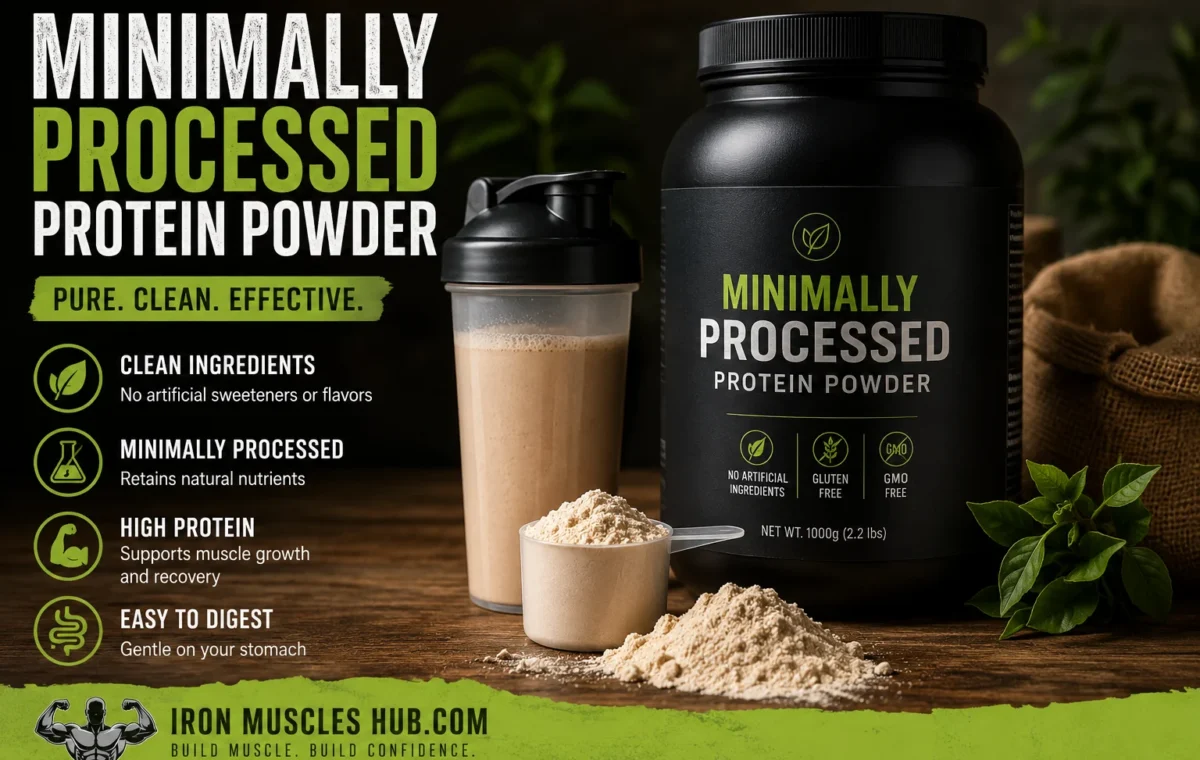
If you want a minimally processed protein powder, focus less on marketing words such as “clean” and more on the actual ingredient list, protein source, processing method, and independent quality testing. The simplest options are usually unflavored powders with one or very few ingredients.
- Quick Answer
- What Is Minimally Processed Protein Powder?
- Processed doesn't automatically mean bad
- How to Choose a Minimally Processed Protein Powder
- 1. Start with the protein source
- 2. Read the ingredient list
- 3. Check protein per serving
- 4. Look for unnecessary extras
- 5. Check independent testing
- Minimally Processed Protein Powder Comparison
- What Is the Least Processed Protein Powder?
- Whey protein
- Egg-white protein
- Plant protein
- How Much Protein Do You Actually Need?
- Worked example: 70 kg / 154 lb beginner
- Do You Need Protein Powder to Build Muscle?
- When Should You Take Minimally Processed Protein Powder?
- Common Mistakes → Why → Fix
- Mistake 1: Believing “clean” means healthy
- Mistake 2: Assuming all additives are dangerous
- Mistake 3: Choosing a powder only because it has one ingredient
- Mistake 4: Taking protein powder on top of an already high-protein diet
- Mistake 5: Ignoring allergies and tolerance
- Mistake 6: Thinking “natural” means minimally processed
- Mistake 7: Buying the biggest tub because it looks cheaper
- A 30-Second Protein Powder Decision Rule
- Question 1: Is the protein source obvious?
- Question 2: Is the ingredient list reasonably short?
- Question 3: Is the protein amount clearly stated?
- Question 4: Is there credible independent testing?
- Question 5: Will you actually use it?
- Who Is Minimally Processed Protein Powder NOT For?
- You may not need it if:
- You may need professional guidance if:
- Can Minimally Processed Protein Powder Help With Muscle Gain?
- Minimally Processed vs. Whole-Food Protein
- What About Heavy Metals and Contaminants?
- Should You Choose Whey or Plant Protein?
- Choose whey if:
- Choose plant protein if:
- Do You Need an Unflavored Protein Powder?
- Frequently Asked Questions
- What is the least processed protein powder?
- Is whey protein considered minimally processed?
- What protein powder has the fewest ingredients?
- Is protein powder without additives better?
- How much protein powder should a beginner take?
- Bottom Line: How I’d Choose One
- Final Thoughts
Protein powder is processed by definition because protein has to be separated, concentrated, dried, or otherwise prepared before it becomes a powder. That doesn’t automatically make it unhealthy. The useful question is how much processing and how many additional ingredients are involved, and whether the finished product gives you a practical source of protein that fits your diet. For more insights read here :- Protein Breakfast and High Protein Foods for Muscle Growth.
Quick Answer
- Minimally processed protein powder is still processed, but it generally has a short ingredient list and fewer added ingredients.
- Unflavored whey, egg-white, and some simple plant proteins can fit a minimally processed approach.
- Don’t assume “natural” or “clean” on the front label means a product is minimally processed.
- Third-party testing matters because ingredient simplicity doesn’t by itself prove purity or contaminant control.
- For muscle gain, the important factor is your total daily protein intake and resistance training, not whether a tub has the word “clean” on it.
What Is Minimally Processed Protein Powder?
A minimally processed protein powder is a powdered protein food that uses relatively simple processing and has few additional ingredients. The goal isn’t to find a powder that has never been processed. That’s impossible for a conventional protein powder.
For example, whey starts as a component of milk and is separated during dairy production. It can then be filtered, concentrated and dried into powder. Plant proteins may be produced by processing peas, soy, rice, hemp, seeds or other foods to concentrate their protein.
The final product can therefore be highly useful while still being a processed food.
The important distinction is between processing the protein itself and adding a long list of ingredients for flavor, texture, color, sweetness or shelf stability.
A simple unflavored powder might contain only the protein source. A flavored product could contain protein plus sweeteners, flavors, gums, emulsifiers, colors and other ingredients.
That doesn’t automatically make the second product dangerous. It simply means it isn’t as minimal.
The term “clean protein” isn’t a standardized scientific category, so don’t let the front of the package make the decision for you. Forbes Health similarly describes clean protein as a consumer term generally associated with minimal ingredients, fewer artificial additives and attention to testing.
Processed doesn’t automatically mean bad
This is one of the most important points for beginners.
If you see “whey isolate” or “pea protein isolate,” don’t assume the word isolate means the product is unhealthy.
An isolate is simply a protein ingredient that has undergone additional processing to remove or concentrate other components.
Processing can make protein easier to store, measure and consume.
The bigger question is whether you need the supplement in the first place.
If you already eat enough protein from foods such as eggs, yogurt, milk, meat, fish, beans, lentils or tofu, a protein powder is optional.
If you’re struggling to reach your protein target because you’re busy, have a low appetite or need something convenient after training, a simple protein powder can be useful.
How to Choose a Minimally Processed Protein Powder
Start with the back of the tub, not the advertising on the front.
A practical label check has five steps:
- Identify the protein source.
- Check the ingredient list.
- Check the protein amount per serving.
- Look for unnecessary additions.
- Check whether the manufacturer provides credible independent testing.
1. Start with the protein source
Common choices include:
| Protein source | What it is | Good fit for |
|---|---|---|
| Whey concentrate | Dairy-derived protein | People who tolerate dairy |
| Whey isolate | More highly filtered dairy protein | People wanting a concentrated dairy protein |
| Casein | Dairy protein that digests more slowly | People who prefer casein |
| Egg white | Dried egg-white protein | People avoiding dairy |
| Soy | Plant protein | Vegetarian/vegan diets |
| Pea | Plant protein | Dairy-free diets |
| Hemp | Seed-based plant protein | People wanting a simple plant option |
| Rice | Grain-derived protein | Dairy-free diets |
There’s no universal winner.
Your best option depends on allergies, dietary preferences, digestion, taste, availability and how you use it.
Research also shows that different protein sources can support resistance-training adaptations when total protein intake is adequate. A 2023 network meta-analysis involving 116 trials and 4,711 participants found beneficial effects from several protein types, including milk proteins, red meat and mixed proteins.
2. Read the ingredient list
This is where minimally processed products become easier to identify.
An unflavored product might look something like:
Whey protein concentrate
That’s about as simple as a protein powder gets.
Another product might list:
Whey protein isolate, natural flavors, sunflower lecithin, stevia
That’s still a relatively short formula.
A much longer ingredient list may include several sweeteners, gums, stabilizers, colors and flavoring systems.
Again, longer doesn’t automatically mean unsafe.
The point is simply that a longer list is less consistent with your goal if your priority is minimal processing and ingredient simplicity.
3. Check protein per serving
Don’t judge a powder only by the size of the scoop.
A large scoop doesn’t necessarily mean you’re getting more protein.
Look at the nutrition panel and compare:
protein grams ÷ serving size in grams
For example, imagine a product provides 24 g of protein from a 30 g serving.
That means:
24 ÷ 30 = 80% protein by weight.
That calculation can help you compare powders without getting distracted by package size.
4. Look for unnecessary extras
If minimal ingredients are your goal, pay attention to:
- Multiple sweeteners
- Artificial colors
- Several gums and thickeners
- Large flavoring systems
- Unnecessary fillers
- Proprietary blends that make the formula difficult to understand
You don’t need to treat every one of these ingredients as harmful.
Some ingredients are added because they improve mixing, texture or taste.
For example, lecithin can help a powder mix more easily.
If your goal is the shortest practical ingredient list, however, you may prefer an unflavored product.
5. Check independent testing
This is a part many “clean protein” articles don’t explain well enough.
A short ingredient list doesn’t prove that a product is free from contaminants.
Mayo Clinic notes that independent third-party testing can be useful when evaluating protein powders and recommends looking for credible programs such as NSF, Informed Sport or BSCG.
So think about quality in two separate categories:
Ingredient simplicity: What’s deliberately added to the formula?
Quality control: Has the finished product been independently tested?
Ideally, you want both.
Minimally Processed Protein Powder Comparison
Here’s a practical way to compare common options.
| Type | Processing level | Ingredient simplicity potential | Dairy-free | Beginner-friendly |
|---|---|---|---|---|
| Unflavored whey concentrate | Moderate | High | No | Yes |
| Unflavored whey isolate | Moderate-to-higher | High | No | Yes |
| Unflavored egg white | Moderate | High | Yes | Yes |
| Simple pea protein | Moderate | High | Yes | Yes |
| Simple hemp protein | Moderate | High | Yes | Yes |
| Flavored whey blend | Higher | Medium/low | No | Yes |
| Multi-ingredient meal powder | Higher | Low | Depends | Depends |
Important: “Processing level” here is a practical label-reading category, not an official regulatory classification.
The goal isn’t to find the least processed product at any cost.
The goal is to find a product that gives you the protein you need without unnecessary complexity.
What Is the Least Processed Protein Powder?
There isn’t one universally least-processed protein powder.
If ingredient simplicity is your main priority, an unflavored, single-source powder is usually the easiest format to evaluate.
That could be unflavored whey, egg-white protein or a simple plant protein.
A 2026 guide focused specifically on least-processed protein powders makes the same practical distinction: protein powders are processed, but products can differ considerably in the amount and type of processing and in the number of added ingredients.
Whey protein
Whey is a dairy-derived protein.
You may see:
- Whey concentrate
- Whey isolate
- Hydrolyzed whey
These aren’t interchangeable processing methods.
Whey concentrate generally retains more of the non-protein components of milk.
Whey isolate undergoes additional filtration to produce a more concentrated protein ingredient.
Hydrolyzed whey has been further broken down into smaller protein fragments.
If your only goal is minimal processing, an unflavored concentrate may appeal to you.
If your priority is a concentrated protein source with fewer carbohydrates or fats, you may prefer an isolate.
The choice should match your actual needs.
Egg-white protein
Egg-white protein is another straightforward option.
The egg whites are pasteurized and dried into powder.
For someone who wants to avoid dairy, an unflavored egg-white protein can provide a relatively simple ingredient option.
Plant protein
Plant proteins can also fit a minimally processed approach.
Examples include:
- Pea
- Soy
- Hemp
- Rice
- Pumpkin seed
Don’t assume plant-based automatically means less processed.
A plant protein powder can still contain a long list of added ingredients.
Read the label.
How Much Protein Do You Actually Need?
This is where beginners often overcomplicate things.
The U.S. dietary reference intake for adults is 0.8 g of protein per kg of body weight per day. The National Academies reference tables identify 0.8 g/kg/day as the adult protein RDA.
Resistance-training research provides a different context.
A large meta-analysis of 49 studies involving 1,863 participants found that protein supplementation supported gains in fat-free mass and strength during prolonged resistance training, with no additional fat-free-mass benefit detected beyond approximately 1.62 g/kg/day of total protein intake.
That doesn’t mean everyone should automatically eat exactly 1.62 g/kg/day.
Your needs depend on your training, body size, diet, age, goals and health situation.
Worked example: 70 kg / 154 lb beginner
Suppose you weigh 70 kg (154 lb).
Using the adult RDA:
70 × 0.8 = 56 g/day
That’s the general adult RDA calculation.
Now consider the resistance-training evidence around approximately 1.6 g/kg/day:
70 × 1.6 = 112 g/day
So the two numbers answer different questions.
- 56 g/day: general adult RDA calculation
- About 112 g/day: a higher intake consistent with the range often studied in resistance-training contexts
The protein powder doesn’t need to provide all 112 g.
If food gives you 85 g, a shake supplying another 20–25 g may close much of the gap.
That’s the coach’s approach: use the powder to fill a gap, not replace your entire diet.
Do You Need Protein Powder to Build Muscle?
No.
You can build muscle without protein powder.
Protein powder is a convenience food.
Resistance training provides the training stimulus. Adequate nutrition provides the raw materials and energy needed to support adaptation.
A major meta-analysis found that protein supplementation can enhance muscle and strength gains during prolonged resistance training, but that doesn’t mean supplementation is mandatory.
If your meals already provide enough protein, spending money on powder may add little practical value.
If you regularly fall short, a simple shake can make your diet easier to manage.
That’s the real benefit.
When Should You Take Minimally Processed Protein Powder?
You don’t need to obsess over a tiny post-workout window.
Protein can be used at breakfast, between meals, after training or whenever it helps you reach your daily intake.
A 2023 network meta-analysis examined different protein types and timing strategies across 116 trials. Some post-exercise and nighttime strategies showed benefits for certain outcomes, but the evidence doesn’t turn protein timing into a magic rule.
For beginners, use the simplest rule:
Take protein powder at the time that makes it easiest for you to consistently meet your daily protein needs.
For example:
- Breakfast is low in protein → add a shake.
- Lunch is rushed → use a shake with a meal.
- You finish training and won’t eat for several hours → a shake is convenient.
- Your meals already cover your needs → you may not need one.
Consistency beats complicated timing.
Common Mistakes → Why → Fix
Mistake 1: Believing “clean” means healthy
Why: “Clean” isn’t a precise scientific or regulatory category. Companies can use marketing language that sounds healthier than the actual formula.
Fix: Ignore the front label initially. Read the ingredients and nutrition panel.
Mistake 2: Assuming all additives are dangerous
Why: Some ingredients exist for legitimate technical reasons, such as improving mixability or texture.
Fix: If your goal is minimal processing, reduce unnecessary ingredients without treating every additive as toxic.
Mistake 3: Choosing a powder only because it has one ingredient
Why: Ingredient count doesn’t tell you everything about quality, protein suitability or contamination control.
Fix: Combine ingredient simplicity with reputable manufacturing and independent testing.
Mistake 4: Taking protein powder on top of an already high-protein diet
Why: More isn’t automatically better for muscle growth.
Fix: First estimate how much protein you’re already getting from food. Use powder to fill a gap.
Mistake 5: Ignoring allergies and tolerance
Why: Whey and casein come from milk. Other powders can contain soy, nuts or other ingredients that some people need to avoid.
Fix: Read the allergen statement and ingredient list every time you change products.
Mistake 6: Thinking “natural” means minimally processed
Why: A product can use natural flavors or sweeteners and still contain many ingredients.
Fix: Count and understand the ingredients instead of relying on one marketing word.
Mistake 7: Buying the biggest tub because it looks cheaper
Why: A large package doesn’t tell you the actual cost per amount of protein.
Fix: Compare the price per 25 g of protein rather than the price of the tub alone.
A 30-Second Protein Powder Decision Rule
Use this quick test when you’re standing in a store or comparing products online.
Question 1: Is the protein source obvious?
Yes: Continue.
No: Choose a clearer product.
Question 2: Is the ingredient list reasonably short?
Yes: Continue.
No: Ask whether the additional ingredients actually serve a purpose for you.
Question 3: Is the protein amount clearly stated?
Yes: Continue.
No: Skip it.
Question 4: Is there credible independent testing?
Yes: That’s a quality advantage.
No: Don’t automatically assume the product is unsafe, but recognize that you have less independent evidence about quality.
Question 5: Will you actually use it?
If the answer is no, don’t buy it.
The best protein powder is useless if it sits unopened in your cupboard.
Who Is Minimally Processed Protein Powder NOT For?
A minimally processed powder isn’t automatically the best choice for everyone.
You may not need it if:
- Your normal meals already provide enough protein.
- You dislike protein shakes.
- You prefer whole foods.
- You have no problem meeting your nutrition needs through meals.
You may need professional guidance if:
- You have kidney disease or another medical condition affected by protein intake.
- You have significant food allergies.
- You’re pregnant or breastfeeding.
- You’re under 18.
- You’re taking medications that could interact with dietary changes.
- You’re using supplements as a substitute for medical nutrition treatment.
In those situations, speak with a doctor or registered dietitian rather than relying on a general fitness article.
Can Minimally Processed Protein Powder Help With Muscle Gain?
Yes, it can help if it makes it easier for you to consume enough protein while following a good resistance-training program.
The powder itself isn’t the muscle-building stimulus.
Your training program, recovery, overall nutrition and consistency matter.
The evidence supports a useful role for protein supplementation during resistance training. In the large 2018 meta-analysis, 49 studies with 1,863 participants were included, and supplementation was associated with improvements in strength and fat-free mass compared with resistance training without additional protein supplementation.
But the same research also provides an important lesson: once total protein intake is already high enough, adding more protein doesn’t necessarily continue producing additional muscle gains.
That’s why I wouldn’t tell a beginner to drink three or four shakes every day.
Get your meals right first.
Then use a simple powder where it solves a genuine problem.
Minimally Processed vs. Whole-Food Protein
It’s useful to understand that minimally processed protein powder isn’t the same thing as whole-food protein.
Consider these options:
Whole food: eggs
Minimally processed supplement: egg-white protein powder
Whole food: milk or yogurt
Protein supplement: whey powder
Whole food: peas or soy foods
Protein supplement: pea or soy protein powder
The powder is more concentrated and convenient, but it has been processed to reach that form.
That isn’t automatically a negative.
Think of it as a convenience tool.
For most beginners, I’d build the diet around normal foods and use protein powder when convenience makes adherence easier.
What About Heavy Metals and Contaminants?
This is an area where buyers should pay attention without becoming alarmist.
Protein powders are concentrated products, so independent quality testing can provide useful information beyond the ingredient list.
Mayo Clinic’s guidance specifically recommends looking for independent testing organizations such as NSF, Informed Sport or BSCG when assessing purity.
The important lesson is:
Simple ingredients ≠ guaranteed purity.
A product with one ingredient can still come from a manufacturer whose quality-control practices you know little about.
Conversely, a product with several ingredients isn’t automatically unsafe.
For a beginner, a sensible purchasing hierarchy is:
- Clear protein source
- Reasonable ingredient list
- Accurate nutrition information
- Allergen information
- Reputable manufacturer
- Independent testing where available
That is a much better system than buying something simply because its packaging says “clean.”
Should You Choose Whey or Plant Protein?
Choose based on your diet and tolerance.
Choose whey if:
- You consume dairy.
- You tolerate milk proteins well.
- You want a convenient high-quality protein source.
- You like the taste and texture.
Choose plant protein if:
- You avoid dairy.
- You’re vegan or prefer plant foods.
- You tolerate the particular plant source.
- You like the product enough to use it consistently.
A 2021 controlled study compared protein-matched vegan and omnivorous diets during resistance training. Participants consuming about 1.6 g/kg/day protein showed increases in muscle-related outcomes, with no significant differences between the protein-matched dietary groups for the measured adaptations.
The lesson isn’t “plant protein is better” or “whey is better.”
The lesson is to look at the whole dietary pattern and total protein intake.
Do You Need an Unflavored Protein Powder?
No.
But unflavored products have one major advantage for a minimalist approach: there’s less need for additional flavoring and sweetening ingredients.
You can mix an unflavored powder into:
- Oatmeal
- Yogurt
- Smoothies
- Milk
- Pancake batter
- Homemade shakes
The downside is taste.
An unflavored protein powder can taste noticeably more basic than a heavily flavored product.
That’s fine if you’re comfortable adding fruit, cocoa, cinnamon or another food yourself.
Don’t buy a product you hate just because its ingredient list is shorter.
A protein powder that tastes good enough for you to use consistently may be the more practical choice.
Frequently Asked Questions
What is the least processed protein powder?
There isn’t one universal winner. If your main criterion is ingredient simplicity, an unflavored, single-source powder is one of the easiest formats to identify. Options can include unflavored whey, egg-white or simple plant protein. Remember that all conventional protein powders involve processing; the useful distinction is how the protein is prepared and what else is added to the final product.
Is whey protein considered minimally processed?
Whey protein is processed because whey must be separated, concentrated and dried before it becomes powder. That doesn’t automatically make it unhealthy. An unflavored whey powder with a short ingredient list is a practical choice for someone who wants a relatively simple protein supplement. Whey isolate generally undergoes more filtration than whey concentrate, so “minimal processing” and “highest protein concentration” aren’t necessarily the same goal.
What protein powder has the fewest ingredients?
The simplest products are often unflavored, single-source powders. An ingredient list may contain only the protein itself, while other products add flavorings, sweeteners, emulsifiers or thickeners. Don’t use ingredient count as your only quality test, though. Also check the protein source, allergen information, manufacturer and independent quality testing.
Is protein powder without additives better?
Not automatically. If you prefer a short ingredient list, avoiding unnecessary additives is a reasonable personal preference. But an additive-free product isn’t automatically more effective for building muscle than a flavored product. The bigger factors are your total protein intake, overall diet and resistance training. A large meta-analysis found that protein supplementation can support muscle and strength gains during resistance training, particularly when it helps increase total protein intake.
How much protein powder should a beginner take?
There’s no universal scoop requirement. First estimate how much protein you get from normal food. Then use enough powder to fill the gap rather than automatically taking multiple servings. For example, a 70 kg (154 lb) adult has an RDA calculation of 56 g/day at 0.8 g/kg/day, while resistance-training research has commonly examined higher intakes around 1.6 g/kg/day. Your appropriate intake can differ based on your circumstances, so people with medical conditions should get individual advice.
Bottom Line: How I’d Choose One
If you want minimally processed protein powder, don’t chase a perfect “clean” label.
Turn the tub around.
Look for a recognizable protein source, a reasonably short ingredient list, clear nutrition information and credible quality testing. An unflavored single-source powder is usually the simplest place to start.
Then ask yourself one final question:
Does this product make it easier for me to consistently eat enough protein?
If yes, it has a useful job in your diet.
If you’re already getting plenty of protein from normal meals, you don’t need to buy a supplement just because you’re lifting weights.
Build your diet around real food, train progressively, recover properly, and use protein powder as a convenience tool rather than a shortcut. That’s the approach most beginners can actually stick with.
Final Thoughts
Choosing a minimally processed protein powder doesn’t have to be complicated. Start with the basics: a recognizable protein source, a short ingredient list, accurate nutrition information, and credible quality testing.
Don’t assume that “clean,” “natural,” or “organic” automatically means better. Recent independent testing shows that product quality can vary, and higher price doesn’t necessarily guarantee better quality.
For most beginners, I’d treat protein powder as a convenience tool, not a requirement. Build your diet around nutritious whole foods, train consistently, and use a simple protein powder when it helps you reach your daily protein needs.
If you can find a product that’s simple, transparent, tested, affordable, and easy for you to use consistently, you’ve probably made a good choice.