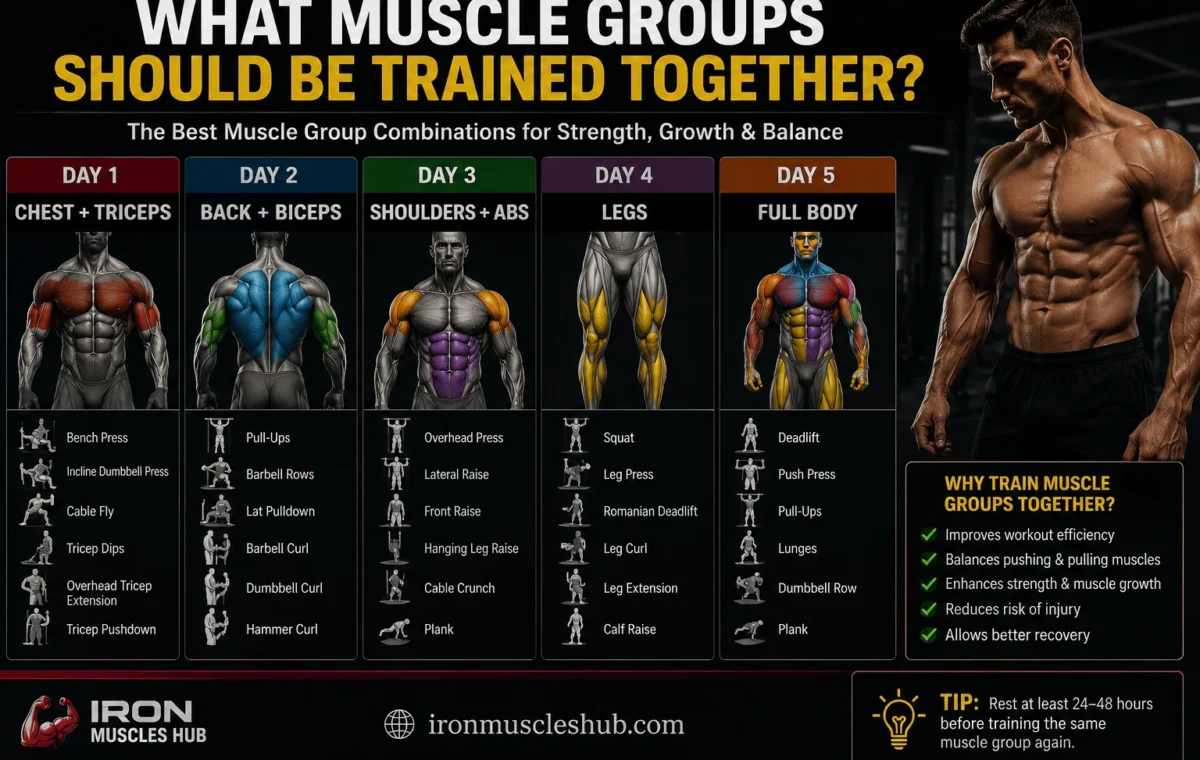
If you’re wondering what muscle groups should be trained together, a simple rule works well: group muscles that perform similar movements. Chest, shoulders, and triceps fit naturally into a push workout, while back and biceps work well together on a pull day. Legs can be trained as one lower-body session.
- Quick Answer
- What Muscle Groups Should Be Trained Together?
- 1. Chest + Shoulders + Triceps
- 2. Back + Biceps
- 3. Quads + Hamstrings + Glutes + Calves
- Best Muscle Group Combinations at a Glance
- How to Choose the Right Muscle Split
- If You Can Train 2 Days Per Week
- If You Can Train 3 Days Per Week
- If You Can Train 4 Days Per Week
- If You Can Train 5–6 Days Per Week
- Push, Pull, Legs Explained
- Push Day
- Pull Day
- Leg Day
- What About Chest + Back?
- Should You Train Arms With Chest and Back?
- Worked Example: Building a Beginner Split
- Worked Load Example
- How Often Should You Train Each Muscle Group?
- Common Mistakes → Why → Fix
- Mistake 1: Copying an Advanced Six-Day Split
- Mistake 2: Training Arms Before Compound Lifts
- Mistake 3: Treating Every Muscle as Completely Separate
- Mistake 4: Adding More Exercises Instead of Improving Performance
- Mistake 5: Ignoring Recovery
- A 30-Second Decision Rule
- Who This Is NOT For
- Should Beginners Train Muscle Groups Together?
- Is Push Pull Legs Good for Beginners?
- Can I Train Chest and Triceps Together?
- Can I Train Back and Biceps Together?
- Is It Better to Train One Muscle Group Per Day?
- What Is the Best Muscle Split for Muscle Growth?
- Final Takeaway
For beginners, though, you don’t need a complicated bodybuilding split. A full-body routine two or three days per week can be a better starting point. As your training experience, schedule, and recovery improve, you can move to an upper/lower or push/pull/legs split. Current ACSM guidance also emphasizes that the overall resistance-training plan matters more than chasing one perfect exercise or split. For more insights read here :- muscle gain fat loss and strength training gain weight .
Quick Answer
- Push: chest, shoulders, and triceps.
- Pull: back, rear shoulders, and biceps.
- Legs: quads, hamstrings, glutes, and calves.
- Beginners: full-body training 2–3 days per week is often simpler than a high-frequency split.
- Four-day option: upper body Monday/Thursday and lower body Tuesday/Friday is a practical setup.
- Best split: the one that lets you train consistently while managing fatigue and recovering between sessions.
What Muscle Groups Should Be Trained Together?
The easiest approach is to organize workouts around movement patterns and muscles that already assist each other. Chest, shoulders, and triceps all contribute to pressing movements, while the back and biceps work together during many pulling exercises. Your lower body can be trained together because squats, hinges, lunges, and related exercises involve several major leg muscles.
There isn’t one mandatory combination for everyone. Your training age, available days, goals, exercise selection, weekly workload, and recovery all matter. NSCA guidance specifically notes that training frequency depends on factors such as the number of muscle groups trained, program structure, volume, intensity, training status, and overall workload.
1. Chest + Shoulders + Triceps
This is the classic push-day combination.
Your chest is the main target during movements such as bench presses and push-ups. The front portion of the shoulders assists pressing, while the triceps help extend the elbow.
A beginner-friendly push session could look like:
| Exercise | Main muscles | Example starting load |
|---|---|---|
| Bench press | Chest, triceps, shoulders | 40 kg / 88 lb |
| Dumbbell shoulder press | Shoulders, triceps | 10 kg / 22 lb each |
| Incline dumbbell press | Upper chest, shoulders, triceps | 10 kg / 22 lb each |
| Cable or machine lateral raise | Side delts | 5 kg / 11 lb |
| Triceps pressdown | Triceps | 15 kg / 33 lb |
The loads above are illustrative examples, not recommendations for every beginner. Your appropriate starting weight depends on technique, training experience, equipment, and ability.
One reason this combination works is efficiency. Instead of completely exhausting your triceps before pressing, you perform your larger compound pressing exercises first and use smaller isolation exercises later.
2. Back + Biceps
Back and biceps are another natural pairing.
Rows, pulldowns, pull-ups, and similar exercises train the muscles of your back while also requiring elbow flexion from the biceps.
A simple pull workout could include:
- Lat pulldown
- Seated cable row
- Chest-supported dumbbell row
- Rear-delt fly
- Dumbbell curl
- Hammer curl
You don’t necessarily need every exercise in one workout. A beginner can make progress with a smaller selection performed with good technique.
The important point is overlap. If you train biceps hard immediately before back exercises, your biceps may become the limiting factor on pulling movements. Training back first generally makes sense because the back is the larger target and compound pulling exercises require more overall coordination.
3. Quads + Hamstrings + Glutes + Calves
For many beginners, training the major lower-body muscles together is straightforward.
A lower-body day can include:
- Squat or leg press
- Romanian deadlift
- Split squat or lunge
- Leg curl
- Calf raise
These exercises don’t all train the exact same tissues. Squats emphasize the quadriceps and glutes, while hip-hinge movements such as Romanian deadlifts place more demand on the hamstrings and glutes.
Training them together also makes weekly scheduling easier.
For example:
Monday: Upper body
Tuesday: Lower body
Wednesday: Rest
Thursday: Upper body
Friday: Lower body
Saturday: Rest
Sunday: Rest
NSCA gives a similar four-day upper/lower structure as an example for intermediate trainees, with upper-body sessions separated by lower-body sessions and rest days arranged to support recovery.
Best Muscle Group Combinations at a Glance
| Combination | Main muscles | Best fit | Main advantage |
| Chest + shoulders + triceps | Push muscles | Beginners/intermediates | Similar pressing pattern |
| Back + biceps | Pull muscles | Beginners/intermediates | Similar pulling pattern |
| Quads + hamstrings + glutes + calves | Lower body | Most lifters | Simple lower-body day |
| Chest + back | Opposing upper-body muscles | Intermediate lifters | Efficient upper-body session |
| Shoulders + arms | Delts, biceps, triceps | Intermediate lifters | Useful accessory-focused day |
| Upper body + lower body | Multiple regions | Beginners/intermediates | Easy weekly organization |
| Full body | Major muscle groups | Beginners | Efficient when training fewer days |
There is no rule saying you must use only one of these combinations.
The best choice is the one that matches your weekly schedule and recovery capacity.
How to Choose the Right Muscle Split
Start with the number of days you can realistically train.
Don’t begin by asking, “What’s the most advanced split?”
Ask:
“How many good-quality training sessions can I consistently complete every week?”
That question usually gives you a better answer.
If You Can Train 2 Days Per Week
Use full-body training.
For example:
Monday — Full Body A
- Squat
- Bench press
- Row
- Romanian deadlift
- Shoulder or arm exercise
Thursday — Full Body B
- Leg press or squat variation
- Overhead press
- Lat pulldown
- Hip hinge
- Optional arm or calf exercise
This approach gives you repeated exposure to the major movement patterns without requiring five or six gym visits.
If You Can Train 3 Days Per Week
Full-body training remains a strong option.
You could use:
- Monday — Full Body A
- Wednesday — Full Body B
- Friday — Full Body C
Change exercises slightly between sessions while keeping the major movement patterns consistent.
For novice lifters, NSCA identifies two or three weekly resistance-training days as a practical frequency for full-body training, with nonconsecutive sessions used to provide recovery.
If You Can Train 4 Days Per Week
An upper/lower split is one of the easiest choices.
| Day | Workout |
| Monday | Upper |
| Tuesday | Lower |
| Wednesday | Rest |
| Thursday | Upper |
| Friday | Lower |
| Saturday | Rest |
| Sunday | Rest |
This lets you train the upper and lower body twice per week without needing to visit the gym six days in a row.
It also makes it easier to distribute your weekly workload instead of trying to cram every exercise into one long workout.
If You Can Train 5–6 Days Per Week
Push/pull/legs becomes an option.
A three-day PPL structure looks like:
Push: chest + shoulders + triceps
Pull: back + rear delts + biceps
Legs: quads + hamstrings + glutes + calves
You can repeat the sequence if your schedule and recovery support it.
But don’t assume that six gym days automatically produce better results. More sessions also mean more opportunities to accumulate fatigue.
ACSM’s 2026 position stand synthesized 137 systematic reviews involving more than 30,000 participants and found that resistance training improves strength, hypertrophy, power, endurance, and several measures of physical function. It also found that different prescription variables have different effects, rather than one universal program being best for everyone.
Push, Pull, Legs Explained
The PPL split is popular because it groups exercises according to their primary movement.
Push Day
Train:
- Chest
- Shoulders
- Triceps
Typical exercises:
- Bench press
- Incline press
- Overhead press
- Lateral raise
- Triceps extension
Pull Day
Train:
- Back
- Rear delts
- Biceps
Typical exercises:
- Pull-up or pulldown
- Row
- Chest-supported row
- Rear-delt fly
- Curl
Leg Day
Train:
- Quadriceps
- Hamstrings
- Glutes
- Calves
Typical exercises:
- Squat
- Leg press
- Romanian deadlift
- Leg curl
- Calf raise
The advantage is that muscles that assist one another are trained in the same session.
The downside is that a six-day PPL routine may be unnecessarily demanding for someone who only has a few months of lifting experience.
What About Chest + Back?
Chest and back can also be trained together.
They perform largely opposing upper-body actions: pressing versus pulling.
For an intermediate lifter, a chest-and-back session can be very effective:
- Bench press
- Row
- Incline press
- Lat pulldown
- Lateral raise
- Curl or triceps exercise
This setup can save time because you aren’t waiting for a muscle group to recover before training its opposing group.
It also gives you an upper-body workout without requiring separate chest and back days.
The important factor is total workload. A session containing six hard compound movements may be too much for a new lifter, while an experienced trainee may tolerate it well.
Should You Train Arms With Chest and Back?
Yes.
Your smaller muscles already participate in many compound exercises.
For example:
- Chest pressing also trains the triceps.
- Overhead pressing also trains the triceps.
- Rows and pulldowns also train the biceps.
- Pull-ups heavily involve elbow flexors.
That means you don’t need to treat every muscle as completely independent.
A useful beginner strategy is:
Large compound exercise first → secondary compound exercise → isolation work afterward.
This helps you put effort into the movements that require the most coordination before fatigue builds up.
Worked Example: Building a Beginner Split
Suppose a beginner can train four days each week.
Instead of creating a six-day bodybuilding schedule, use:
Monday — Upper A
- Bench press: 3 sets
- Lat pulldown: 3 sets
- Dumbbell shoulder press: 2 sets
- Cable row: 2 sets
- Triceps pressdown: 2 sets
- Dumbbell curl: 2 sets
Tuesday — Lower A
- Squat: 3 sets
- Romanian deadlift: 3 sets
- Split squat: 2 sets
- Leg curl: 2 sets
- Calf raise: 2 sets
Thursday — Upper B
- Incline dumbbell press: 3 sets
- Seated cable row: 3 sets
- Machine shoulder press: 2 sets
- Lat pulldown: 2 sets
- Lateral raise: 2 sets
- Hammer curl: 2 sets
Friday — Lower B
- Leg press: 3 sets
- Romanian deadlift or hip hinge: 3 sets
- Walking lunge: 2 sets
- Leg curl: 2 sets
- Calf raise: 2 sets
The exact number of sets should be adjusted to training experience and recovery rather than copied blindly.
ACSM’s 2026 evidence review found that hypertrophy was enhanced by higher weekly training volumes, with 10 or more sets per muscle group per week identified as a useful evidence-based threshold in its review. That doesn’t mean every beginner must immediately perform 10 hard sets for every muscle; it means weekly volume is an important variable, and your program can build toward an appropriate workload.
Worked Load Example
Imagine a beginner can perform a bench press with 40 kg / 88 lb for the planned repetitions while maintaining good technique.
The next goal isn’t to rush to 60 kg / 132 lb.
Instead, the lifter might first improve repetition quality and gradually increase the load when the current workload becomes comfortably manageable.
For example:
- Week 1: 40 kg / 88 lb
- Week 2: 40 kg / 88 lb
- Week 3: 42.5 kg / 94 lb
- Week 4: 42.5 kg / 94 lb
These numbers are an illustration of gradual progression, not a prescribed progression rate.
Older ACSM progression guidance recommended increasing load by about 2–10% when a trainee can perform one or two repetitions beyond the desired workload.
The key lesson is simple: progress should be earned through good technique and repeatable performance, not forced because the calendar says it’s time to add weight.
How Often Should You Train Each Muscle Group?
This is where beginners often get confused.
You may hear that every muscle must be trained exactly twice per week.
That’s too rigid.
Research comparing resistance-training frequency shows that when total weekly volume is matched, frequency by itself does not consistently produce a major difference in hypertrophy. A PubMed systematic review and meta-analysis found no significant difference in muscle growth between higher and lower frequencies when volume was equated.
Another earlier meta-analysis found an advantage for twice-weekly training compared with once-weekly training, showing that the evidence has evolved as more research has become available.
So the practical takeaway is:
Use frequency to distribute your weekly work, not as a magic number.
If 12 weekly sets are appropriate for you, performing them as:
- 12 sets on Monday, or
- 6 sets Monday + 6 sets Thursday
can be easier to manage than forcing all the work into one session.
Splitting the workload can also help maintain exercise quality.
Common Mistakes → Why → Fix
Mistake 1: Copying an Advanced Six-Day Split
Why:
A six-day routine can create a large recovery demand. A beginner may not need that many training sessions.
Fix:
Start with two or three full-body sessions, or use four days of upper/lower training once you’re ready.
Mistake 2: Training Arms Before Compound Lifts
Why:
Heavy curls before rows or pulldowns can fatigue the biceps. Heavy triceps work before pressing can reduce pressing performance.
Fix:
Perform your major compound movements first, then train smaller muscles.
Mistake 3: Treating Every Muscle as Completely Separate
Why:
Muscles work together. Pressing exercises already involve the triceps and shoulders, while pulling exercises involve the biceps and other elbow flexors.
Fix:
Account for indirect work when planning your weekly training.
Mistake 4: Adding More Exercises Instead of Improving Performance
Why:
A longer workout isn’t automatically a better workout.
Fix:
Track your exercises, repetitions, load, and technique. Progress gradually.
Mistake 5: Ignoring Recovery
Why:
Your training plan doesn’t exist in isolation. Sleep, work, sport, stress, and other physical activity all contribute to total workload.
Fix:
If performance repeatedly drops, soreness stays unusually high, or you struggle to recover between sessions, reduce workload or add recovery time.
NSCA specifically notes that overall physical and psychological stress should be considered when determining resistance-training frequency.
A 30-Second Decision Rule
Use this quick test before choosing your split:
How many days can you train consistently?
- 1 day: Full body
- 2 days: Full body
- 3 days: Full body or a simple push/pull/legs rotation
- 4 days: Upper/lower
- 5 days: Upper/lower with an additional session, or a customized split
- 6 days: Push/pull/legs if recovery and schedule support it
Then ask a second question:
Can I recover before I train the same muscles hard again?
If yes, your split may work.
If no, change the schedule before adding more exercises.
Who This Is NOT For
This type of general muscle-group guidance isn’t enough for someone who needs a rehabilitation program, has a diagnosed injury, is recovering from surgery, or has a medical condition that affects exercise tolerance.
It also isn’t a substitute for individualized coaching if you have major technique limitations or are preparing for a specific competitive sport.
In those situations, your program should be adjusted to your individual circumstances by an appropriately qualified healthcare professional or coach.
Should Beginners Train Muscle Groups Together?
Yes, but beginners generally don’t need to isolate one muscle group per day.
A full-body routine can be easier because each workout covers the major movement patterns. You can also practice important exercises more regularly without needing a complicated weekly schedule.
For example, instead of:
- Monday: chest
- Tuesday: back
- Wednesday: shoulders
- Thursday: arms
- Friday: legs
a beginner could use:
- Monday: full body
- Wednesday: full body
- Friday: full body
That structure is easier to manage and leaves rest days between sessions.
NSCA’s beginner guidance supports two or three nonconsecutive full-body resistance-training sessions per week as a practical starting point.
Is Push Pull Legs Good for Beginners?
It can be, but the answer depends on how often you can train.
A three-day PPL rotation is possible, but each muscle group may receive a more limited training frequency than a full-body routine unless the schedule is structured carefully.
For someone brand new to resistance training, full-body training can be simpler.
Once you have established basic technique and can consistently train three or more days per week, PPL becomes another useful option.
Don’t choose PPL because it sounds advanced. Choose it because the structure fits your life.
Can I Train Chest and Triceps Together?
Yes.
Chest pressing movements already involve the triceps, so pairing them is logical.
A simple session might use:
- Bench press
- Incline press
- Machine chest press
- Triceps pressdown
- Overhead triceps extension
Train the chest exercises first if chest development is your priority.
If triceps strength is your main goal, you could modify the exercise order, but understand that fatigue from earlier exercises can affect later performance.
Can I Train Back and Biceps Together?
Yes.
This is one of the most common muscle-group pairings because the biceps assist many back exercises.
A basic session could include:
- Lat pulldown
- Seated row
- One-arm dumbbell row
- Rear-delt fly
- Dumbbell curl
- Hammer curl
Start with the larger back exercises, then finish with direct biceps work.
This approach gives you a logical flow from larger, more demanding movements to smaller isolation exercises.
Is It Better to Train One Muscle Group Per Day?
Not necessarily.
A traditional body-part split can work, but it isn’t automatically superior to full-body, upper/lower, or push/pull/legs training.
Your choice should account for:
- Training frequency
- Weekly volume
- Recovery
- Exercise performance
- Schedule
- Experience
- Personal preference
Current ACSM evidence does not support the idea that there is one universal resistance-training setup that everyone should follow. Its 2026 position stand reviewed a very large body of research and found that different program variables affect different outcomes.
What Is the Best Muscle Split for Muscle Growth?
For a beginner, the best split is usually the one you can execute consistently with good technique.
A practical progression is:
Beginner:
Full body 2–3 days per week.
Early intermediate:
Upper/lower 4 days per week.
Experienced lifter:
Push/pull/legs or another individualized split, depending on goals and recovery.
You don’t need to change your split every few weeks.
If your current program is producing steady improvements, your technique is getting better, and you’re recovering well, there is no reason to change it simply because another split is popular online.
Final Takeaway
The best answer to what muscle groups should be trained together is to group muscles that share movement patterns and assist one another. Chest, shoulders, and triceps work well as a push group; back and biceps fit naturally into a pull workout; and quads, hamstrings, glutes, and calves can be trained together on a lower-body day.
For beginners, simplicity usually wins. Start with full-body training two or three days per week, then consider an upper/lower or push/pull/legs split as your experience and schedule develop. The split itself isn’t the magic ingredient. Consistent resistance training, appropriate workload, progressive improvement, sound technique, and adequate recovery are what make the plan useful.
If you’re building your first routine, pick the simplest split you can follow for several months and adjust it only when your training needs change.