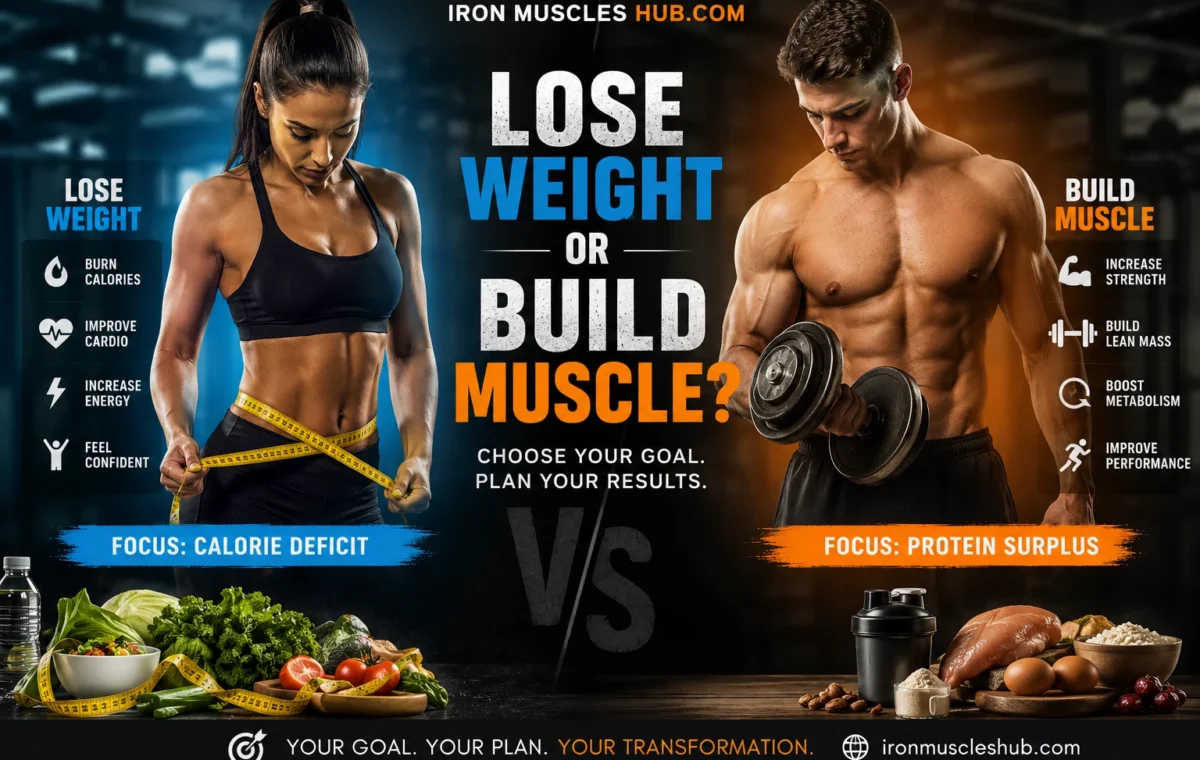
If you’re asking “should I lose weight or build muscle?”, you usually don’t need to choose one forever. For many beginners, especially people carrying some extra body fat, a sensible resistance-training program combined with adequate protein and a modest calorie deficit can reduce fat while helping you gain or preserve muscle.
- Quick Answer
- A simple beginner decision rule
- Weight Loss vs. Fat Loss
- What Does Body Recomposition Mean?
- Don't Turn Fat Loss Into a Crash Diet
- Beginner full-body template
- How Hard Should You Train?
- Worked protein example
- Spread Protein Across the Day
- If fat loss is the priority
- If muscle gain is the priority
- If recomposition is the priority
- Training
- Protein
- Progress tracking
- If you have more body fat than you want
- If you're relatively lean and want to get bigger
- If you're new to lifting and have both goals
- Mistake 1: Doing only cardio to lose weight
- Mistake 2: Starting a huge calorie deficit
- Mistake 3: Trying to “bulk” because you're skinny
- Mistake 4: Chasing the scale
- Mistake 5: Changing workouts every week
- Mistake 6: Thinking soreness equals muscle growth
- Mistake 7: Eating huge amounts of protein
- 1. Body-weight trend
- 2. Waist measurement
- 3. Strength
- 4. Photos
- 5. How you feel
- Weeks 1–4: Learn
- Weeks 5–8: Progress
- Weeks 9–12: Review
- Should I lose weight before building muscle?
- Can I lose fat and gain muscle at the same time?
- Should I do cardio or weights first for fat loss?
- How much protein should I eat to build muscle while losing fat?
- What should I do if my weight isn't changing but I'm getting stronger?
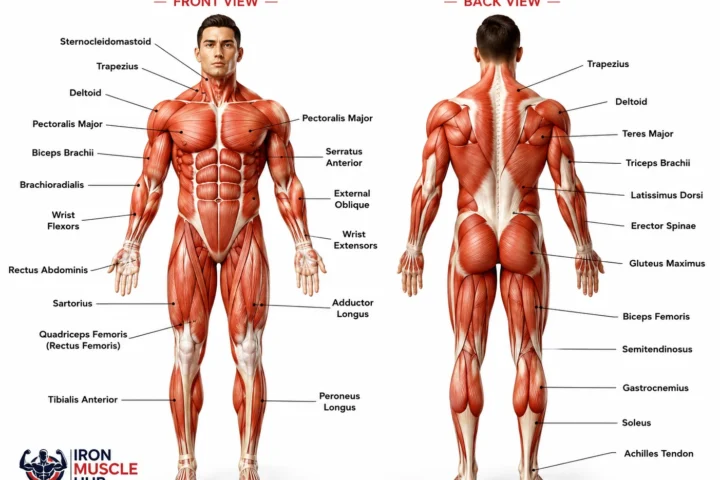
The important distinction is between losing scale weight and improving body composition. The scale can fall because of fat, muscle, water, or a combination. Your better long-term target is usually to lose unnecessary body fat while keeping or increasing useful lean tissue. Resistance training is particularly valuable during weight loss because it helps preserve muscle and improve strength. For more insights read here :- muscle anatomy chart and muscular system diagram.
Quick Answer
- If you’re a beginner with noticeable extra body fat: start with fat loss plus resistance training rather than a traditional bulk.
- If you’re relatively lean and mainly want more muscle: prioritize muscle gain around maintenance calories or a small surplus.
- If you’re new to lifting, returning after a long break, or carrying higher body fat: body recomposition can be a practical middle ground.
- Don’t judge the plan only by scale weight. Track waist size, body weight trends, gym performance, photos, and how your clothes fit.
Should You Lose Weight or Build Muscle First?
For most beginners, I’d start with strength training and a controlled nutrition plan, not an aggressive bulk or crash diet. If you have excess body fat, use a modest calorie deficit and aim to maintain or improve your strength. If you’re already fairly lean, putting more emphasis on muscle growth may make more sense.
The reason is simple: your starting point changes the best strategy. A beginner can often make several improvements at once because the body is adapting to a new training stimulus. Research also shows that resistance exercise helps preserve lean mass during weight loss.
A simple beginner decision rule
Ask yourself three questions:
- Do I have a significant amount of body fat I want to lose?
- Am I new to structured resistance training?
- Is my main goal appearance, health, strength, or maximum muscle size?
If you answered yes to the first two, start with a fat-loss-focused recomposition approach.
If you’re relatively lean and your main goal is adding muscle, don’t automatically start dieting. A muscle-building phase may be more appropriate.
If you’re unsure, spend the first 8–12 weeks building consistent habits rather than trying to execute a perfect bulk or cut.
Weight Loss vs. Fat Loss
These terms aren’t interchangeable.
Weight loss means your total body weight decreases.
Fat loss means you reduce stored body fat.
You can lose 5 kg (11 lb) on the scale without losing 5 kg (11 lb) of fat. Some of the change may come from water and lean tissue.
That’s why a beginner who wants a better physique shouldn’t make the scale the only scoreboard.
For example, imagine your body weight stays almost unchanged for several weeks while your waist becomes smaller and your lifts improve. That’s not necessarily failure. You may be improving body composition.
On the other hand, if your weight is dropping quickly but your strength is falling, your recovery is poor, and you’re constantly hungry, the deficit may be unnecessarily aggressive.
Mayo Clinic notes that weight loss generally requires eating fewer calories, increasing physical activity, or both. It also recommends resistance training as part of a weight-management program because it can help protect muscle and bone.
Can You Lose Fat and Build Muscle at the Same Time?
Yes, it is possible, but it isn’t equally easy for everyone.
Beginners are in a particularly useful position because resistance training provides a new stimulus. People returning after a long training break may also respond well. Someone carrying more body fat has substantial stored energy available, which can make simultaneous improvements in body composition more achievable.
That doesn’t mean everyone can rapidly add muscle while losing fat. Advanced lifters who are already lean and highly trained generally have less room for rapid muscle gain.
The goal shouldn’t be to force simultaneous fat loss and muscle gain at any cost.
Instead, build the conditions that support it:
- Progressive resistance training
- Adequate protein
- Appropriate calorie intake
- Sufficient sleep
- Regular activity
- Reasonable recovery
- Patience
A review of weight-loss research found that resistance exercise helps preserve lean mass during weight loss, while protein intake can also support lean-mass retention.
What Does Body Recomposition Mean?
Body recomposition means improving the ratio of lean mass to fat mass.
In practical terms, you want:
Less body fat + more or maintained muscle = better body composition
Your body doesn’t need to obey a calendar where January is “fat loss” and March is “muscle gain.”
For a beginner, you can often train for strength and muscle while eating in a controlled way that gradually reduces excess fat.
The rate of change may be slower than an aggressive diet promises, but the result can be more useful because you’re not simply trying to make the scale smaller.
When Should You Focus on Losing Weight?
A fat-loss phase may make more sense if excess body fat is currently your biggest concern.
You might prioritize fat loss if:
- Your waist measurement is steadily increasing.
- You have a significant amount of body fat to lose.
- Your primary health goal is reducing excess body weight.
- You don’t have much resistance-training experience.
- You’d feel more comfortable becoming leaner before focusing heavily on muscle gain.
That doesn’t mean you should stop lifting weights.
In fact, keep resistance training in the plan.
Mayo Clinic recommends strength training for all major muscle groups at least twice per week for healthy adults.
Resistance training gives your body a reason to retain and develop muscle while your diet creates the conditions for fat loss.
Don’t Turn Fat Loss Into a Crash Diet
A common beginner mistake is thinking:
“If some calorie restriction works, extreme calorie restriction must work faster.”
That’s poor coaching.
A very aggressive diet can make training harder, reduce energy, increase hunger, and make it more difficult to preserve lean tissue.
You don’t need to starve yourself to lose fat.
Mayo Clinic describes a commonly used calorie reduction of roughly 500–750 calories per day in the context of weight loss, but that doesn’t mean every person should automatically use that exact deficit. Individual energy needs and medical circumstances differ.
Your plan should be sustainable enough that you can train, recover, eat nutritious food, and maintain it for long enough to see meaningful change.
When Should You Focus on Building Muscle?
If you’re already relatively lean and your biggest priority is adding muscle, constantly trying to lose more weight can work against your goal.
You may benefit from prioritizing muscle gain if:
- You’re relatively lean.
- Your weight has been stable for a while.
- Your main goal is increasing muscular size.
- You’re already resistance training consistently.
- You don’t have a large amount of body fat you want to reduce.
Muscle growth requires a strong training stimulus, adequate nutrition, and recovery.
That doesn’t mean you need an enormous calorie surplus.
For a beginner, eating around maintenance or using a modest surplus can be enough to support training while reducing unnecessary fat gain.
The exact calorie requirement depends on your age, sex, height, body weight, activity level, and other factors, so avoid copying another person’s calorie target.
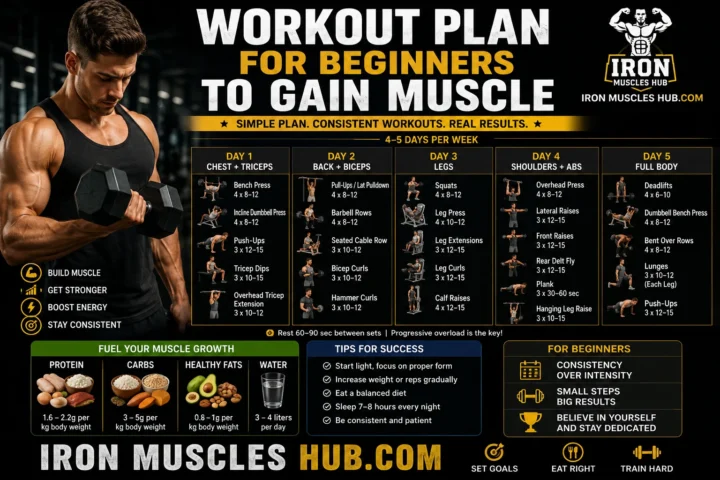
The Best Training Approach for Beginners
Your first goal isn’t to find the world’s most complicated workout.
Your goal is to train consistently and get stronger with good technique.
The 2026 ACSM resistance-training position stand highlights resistance training as an important tool for improving muscle function and hypertrophy.
For a beginner, a full-body routine performed 2–3 days per week is a practical starting point. NSCA guidance similarly identifies two or three weekly full-body sessions as appropriate for many novice clients, with nonconsecutive training days allowing recovery.
Beginner full-body template
| Movement | Example exercise | Beginner sets | Reps |
|---|---|---|---|
| Squat | Goblet squat or leg press | 2 | 8–12 |
| Hip hinge | Romanian deadlift | 2 | 8–12 |
| Push | Push-up or chest press | 2 | 8–12 |
| Pull | Seated row or lat pulldown | 2 | 8–12 |
| Shoulder | Dumbbell shoulder press | 1–2 | 8–12 |
| Core | Plank or dead bug | 2 | Controlled |
This is a starting framework, not a mandatory program.
You can use machines, dumbbells, barbells, resistance bands, or bodyweight exercises.
Mayo Clinic notes that strength training can be performed with free weights, machines, resistance bands, or bodyweight movements.
How Hard Should You Train?
You don’t need to destroy yourself in every workout.
Use a resistance that makes the final repetitions challenging while allowing you to maintain good technique.
If you can easily perform far more repetitions than your target range, the exercise may be too easy.
If your technique breaks down early, the weight is probably too heavy.
Progress gradually.
For example:
Week 1: 10 kg (22 lb) dumbbell × 10 reps
Week 2: 10 kg (22 lb) × 12 reps
Week 3: 12 kg (26.5 lb) × 10 reps
That’s progress without needing dramatic changes every workout.
How Much Cardio Should You Do?
Cardio and strength training aren’t enemies.
You can walk, cycle, swim, jog, or perform another aerobic activity while working toward muscle and strength goals.
Current U.S. physical-activity guidance recommends adults accumulate 150–300 minutes of moderate aerobic activity per week, or 75–150 minutes of vigorous activity, along with muscle-strengthening activity on at least two days each week.
If you’re currently inactive, don’t feel obligated to jump straight to the upper end.
Start smaller.
For example:
- Monday: 30-minute brisk walk
- Tuesday: Strength workout
- Wednesday: 30-minute walk
- Thursday: Strength workout
- Friday: 30-minute walk
- Saturday: Strength workout or easy activity
- Sunday: Rest or gentle walking
Your starting point matters more than someone else’s routine.
How Much Protein Do You Need?
Protein is important for maintaining and building muscle, particularly when you’re resistance training.
The evidence doesn’t support the idea that you need enormous amounts.
ACSM educational material gives a range of about 1.2–1.7 g/kg (0.5–0.8 g/lb) per day for people who regularly lift weights or train for endurance activities.
A major systematic review and meta-analysis found that protein supplementation can improve resistance-training gains and that benefits to fat-free mass did not continue to increase beyond approximately 1.6 g/kg/day in its analysis.
For many beginners, a practical target is therefore around 1.2–1.6 g/kg/day, adjusted for individual circumstances.
Worked protein example
Suppose you weigh:
90 kg (198 lb)
At 1.2 g/kg:
90 × 1.2 = 108 g protein/day
At 1.6 g/kg:
90 × 1.6 = 144 g protein/day
So a practical range could be approximately:
108–144 g protein per day
That’s not a prescription. If you have kidney disease, another medical condition, or specific dietary restrictions, discuss your protein needs with an appropriate healthcare professional.
Spread Protein Across the Day
You don’t need to obsess over a perfect post-workout minute.
Your total daily intake matters greatly.
You can divide your protein across breakfast, lunch, dinner, and one or two snacks.
For the 90 kg (198 lb) example, you could structure meals around approximately 25–40 g of protein at several meals rather than trying to consume almost everything at dinner.
Protein-rich foods include:
- Eggs
- Greek yogurt
- Milk
- Chicken
- Turkey
- Fish
- Lean beef
- Cottage cheese
- Tofu
- Beans
- Lentils
Protein powder can be convenient, but it isn’t required.
How Many Calories Should You Eat?
This is where beginners often make the biggest mistake: they search for one universal calorie number.
There isn’t one.
Two people weighing 80 kg (176 lb) can have very different calorie needs because their height, age, sex, activity, occupation, training, and daily movement differ.
Instead of copying a random “1,800 calorie” or “2,500 calorie” plan, start with your estimated maintenance intake and monitor your real-world trend.
If fat loss is the priority
Use a modest calorie deficit.
Your body weight should generally trend downward over time, but daily changes can be affected by water, food volume, sodium, carbohydrate intake, and other factors.
Look at trends rather than one morning’s weigh-in.
If muscle gain is the priority
Aim around maintenance or a modest surplus rather than assuming you need a huge bulk.
Your gym performance, body measurements, body weight trend, and recovery should all be considered.
If recomposition is the priority
Stay closer to maintenance or use a modest deficit while prioritizing resistance training and protein.
The scale may move slowly.
That’s okay.
Worked Example: 90 kg (198 lb) Beginner
Let’s make this practical.
Imagine a beginner who is:
- 90 kg / 198 lb
- 175 cm / 5 ft 9 in
- New to resistance training
- Wants to lose body fat
- Also wants to look more muscular
- Can train three days per week
The goal doesn’t need to be “lose 15 kg as fast as possible.”
A better first target is:
Improve body composition while building training consistency.
Training
Monday: Full-body strength
Wednesday: Full-body strength
Friday: Full-body strength
Add walking or other enjoyable aerobic activity across the week.
Protein
Using 1.2–1.6 g/kg:
108–144 g/day
Progress tracking
Record:
- Morning body weight several days per week
- Weekly average body weight
- Waist measurement
- Main exercise performance
- Progress photos under similar conditions
Suppose after several weeks:
Starting: 90 kg / 198 lb
Later: 87.5 kg / 193 lb
That’s a 2.5 kg / 5.5 lb decrease.
But imagine your squat, row, and pressing performance have improved while your waist has decreased.
That’s a much better result than simply seeing “2.5 kg lost.”
The 30-Second Decision Rule
Here’s the simple rule I’d give a beginner who doesn’t know where to start:
If you have more body fat than you want
Lose fat + lift weights + eat adequate protein.
If you’re relatively lean and want to get bigger
Build muscle + lift weights + eat enough to support growth.
If you’re new to lifting and have both goals
Recompose: lift consistently, eat around maintenance or use a modest deficit, and prioritize protein.
Then reassess after several weeks using your trend data.
Don’t change the plan every four days.
Common Mistakes → Why → Fix
Mistake 1: Doing only cardio to lose weight
Why: Cardio can increase energy expenditure, but it doesn’t provide the same muscle-building stimulus as resistance training.
Fix: Keep cardio, but add strength training for all major muscle groups at least twice per week.
Mistake 2: Starting a huge calorie deficit
Why: Aggressive restriction can make training and recovery harder and may increase the risk of losing lean tissue during weight loss.
Fix: Use a more moderate approach and monitor your weight trend, waist measurement, hunger, energy, and training performance.
Mistake 3: Trying to “bulk” because you’re skinny
Why: Beginners sometimes confuse being under-muscled with needing a large calorie surplus.
Fix: Start resistance training first. Improve food quality and protein intake. If additional calories are needed, increase them gradually.
Mistake 4: Chasing the scale
Why: Scale weight doesn’t tell you exactly what happened to your fat or muscle.
Fix: Track at least three markers: body-weight trend, waist measurement, and gym performance.
Mistake 5: Changing workouts every week
Why: Constant exercise changes make it harder to judge whether you’re actually getting stronger.
Fix: Keep the main movement patterns consistent long enough to learn technique and measure progression.
Mistake 6: Thinking soreness equals muscle growth
Why: Muscle soreness is a response to training stress, not a direct measurement of hypertrophy.
Fix: Judge progress through performance, consistency, measurements, and longer-term changes.
Mistake 7: Eating huge amounts of protein
Why: More isn’t automatically better.
Fix: Start with a reasonable protein target. ACSM materials place regularly active adults and lifters around 1.2–1.7 g/kg/day, while research suggests approximately 1.6 g/kg/day is a useful upper point for many resistance-training outcomes.
Who Is This Approach NOT For?
This general beginner framework isn’t appropriate as a substitute for medical or dietetic care if you:
- Are pregnant or recently gave birth and need individualized exercise guidance.
- Have a history of an eating disorder.
- Have significant kidney, heart, metabolic, or musculoskeletal disease.
- Have unexplained weight loss or gain.
- Take medication that can affect exercise tolerance, appetite, blood glucose, or body weight.
- Have been advised by a healthcare professional to restrict physical activity.
In these situations, get individualized guidance before making major changes to training or food intake.
How to Track Whether Your Plan Is Working
You don’t need a laboratory body-composition test every month.
For most beginners, a simple tracking system is enough.
1. Body-weight trend
Weigh yourself under similar conditions and look at the weekly trend rather than reacting to one measurement.
2. Waist measurement
Measure at the same location and under similar conditions.
For example:
Week 1: 100 cm / 39.4 in
Week 5: 96 cm / 37.8 in
That’s a 4 cm / 1.6 in reduction.
If your scale weight changes only modestly while your waist shrinks, that’s useful information.
3. Strength
Track your main exercises.
If you can perform more repetitions with the same weight, use more weight with good technique, or perform the movement with better control, you’re progressing.
4. Photos
Take front, side, and back photos under similar lighting and distance.
Don’t compare a relaxed morning photo with a post-workout photo under completely different lighting.
5. How you feel
Pay attention to:
- Energy
- Hunger
- Sleep
- Recovery
- Motivation
- Training quality
A plan that looks perfect on paper but leaves you exhausted isn’t a good long-term plan.
How Long Should You Follow the Plan?
Give your plan enough time to produce a trend.
Beginners often want an answer after one week.
That’s too soon.
Body weight naturally fluctuates. Training can cause temporary changes in water retention. Food intake and carbohydrate intake also influence scale weight.
Instead, collect several weeks of consistent data.
If your fat-loss trend has stalled for a sustained period, review:
- Portion sizes
- Drinks and snacks
- Weekend eating
- Daily movement
- Training consistency
- Sleep
- Stress
- Tracking accuracy
Don’t immediately slash calories.
If your goal is muscle gain and your weight and performance haven’t changed for a sustained period, review your food intake and training progression before making a major adjustment.
What About Men vs. Women?
The basic principles are similar.
Both men and women can use resistance training, adequate protein, sensible calorie control, and regular activity to improve body composition.
The difference is that individual energy needs, body composition, training history, hormonal factors, age, and goals vary.
That’s why I wouldn’t give every man the same calorie target or every woman the same training plan.
The principle is more useful:
Choose the strategy that matches your starting point and goal.
What About “Skinny Fat”?
“Skinny fat” is a popular informal phrase for someone who doesn’t have a high body weight but feels they have relatively little muscle and more body fat than they’d like.
If that sounds like you, immediately going into a hard calorie deficit may not be the best first move.
You may benefit more from:
- Consistent resistance training
- Adequate protein
- Calories around maintenance or a modest deficit
- Progressive overload
- Regular walking or cardio
- Patience
The objective is to improve the amount of muscle you carry relative to your body fat.
A Simple 12-Week Beginner Roadmap
Weeks 1–4: Learn
Focus on:
- Exercise technique
- Two or three full-body workouts weekly
- Consistent protein intake
- Regular walking
- Establishing a realistic eating routine
Don’t worry about making everything perfect.
Weeks 5–8: Progress
Now look for measurable improvements.
Try to add:
- A repetition
- A small amount of resistance
- Better technique
- More controlled movement
Keep your nutrition consistent.
Weeks 9–12: Review
Compare:
- Average body weight
- Waist measurement
- Photos
- Strength
- Energy
- Recovery
Then decide whether you should continue the same approach or make a small adjustment.
This is much more useful than changing your entire strategy every Monday.
FAQ
Should I lose weight before building muscle?
Not necessarily. If you’re a beginner with excess body fat, you can often combine fat loss with resistance training instead of completing a separate weight-loss phase first. Resistance training helps preserve lean mass during weight loss, and beginners can make meaningful strength improvements while reducing body fat. If you’re already relatively lean and your main goal is maximum muscle growth, a muscle-focused phase may make more sense.
Can I lose fat and gain muscle at the same time?
Yes, body recomposition is possible. It tends to be more realistic for beginners, people returning to training, and people carrying more body fat than for advanced, very lean lifters. The key pieces are consistent resistance training, adequate protein, appropriate calorie intake, and recovery. Don’t expect rapid changes in both directions at once; judge progress over several weeks using strength, waist measurements, photos, and weight trends.
Should I do cardio or weights first for fat loss?
If improving body composition is your goal, don’t treat this as an either-or decision. Resistance training should have an important place because it provides a muscle-building or muscle-preserving stimulus. Cardio can help increase physical activity and energy expenditure. Current U.S. guidelines recommend at least 150 minutes of moderate aerobic activity weekly plus muscle-strengthening activity on at least two days for adults.
How much protein should I eat to build muscle while losing fat?
A practical starting range for many active beginners is around 1.2–1.6 g/kg (0.5–0.7 g/lb) of body weight per day. ACSM educational guidance gives approximately 1.2–1.7 g/kg/day for people who regularly lift weights, while a large meta-analysis found that benefits to fat-free mass generally did not continue increasing beyond about 1.6 g/kg/day during resistance training. Individual needs can differ.
What should I do if my weight isn’t changing but I’m getting stronger?
Don’t immediately assume the plan isn’t working. If you’re new to resistance training, strength can improve while body composition changes in ways the scale doesn’t fully show. Check your waist measurement, photos, gym performance, and average weight over several weeks. If your waist is shrinking and performance is improving, you may be making useful progress even if scale weight is relatively stable. If nothing is changing for a sustained period, review your food intake and activity.
Final Takeaway
If you’re a beginner wondering whether to lose weight or build muscle, you don’t necessarily need to choose one and ignore the other. Start by looking at your current body composition, training experience, and main goal. If you have excess body fat, combine a sensible calorie deficit with resistance training and adequate protein. If you’re already lean and want more size, give muscle growth greater priority. If you’re new to lifting, body recomposition can be a practical starting strategy.