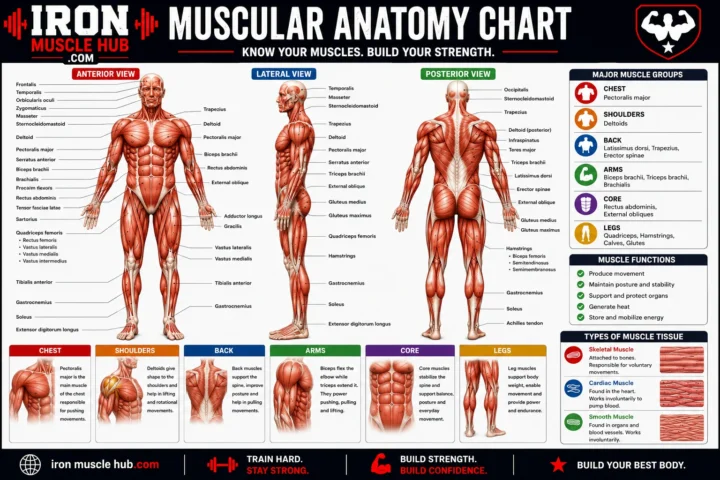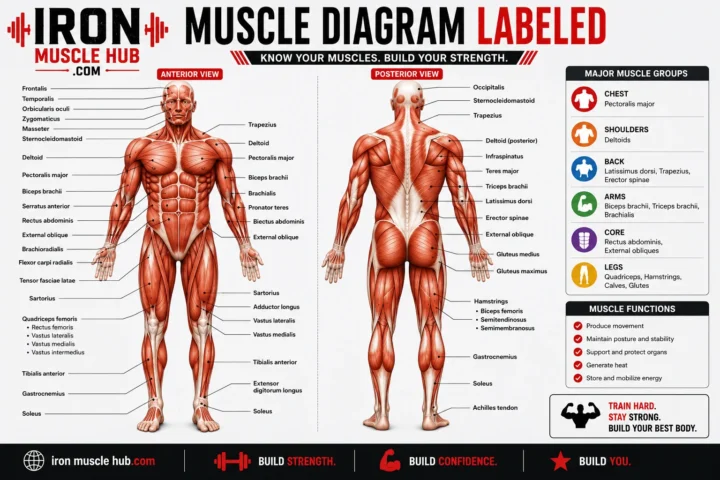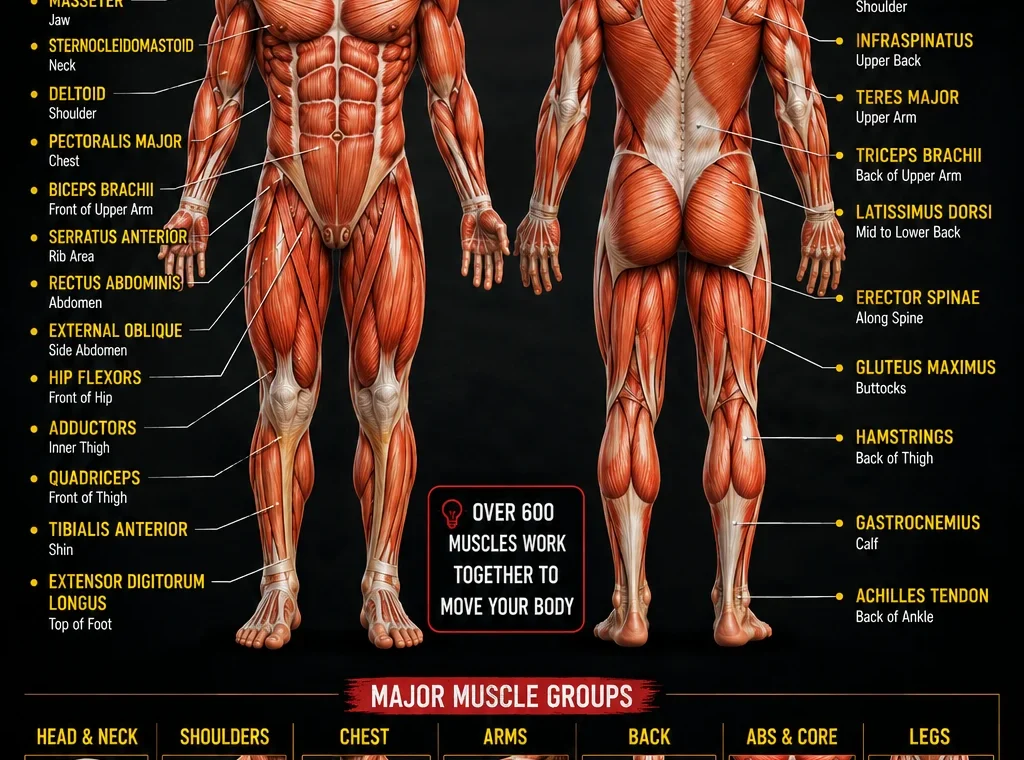
Have you ever wondered why muscles have names like biceps brachii, gluteus maximus, or deltoid? The naming of muscles follows a logical system based on each muscle’s size, shape, location, function, number of origins, and the direction of its muscle fibers. Once you understand these rules, muscle names become much easier to remember.
- Quick Answer
- Examples
- Common Examples
- Examples
- How Muscles Are Named by the Direction of Their Muscle Fibers
- Common Fiber Direction Terms
- Examples
- Common Terms
- Biceps Brachii
- Triceps Brachii
- Quadriceps Femoris
- Example: Sternocleidomastoid
- Other Examples of Attachment-Based Names
- Common Action Terms
- Examples
- Flexor Carpi Radialis
- Extensor Digitorum
- Adductor Longus
- Example 1: Flexor Carpi Radialis
- Example 2: Extensor Carpi Ulnaris
- Example 3: Biceps Brachii
- 1. Memorizing Without Understanding
- 2. Ignoring Latin Meanings
- 3. Confusing Origin and Insertion
- 4. Forgetting Muscle Function
- Key Takeaways from Part 2
- Complete Muscle Naming Reference Chart
- Study by Body Region
- Learn the Common Prefixes
- Use Labeled Anatomy Diagrams
- Review During Exercise
- Practice Regularly
- Why are muscle names written in Latin?
- Is it necessary to memorize every muscle name?
- What is the hardest muscle name to pronounce?
- Why do some muscles have more than one naming rule?
- What is the easiest way to remember muscle names?
- Do all muscles follow the same naming system?
Whether you’re a student studying anatomy, a fitness enthusiast, or simply curious about the human body, learning how muscles are named helps you understand anatomy instead of memorizing long scientific terms. This guide explains the naming system in simple language with practical examples. For more insights read here :- lean and muscle body and fastest way to gain muscle.
Quick Answer
| Muscle Naming Rule | What It Means | Example |
|---|---|---|
| Location | Where the muscle is found | Tibialis anterior |
| Shape | The muscle’s shape | Deltoid |
| Size | Large, small, long, or short | Gluteus maximus |
| Direction of fibers | Fiber arrangement | Rectus abdominis |
| Number of origins | How many heads it has | Biceps brachii |
| Attachment points | Origin and insertion | Sternocleidomastoid |
| Action | What the muscle does | Flexor carpi radialis |
Key takeaway: Most muscle names describe one or more characteristics of the muscle rather than giving it a random name.
Why Do Muscles Have Scientific Names?
Scientists and healthcare professionals use standardized anatomical names so everyone around the world refers to the same muscle. Common names often vary between countries, but scientific names are universal.
For example, a physical therapist in the United States and a surgeon in the United Kingdom both recognize pectoralis major as the same chest muscle.
Using standardized names also helps avoid confusion during:
- Medical treatment
- Anatomy classes
- Fitness coaching
- Sports medicine
- Scientific research
Instead of memorizing thousands of unrelated names, you can understand the meaning behind each one.
The Main Rules Used in the Naming of Muscles
Most skeletal muscles receive their names based on one or more identifying features. These characteristics make each muscle easier to identify.
The primary naming categories include:
- Location
- Shape
- Relative size
- Direction of muscle fibers
- Number of origins (heads)
- Attachment points
- Primary action
Many muscles combine two or more of these rules in a single name.
For example:
- Flexor carpi radialis
- Flexor = action
- Carpi = wrist
- Radialis = thumb side of the forearm
This name tells you exactly what the muscle does and where it is located.
How Muscles Are Named by Location
One of the simplest naming methods is based on where a muscle is located in the body.
These names usually refer to a nearby bone or anatomical region.
Examples
| Muscle | Named After | Body Area |
|---|---|---|
| Tibialis anterior | Tibia | Front of lower leg |
| Temporalis | Temporal bone | Side of the skull |
| Intercostals | Between ribs | Chest |
| Brachialis | Arm (brachium) | Upper arm |
| Abdominis | Abdomen | Stomach region |
When you know basic anatomical regions, these names become much easier to understand.
How Muscles Are Named by Shape
Some muscles are named because their shape resembles a familiar object.
These names often provide a visual clue.
Common Examples
| Muscle | Shape |
|---|---|
| Deltoid | Triangle |
| Trapezius | Trapezoid |
| Rhomboid | Diamond |
| Serratus anterior | Saw-toothed edge |
| Orbicularis oculi | Circular |
For example, the deltoid muscle covering your shoulder has a broad triangular appearance, making its name easy to remember.
Naming Muscles by Size
Muscles can also be named according to their relative size.
Common Latin terms include:
| Word | Meaning |
|---|---|
| Maximus | Largest |
| Minimus | Smallest |
| Major | Larger |
| Minor | Smaller |
| Longus | Long |
| Brevis | Short |
Examples
- Gluteus maximus
- Gluteus medius
- Gluteus minimus
- Adductor longus
- Adductor brevis
Notice how these muscles belong to the same group but differ in size or length.
Why Learning Muscle Naming Matters
Understanding the naming of muscles offers several practical benefits beyond anatomy class.
It helps you:
- Learn anatomy faster
- Understand medical reports
- Follow workout programs more easily
- Communicate with healthcare professionals
- Remember muscle functions without rote memorization
For example, if you already know that flexor means “to bend,” you’ll immediately understand the basic job of many muscles that begin with that word.
Summary Table: Basic Muscle Naming Categories
| Naming Method | What It Describes | Example |
|---|---|---|
| Location | Body region | Tibialis anterior |
| Shape | Appearance | Deltoid |
| Size | Relative size | Gluteus maximus |
| Direction | Fiber orientation | Rectus abdominis |
| Origins | Number of heads | Biceps brachii |
| Attachments | Origin and insertion | Sternocleidomastoid |
| Action | Function | Flexor carpi radialis |
How Muscles Are Named by the Direction of Their Muscle Fibers
Another important rule in the naming of muscles is the direction in which the muscle fibers run. Muscle fibers can be arranged vertically, diagonally, horizontally, or in several other patterns. Their direction often affects how the muscle contracts and moves a joint.
Learning these terms makes it much easier to understand anatomy textbooks and exercise guides.
Common Fiber Direction Terms
| Muscle Name Term | Meaning | Example |
|---|---|---|
| Rectus | Straight fibers | Rectus abdominis |
| Transversus | Horizontal fibers | Transversus abdominis |
| Oblique | Diagonal fibers | External oblique |
| Orbicularis | Circular fibers | Orbicularis oris |
Examples
Rectus Abdominis
The word rectus means “straight.” The muscle fibers run vertically along the front of the abdomen, creating the familiar “six-pack” appearance when well developed.
External Oblique
The fibers of the external oblique run diagonally across the sides of the abdomen. These muscles help rotate and bend the trunk.
Transversus Abdominis
This deep abdominal muscle has horizontal fibers that wrap around the abdomen like a natural weightlifting belt, helping stabilize the spine.
How Muscles Are Named by the Number of Origins (Heads)
Some muscles begin with more than one tendon. These starting points are called origins, and the number of origins often becomes part of the muscle’s name.
Common Terms
| Prefix | Number of Heads | Example |
|---|---|---|
| Bi- | Two | Biceps brachii |
| Tri- | Three | Triceps brachii |
| Quadri- | Four | Quadriceps femoris |
This is one of the easiest naming rules to remember.
Biceps Brachii
- Bi = Two
- Ceps = Heads
- Brachii = Arm
Meaning: A muscle in the upper arm with two heads.
Triceps Brachii
- Three separate origins
- Located at the back of the upper arm
- Main function is extending the elbow
Quadriceps Femoris
The quadriceps group contains four muscles located on the front of the thigh.
These include:
- Rectus femoris
- Vastus lateralis
- Vastus medialis
- Vastus intermedius
Together, they straighten the knee and help with walking, running, and jumping.
How Muscles Are Named by Their Attachment Points
Many muscles receive names based on where they begin (origin) and where they end (insertion).
This method creates long names, but each part provides useful information.
Example: Sternocleidomastoid
Although it looks difficult at first, the name becomes simple when divided into parts.
| Name Part | Meaning |
|---|---|
| Sterno | Sternum (breastbone) |
| Cleido | Clavicle (collarbone) |
| Mastoid | Mastoid process behind the ear |
The muscle starts on the sternum and clavicle and attaches to the mastoid process of the skull.
Because its name includes all three attachment points, anatomy students often remember it more easily once they know the breakdown.
Other Examples of Attachment-Based Names
| Muscle | Named After |
|---|---|
| Sternohyoid | Sternum to hyoid bone |
| Thyrohyoid | Thyroid cartilage to hyoid bone |
| Coracobrachialis | Coracoid process to upper arm |
These names tell you exactly where each muscle connects.
How Muscles Are Named by Their Action
Many muscles are named according to the movement they produce.
If you understand the action words, you can often predict what the muscle does before studying it in detail.
Common Action Terms
| Term | Function |
|---|---|
| Flexor | Bends a joint |
| Extensor | Straightens a joint |
| Adductor | Moves toward the body’s midline |
| Abductor | Moves away from the body’s midline |
| Levator | Raises a body part |
| Depressor | Lowers a body part |
| Pronator | Turns the palm downward |
| Supinator | Turns the palm upward |
| Tensor | Tightens a structure |
Examples
Flexor Carpi Radialis
Breaking the name apart:
- Flexor = bends
- Carpi = wrist
- Radialis = thumb side
The muscle bends the wrist toward the thumb side.
Extensor Digitorum
- Extensor = straightens
- Digitorum = fingers
This muscle extends the fingers after they have been bent.
Adductor Longus
- Adductor = pulls the thigh inward
- Longus = long
This muscle helps bring the leg toward the body’s center.
Many Muscle Names Combine Multiple Rules
One of the best things about anatomical terminology is that a single muscle name often describes several characteristics at once.
Example 1: Flexor Carpi Radialis
| Part | Meaning |
|---|---|
| Flexor | Action |
| Carpi | Wrist |
| Radialis | Thumb side |
Example 2: Extensor Carpi Ulnaris
| Part | Meaning |
|---|---|
| Extensor | Straightens |
| Carpi | Wrist |
| Ulnaris | Little-finger side |
Example 3: Biceps Brachii
| Part | Meaning |
|---|---|
| Bi | Two |
| Ceps | Heads |
| Brachii | Arm |
Muscle Naming Examples You Should Know
Below are some of the most commonly studied muscles and why they have their names.
| Muscle | Why It’s Named That Way |
|---|---|
| Deltoid | Triangle-shaped |
| Trapezius | Trapezoid-shaped |
| Biceps brachii | Two-headed arm muscle |
| Triceps brachii | Three-headed arm muscle |
| Gluteus maximus | Largest glute muscle |
| Tibialis anterior | Front of the tibia |
| Rectus abdominis | Straight abdominal muscle |
| External oblique | Diagonal abdominal muscle |
| Sternocleidomastoid | Named after its attachments |
| Flexor carpi radialis | Named by action and location |
Common Mistakes Beginners Make
Many students struggle with muscle names because they try to memorize every word without understanding the naming system.
Here are some common mistakes:
1. Memorizing Without Understanding
Instead of learning random names, break each one into smaller parts.
2. Ignoring Latin Meanings
Words like major, minor, maximus, and longus appear repeatedly throughout anatomy.
Learning these meanings saves a lot of study time.
3. Confusing Origin and Insertion
Remember:
- Origin = Usually the more fixed attachment.
- Insertion = Usually the attachment that moves during contraction.
4. Forgetting Muscle Function
Many names already tell you what the muscle does.
For example:
- Flexor = bends
- Extensor = straightens
- Adductor = pulls inward
Knowing these action words makes learning anatomy much easier.
Easy Memory Tips for Learning Muscle Names
If you’re studying anatomy or preparing for exams, these techniques can help:
- Learn common Latin prefixes first.
- Study muscles by body region instead of all at once.
- Break long names into smaller words.
- Use labeled anatomy diagrams regularly.
- Review muscles during workouts by identifying which muscles are active.
- Practice saying the names aloud to improve pronunciation and memory.
For example, once you know that maximus means “largest,” you’ll immediately understand why the gluteus maximus is the biggest muscle in the gluteal group.
Key Takeaways from Part 2
- Muscle fiber direction can be straight, diagonal, horizontal, or circular.
- Some muscles are named by the number of heads they have.
- Long muscle names often describe attachment points.
- Many muscles are named according to the movement they perform.
- Breaking names into smaller parts makes anatomy easier to learn.
- Most muscle names combine two or more naming rules.
Complete Muscle Naming Reference Chart
The table below summarizes the most common muscle naming methods. Use it as a quick revision guide when studying anatomy or reviewing muscle terminology.
| Naming Method | What It Describes | Common Terms | Example |
|---|---|---|---|
| Location | Where the muscle is found | Brachii, Tibialis, Femoris | Tibialis anterior |
| Shape | Appearance of the muscle | Deltoid, Trapezius | Deltoid |
| Size | Relative size | Maximus, Minimus, Major, Minor | Gluteus maximus |
| Fiber Direction | Direction of muscle fibers | Rectus, Oblique, Transversus | Rectus abdominis |
| Number of Origins | Number of muscle heads | Biceps, Triceps, Quadriceps | Biceps brachii |
| Attachment Points | Origin and insertion | Sterno-, Cleido-, Mastoid | Sternocleidomastoid |
| Action | What the muscle does | Flexor, Extensor, Adductor | Flexor carpi radialis |
Quick Revision: Common Muscle Name Terms
Understanding a few common Latin terms makes learning anatomy much easier.
| Latin Term | Meaning |
|---|---|
| Maximus | Largest |
| Minimus | Smallest |
| Major | Larger |
| Minor | Smaller |
| Longus | Long |
| Brevis | Short |
| Rectus | Straight |
| Oblique | Slanted or diagonal |
| Transversus | Horizontal |
| Orbicularis | Circular |
| Flexor | Bends a joint |
| Extensor | Straightens a joint |
| Adductor | Moves toward the body’s midline |
| Abductor | Moves away from the body’s midline |
| Levator | Raises |
| Depressor | Lowers |
Learning these terms first helps you recognize the meaning behind hundreds of muscle names.
Practical Example: Breaking Down a Muscle Name
Let’s decode Flexor Digitorum Longus.
| Word | Meaning |
|---|---|
| Flexor | Bends |
| Digitorum | Fingers or toes (digits) |
| Longus | Long |
Instead of seeing one difficult scientific term, you can understand it as a long muscle that helps bend the digits.
This approach works for many anatomical names and makes studying much less overwhelming.
Tips for Remembering Muscle Names
If you’re preparing for anatomy exams or simply want to improve your knowledge, these strategies can help:
Study by Body Region
Focus on one area at a time, such as the shoulder, arm, leg, or back, rather than trying to memorize every muscle at once.
Learn the Common Prefixes
Prefixes like bi-, tri-, quadri-, maximus, and rectus appear repeatedly. Once you know their meanings, many muscle names become easier to understand.
Use Labeled Anatomy Diagrams
Visual learning helps connect muscle names with their locations and functions.
Review During Exercise
When performing exercises, think about which muscles are working. This practical connection improves long-term memory.
Practice Regularly
Short, consistent review sessions are more effective than trying to memorize everything in one sitting.
Common Questions About Muscle Naming
Many beginners ask the same questions when learning anatomy. Here are clear answers to some of the most common ones.
Frequently Asked Questions
Why are muscle names written in Latin?
Latin has been the traditional language of anatomy for centuries. Because it is no longer a spoken language, the meanings remain stable and are used consistently by healthcare professionals and educators around the world.
Is it necessary to memorize every muscle name?
No. It’s more useful to understand the naming rules first. Once you know how muscles are named by location, size, shape, action, and attachments, many names become easier to interpret without memorizing each one individually.
What is the hardest muscle name to pronounce?
Many students find sternocleidomastoid challenging because it combines three attachment points in one name. Breaking it into smaller parts—sterno, cleido, and mastoid—makes it much easier to learn and pronounce.
Why do some muscles have more than one naming rule?
A muscle often has several unique characteristics. Its name may describe its function, location, size, and attachment points all at once. This gives healthcare professionals more information about the muscle from its name alone.
What is the easiest way to remember muscle names?
Start with the common Latin terms and prefixes, study muscles by body region, and use labeled anatomy diagrams. Understanding the meaning behind each word is much more effective than simple memorization.
Do all muscles follow the same naming system?
Most skeletal muscles follow these naming principles, but there are a few historical exceptions. Even so, the majority of muscle names are based on consistent anatomical rules.
Key Takeaways
- The naming of muscles follows a logical system rather than random labels.
- Muscles can be named by location, shape, size, fiber direction, action, attachment points, or number of origins.
- Many muscle names combine two or more of these characteristics.
- Learning common Latin terms makes anatomy easier to understand.
- Breaking long names into smaller parts helps with both learning and remembering.
Final Thoughts
Learning the naming of muscles may seem difficult at first, but it becomes much simpler once you recognize the patterns behind the terminology. Instead of memorizing hundreds of unrelated names, you can use the naming rules to understand what each muscle is, where it is located, and what it does.
Whether you’re studying anatomy, preparing for exams, working toward a fitness certification, or simply interested in the human body, understanding muscle names provides a strong foundation for future learning. Spend a little time practicing the common prefixes and naming methods, and you’ll find that even complex muscle names become much easier to understand.