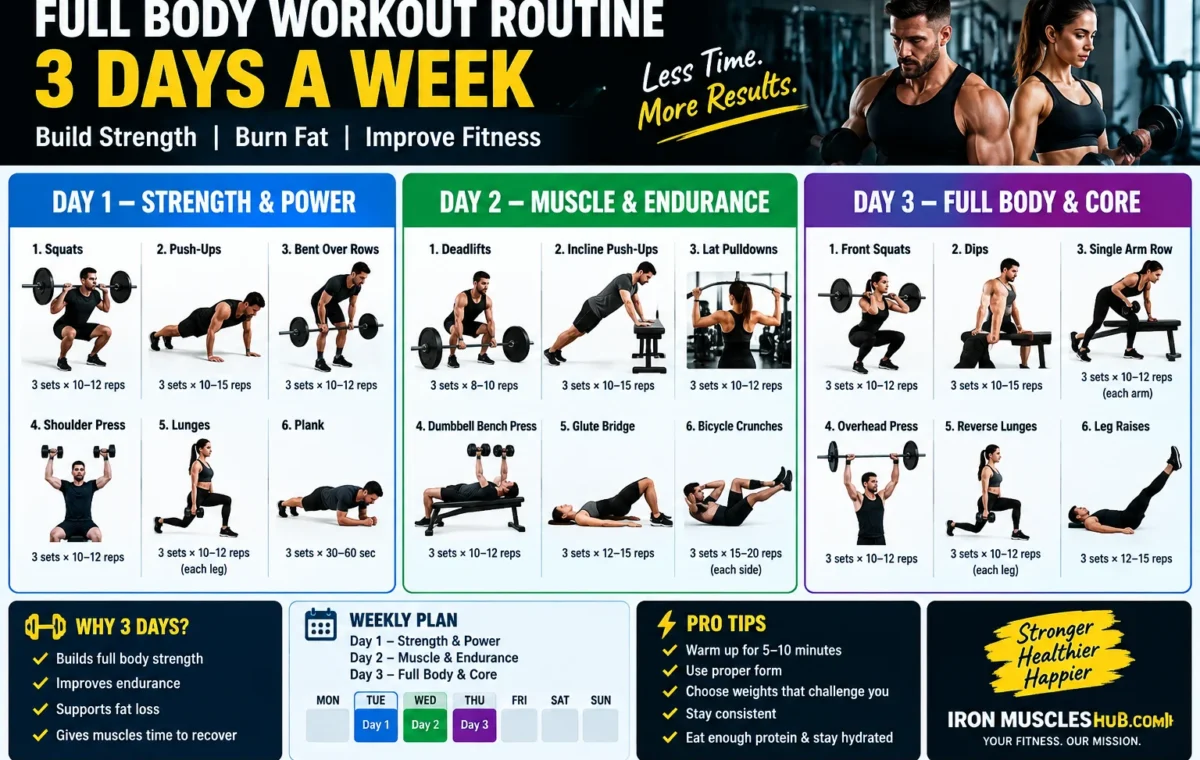
If you can train only three days a week, a full body workout routine 3 days a week is a practical way to train your major muscle groups regularly without spending six days in the gym. For beginners, three non-consecutive resistance-training sessions can provide enough practice and training stimulus while leaving recovery days between workouts. NSCA guidance specifically lists two or three weekly full-body sessions as an appropriate frequency for novice lifters.
- Quick Answer
- Your 3-Day Weekly Schedule
- Workout A — Squat + Horizontal Push
- Workout B — Hinge + Vertical Push
- Workout C — Single-Leg + Upper Body
- Why these exercises?
- Step 1: Pick a rep range
- Step 2: Keep the same weight
- Worked Example: Bench Press
- 1. Doing Too Many Exercises
- 2. Increasing Weight Too Quickly
- 3. Training Hard Three Days in a Row
- 4. Copying an Advanced Lifter's Program
- 5. Changing Exercises Every Week
- 6. Treating Soreness as the Goal
- The decision
- Is working out 3 days a week enough?
- Can I do a full body workout 3 days a week?
- How many exercises should I do in a full body workout?
- Can beginners build muscle with a 3-day workout routine?
- Should I use heavy weights for a 3-day full body workout?
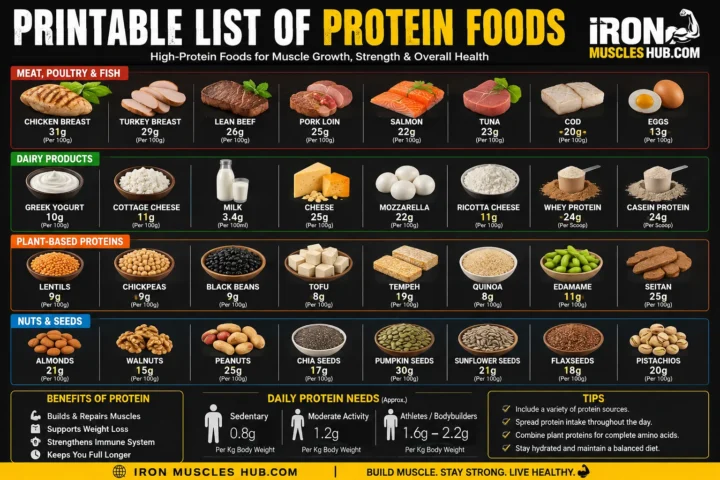
The key isn’t cramming as many exercises as possible into each session. You need a manageable combination of squat, hinge, push, pull, single-leg and core movements, followed by gradual progression. For more insights read here :- high protein high fiber low calorie foods and protein food list printable .
Quick Answer
- Train 3 days per week, preferably with a rest day between sessions, such as Monday, Wednesday and Friday.
- Use 5–6 main exercises per workout, covering the major movement patterns.
- Start with roughly 2–3 working sets per exercise, using controlled technique rather than chasing heavy weights.
- Progress by adding reps first and then a small amount of weight when your technique remains solid.
- Give yourself recovery days instead of turning every workout into a maximum-effort session.
full body workout routine 3 days a week
A three-day full-body plan works well because each session gives your legs, pushing muscles, pulling muscles and trunk some training exposure. You don’t need a separate chest day, back day and leg day to get started.
For a beginner, the bigger challenge is usually learning the movements and building consistency. Three weekly sessions give you repeated practice without requiring daily gym visits.
NSCA guidance recommends that novice lifters can benefit from training the entire body two or three days per week, with non-consecutive sessions and recovery between workouts.
Research also doesn’t support the idea that you must train a muscle every day to grow. A 2019 systematic review and meta-analysis found that, when weekly training volume is equated, resistance-training frequency itself has little meaningful effect on muscle hypertrophy. That makes frequency partly a matter of how you prefer to distribute your work.
For someone who has only three gym slots, full-body training is therefore a sensible structure.
Your 3-Day Weekly Schedule
A simple schedule is:
| Day | Training |
|---|---|
| Monday | Full Body A |
| Tuesday | Rest / easy activity |
| Wednesday | Full Body B |
| Thursday | Rest / easy activity |
| Friday | Full Body C |
| Saturday | Rest / optional easy activity |
| Sunday | Rest |
You don’t have to use Monday, Wednesday and Friday.
For example, Tuesday, Thursday and Saturday also works. The important point is to avoid stacking all three sessions together.
NSCA recommends non-consecutive training days for novice full-body resistance training and notes that beginners generally benefit from recovery between sessions.
The Full Body Workout Routine
This program is designed for a beginner who has access to a normal commercial gym.
You can substitute machines or dumbbells if you’re not comfortable with barbells yet. The goal is to train the movement pattern safely and consistently, not to prove how much weight you can lift.
Workout A — Squat + Horizontal Push
| Exercise | Sets | Reps | Rest |
|---|---|---|---|
| Goblet squat or back squat | 3 | 6–10 | 2–3 min |
| Dumbbell or barbell bench press | 3 | 8–12 | 2 min |
| Seated cable row | 3 | 8–12 | 2 min |
| Romanian deadlift | 2 | 8–12 | 2 min |
| Dumbbell lateral raise | 2 | 10–15 | 60–90 sec |
| Plank | 2 | 20–45 sec | 60 sec |
Workout B — Hinge + Vertical Push
| Exercise | Sets | Reps | Rest |
|---|---|---|---|
| Romanian deadlift or trap-bar deadlift | 3 | 6–10 | 2–3 min |
| Dumbbell shoulder press | 3 | 8–12 | 2 min |
| Lat pulldown | 3 | 8–12 | 2 min |
| Leg press | 2 | 10–12 | 2 min |
| Dumbbell curl | 2 | 10–15 | 60–90 sec |
| Dead bug | 2 | 8–12/side | 60 sec |
Workout C — Single-Leg + Upper Body
| Exercise | Sets | Reps | Rest |
|---|---|---|---|
| Split squat or step-up | 3 | 8–12/leg | 2 min |
| Incline dumbbell press | 3 | 8–12 | 2 min |
| Chest-supported row | 3 | 8–12 | 2 min |
| Hip thrust or glute bridge | 2 | 8–12 | 2 min |
| Cable triceps pressdown | 2 | 10–15 | 60–90 sec |
| Side plank | 2 | 20–40 sec/side | 60 sec |
Why these exercises?
The program deliberately covers several basic movement patterns rather than filling your workout with similar exercises.
- Squat: trains the knee-dominant lower-body pattern.
- Hinge: trains the hips, hamstrings and glutes.
- Horizontal push: trains chest, shoulders and triceps.
- Vertical push: gives the shoulders and triceps another pressing pattern.
- Horizontal pull: trains the upper back and arms.
- Vertical pull: trains the lats and upper back.
- Single-leg work: develops unilateral lower-body strength and control.
- Core work: trains your ability to resist movement and maintain position.
You don’t need all of these movements in every single session. The three workouts distribute them across the week.
How Heavy Should You Lift?
Choose a weight that allows you to complete the prescribed repetitions with good technique.
For a beginner, don’t make your first week a test of your maximum strength.
Suppose your dumbbell bench press target is 3 sets of 8–12 reps.
If you can perform:
- 12 reps
- 12 reps
- 12 reps
with controlled technique, the weight is probably ready to increase slightly at the next session.
If you get:
- 12 reps
- 8 reps
- 6 reps
and your technique starts breaking down, the weight may be too heavy for the prescribed range.
The exact load will vary from person to person. A 70 kg (154 lb) beginner and a 100 kg (220 lb) beginner shouldn’t automatically use the same dumbbell.
Your starting weight should be based on what you can control, not on someone else’s numbers.
How to Progress Each Week
Progression is where many beginner programs fall apart.
Some people add weight every workout regardless of technique. Others use the exact same weight for months.
A better approach is simple double progression.
Step 1: Pick a rep range
For example:
3 × 8–12
Step 2: Keep the same weight
Try to gradually increase the number of good repetitions.
Example:
| Week | Set 1 | Set 2 | Set 3 |
|---|---|---|---|
| Week 1 | 8 | 8 | 8 |
| Week 2 | 9 | 8 | 8 |
| Week 3 | 10 | 9 | 9 |
| Week 4 | 11 | 10 | 10 |
| Week 5 | 12 | 12 | 11 |
| Week 6 | 12 | 12 | 12 |
Once you can complete all three sets at the top of the range with good form, increase the load by a small amount.
Then return toward the lower end of the range.
Research has examined both increasing load and increasing repetitions as ways of progressing resistance training, so progression doesn’t have to mean adding weight every single workout.
A 2026 randomized study also reported greater muscle growth with progressive overload in previously untrained young women, although the study population was specific and shouldn’t be treated as proof that one progression method works identically for everyone.
Worked Example: Bench Press
Let’s say you start bench pressing 40 kg (88 lb).
Your target is 3 × 8–12.
Week 1:
40 kg / 88 lb: 10, 9, 8
Week 2:
40 kg / 88 lb: 10, 10, 9
Week 3:
40 kg / 88 lb: 11, 10, 10
Week 4:
40 kg / 88 lb: 12, 11, 11
Week 5:
40 kg / 88 lb: 12, 12, 12
At this point, you could make a small increase, such as moving to 42.5 kg (94 lb) if that equipment is available and appropriate.
Your reps may drop again:
42.5 kg / 94 lb: 9, 8, 8
That’s not failure. That’s the next stage of progression.
How Long Should Each Workout Take?
A beginner full-body workout doesn’t need to last two hours.
With six exercises and sensible rest periods, expect roughly 45–70 minutes, depending on how busy the gym is and how long you rest between compound movements.
Don’t rush heavy exercises simply to finish faster.
If you need another minute of rest before a technically demanding set, take it.
Your goal is to perform useful work with good technique, not to turn strength training into a race.
Warm-Up Before Your Workout
You don’t need a complicated 20-minute warm-up.
Start with a few minutes of easy general movement, then perform lighter sets of your first exercise.
For example, before squatting:
- Easy movement for a few minutes.
- Bodyweight squats.
- Light warm-up set.
- Slightly heavier warm-up set.
- Begin your working sets.
Your warm-up should prepare you for the exercises you’re about to perform.
Don’t turn your warm-up into a second workout.
How Close Should Beginners Train to Failure?
You don’t need to take every set to complete muscular failure.
For your first several weeks, focus on learning technique and finishing your planned repetitions with control.
A practical beginner rule is to finish most working sets feeling like you could have performed a few more clean repetitions.
This gives you room to practice without making every set a maximal effort.
If your technique changes dramatically during the final repetitions, stop the set rather than forcing another repetition.
Common Mistakes → Why → Fix
1. Doing Too Many Exercises
Why: Beginners often assume more exercises mean faster progress.
Six exercises can quickly become ten or twelve. Your session gets longer, fatigue rises and technique can deteriorate.
Fix: Start with the six-exercise structure above. Add volume only when you have a clear reason.
2. Increasing Weight Too Quickly
Why: Adding weight feels like obvious progress, but your muscles and technique need time to adapt.
Jumping from a 40 kg (88 lb) bench press to 50 kg (110 lb), for example, is a much bigger increase than a beginner may need.
Fix: Use small increases and earn them by completing your target repetitions with good form.
3. Training Hard Three Days in a Row
Why: Full-body training already involves many of the same muscle groups across the week.
Putting all three sessions together reduces the recovery time between them.
Fix: Use Monday/Wednesday/Friday or another schedule with recovery days between sessions.
4. Copying an Advanced Lifter’s Program
Why: Experienced lifters can tolerate different training volumes and have years of movement practice.
A program designed for someone who has trained consistently for five years isn’t automatically appropriate for someone who started five weeks ago.
Fix: Keep your exercise selection simple and focus on progression.
5. Changing Exercises Every Week
Why: Beginners need practice.
If you perform five different squat variations across five weeks, it becomes harder to tell whether you’re actually getting stronger at the movement.
Fix: Keep the main exercises stable for several weeks unless an exercise causes pain, doesn’t suit your equipment, or prevents you from training effectively.
6. Treating Soreness as the Goal
Why: Muscle soreness can happen after resistance training, especially when you’re new, but soreness isn’t the scoreboard for a successful workout.
Fix: Track your exercises, repetitions, weights and technique instead.
A good program should help you train consistently.
Information Gain: A Simple 30-Second Decision Rule
Before adding weight to an exercise, ask yourself three questions:
1. Did I reach the top of my rep range?
If no, keep the same weight.
2. Did every repetition use controlled technique?
If no, keep the same weight or reduce it.
3. Could I repeat the same performance next session?
If you’re unsure because the final set was a complete grind, don’t rush the increase.
The decision
Top of range + clean technique + repeatable performance = consider a small weight increase.
This simple rule prevents the common beginner mistake of treating every successful repetition as a reason to load the bar immediately.
Information Gain: Who Is This Routine NOT For?
A three-day full-body plan isn’t automatically the best choice for everyone.
It may not be suitable as written if:
- You’re an advanced lifter who needs substantially more specialized training volume.
- You’re preparing for a specific powerlifting, weightlifting or sporting event.
- You have an injury that changes which exercises you can safely perform.
- You have a medical condition requiring exercise restrictions.
- You need a program built around specific rehabilitation goals.
- Your schedule makes three weekly sessions unrealistic.
In those situations, the right answer isn’t to force this routine.
Modify the training structure around your actual needs and, when appropriate, work with a qualified professional.
Gym or Home: Can You Do This Routine Without a Barbell?
Yes.
You can preserve the movement patterns without owning a barbell.
| Gym Exercise | Home Alternative |
|---|---|
| Back squat | Goblet squat |
| Barbell bench press | Push-up or dumbbell press |
| Cable row | Resistance-band row |
| Lat pulldown | Band pulldown |
| Barbell RDL | Dumbbell RDL |
| Leg press | Split squat |
| Cable triceps pressdown | Band triceps extension |
| Machine shoulder press | Dumbbell shoulder press |
The important thing is not the brand or type of equipment.
You need a movement you can perform safely, load appropriately and progress over time.
Machines can also be useful for beginners. If a machine lets you learn the intended movement without worrying about balance or setup, there’s nothing inherently wrong with choosing it.
How Many Weeks Should You Follow It?
Give the routine enough time for you to learn the exercises and establish a training pattern.
A practical starting block is 8–12 weeks, provided the exercises remain appropriate and you’re progressing.
You don’t need to redesign your routine every seven days.
During that period, track:
- Exercise
- Weight
- Repetitions
- Sets
- Technique notes
- Any pain or unusual symptoms
At the end of the block, look for evidence of progress.
Are you using more weight?
Are you performing more repetitions with the same weight?
Is your technique better?
Are exercises that felt difficult now easier to control?
Those are more useful indicators than whether you feel destroyed after every session.
What About Cardio?
You can combine cardio with this routine.
For general fitness, walking, cycling, swimming or another form of cardiovascular activity can fit around resistance training.
Keep the main goal of each session clear.
If strength training is the priority, don’t turn every lifting session into a high-fatigue cardio circuit.
On rest days, easy activity can be useful if it helps you stay active without interfering with your recovery.
If you’re new to exercise or returning after a long break, build your overall activity gradually.
What About Muscle Gain?
A three-day full-body routine can support muscle growth, but training alone doesn’t guarantee a specific result.
Your results depend on factors including training quality, recovery, nutrition, sleep, genetics and consistency.
Research on training frequency shows why you shouldn’t obsess over hitting a muscle on a particular number of days. When training volume is controlled, frequency itself appears to have a smaller role in hypertrophy than many online programs suggest.
For a beginner, the priority is simpler:
Train consistently, recover, eat appropriately, and gradually improve your performance.
Don’t assume you need an extreme diet or supplements to make the program worthwhile.
What About Strength?
The same three-day structure can also improve strength.
A systematic review and meta-analysis of resistance-training frequency found that higher frequency was associated with greater strength gains in the overall analysis, but the advantage disappeared when training volume was equated. This supports using frequency as a practical way to distribute training rather than treating three days as a magical number.
That’s one reason this routine uses repeated movement patterns throughout the week.
You’re practicing.
You’re accumulating manageable training volume.
And you’re giving yourself time to recover.
FAQ
Is working out 3 days a week enough?
Yes. Three resistance-training sessions per week can be enough to build a strong foundation, especially for beginners. NSCA guidance lists two or three weekly full-body sessions as an appropriate starting frequency for novice lifters.
The quality of those sessions matters. Three focused workouts with progressive training are more useful than six inconsistent workouts. You also don’t need to train every muscle separately on its own day. A full-body structure lets you cover the major movement patterns during each weekly training cycle.
Can I do a full body workout 3 days a week?
Yes, and it’s a practical option for beginners and people with limited gym time. The main consideration is recovery. Use non-consecutive training days such as Monday, Wednesday and Friday, then allow the remaining days for recovery or easy activity.
You also don’t need to repeat exactly the same workout every session. The A/B/C structure in this guide changes the emphasis while keeping the major movement patterns covered.
How many exercises should I do in a full body workout?
For a beginner, around five or six well-chosen exercises can be plenty. The goal is to cover the major movement patterns without making the session unnecessarily long.
Start with one or two lower-body movements, a push, a pull and a small amount of accessory or core work. As your experience increases, you can adjust volume based on your progress, recovery and goals.
Can beginners build muscle with a 3-day workout routine?
Yes. Beginners can make meaningful strength and muscle adaptations from resistance training performed three days per week. Resistance-training research consistently supports resistance exercise as an effective way to improve strength and muscle-related outcomes.
You don’t need to train six or seven days a week. Consistency, appropriate training stress, recovery and nutrition matter more than simply adding more gym days.
Should I use heavy weights for a 3-day full body workout?
You should use a load that allows you to complete your prescribed repetitions with controlled technique. Heavy does not automatically mean effective, particularly if you’re still learning the movement.
Start with manageable weights. As your technique becomes reliable and you can reach the top of the prescribed repetition range, increase the load gradually. If the heavier weight causes your technique to break down, return to the previous load.
Final Takeaway
A full body workout routine 3 days a week is a straightforward way for beginners to build a training habit while practicing the major resistance-training movements regularly. Use three non-consecutive sessions, keep the exercise selection manageable, and focus on gradually improving your repetitions and loads instead of chasing exhaustion.
Start lighter than your ego wants. Learn the movements. Record your workouts. Recover between sessions. When you consistently reach the top of your rep ranges with good technique, make small increases and repeat the process.
You don’t need a complicated split to make your first months of lifting productive. You need a plan you can actually follow.
If you’re ready to start, use Workout A on your next available training day, then continue with B and C after your recovery days.