If you’re looking for a push pull legs split for beginners, start with three training days per week rather than jumping straight into a six-day routine. A simple Monday-Wednesday-Friday PPL schedule gives you time to learn the exercises, recover and build consistency.
- Quick Answer
- push pull legs split for beginners
- The three training days
- Who should choose PPL?
- Who should choose something else?
- Day 1 — Push
- How to perform the session
- A simple beginner approach
- Week 1
- Week 2
- Week 3
- Use this progression rule
- 1. Can I consistently train three days per week?
- 2. Can I recover comfortably between sessions?
- 3. Can I perform the exercises with controlled technique?
- 1. Is push pull legs good for beginners?
- 2. How many days a week should a beginner do push pull legs?
- 3. Is 3-day PPL enough to build muscle?
- 4. Should beginners do PPL 6 days a week?
- 5. How many sets and reps should beginners do on PPL?
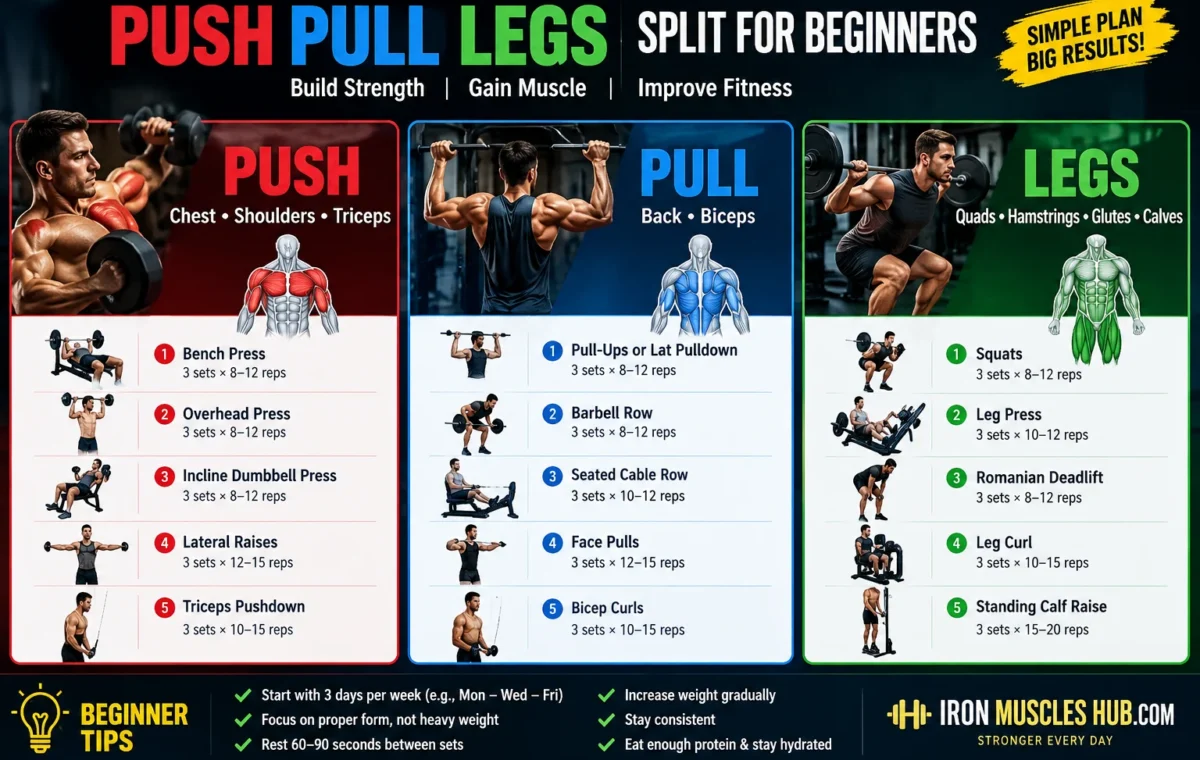
The push day trains your chest, shoulders and triceps. Pull day focuses on your back, rear shoulders and biceps. Legs covers your quads, hamstrings, glutes and calves. The important part isn’t squeezing in as many exercises as possible. It’s using manageable training volume, good technique and gradual progression. For more insights read here :- muscle chart and human muscle chart.
Quick Answer
- Best beginner starting point: 3 PPL workouts per week.
- Schedule: Push → Pull → Legs, preferably with rest days between sessions.
- Sets and reps: Start around 2 sets per exercise and roughly 8–12 reps, adjusting based on the exercise and your ability.
- Progression: Add reps with good form first, then increase the weight gradually.
- Don’t rush to 6 days: A six-day PPL routine can be useful later, but it’s not necessary for a beginner.
ACSM’s resistance-training guidance describes 2–3 weekly sessions, 2–3 sets of 8–12 repetitions and controlled lifting for general resistance training. NSCA guidance similarly places beginners around two or three training days per week.
push pull legs split for beginners
A push pull legs split organizes resistance training according to the main movement pattern and muscles involved.
Push means exercises where you’re generally pushing resistance away from your body. This includes chest presses, shoulder presses and triceps exercises.
Pull means pulling resistance toward your body. Rows, pulldowns, pull-ups and curls fit here.
Legs covers lower-body movements such as squats, leg presses, Romanian deadlifts, lunges and calf raises.
The attraction for beginners is simplicity. Instead of trying to train every muscle randomly, you have a clear purpose for each session.
However, PPL isn’t a special physiological trick. It’s simply a way of organizing resistance training. Your results still depend on consistent training, appropriate exercise selection, progressive overload, recovery and nutrition.
The three training days
| Day | Main muscles | Example movements |
|---|---|---|
| Push | Chest, shoulders, triceps | Bench press, shoulder press, lateral raise |
| Pull | Back, rear delts, biceps | Pulldown, row, curl |
| Legs | Quads, hamstrings, glutes, calves | Squat, RDL, leg curl, calf raise |
A three-day PPL routine trains each group once during the weekly cycle.
That can be practical for someone who wants focused sessions but doesn’t want to spend five or six days in the gym.
Is Push Pull Legs Good for Beginners?
Yes, a push pull legs split can work for beginners, particularly if you enjoy focused gym sessions and can consistently train three days per week.
But it isn’t automatically the best choice for every new lifter.
For general strength and health, established guidance supports training the major muscle groups at least twice weekly, while NSCA guidance notes that novice lifters can benefit from two or three weekly resistance-training sessions.
That’s an important distinction.
A three-day PPL schedule gives each muscle group one dedicated workout per week. A full-body routine can train the same major muscle groups more frequently while using fewer weekly gym visits.
So if your schedule only allows two workouts per week, I wouldn’t force a PPL split.
If you can reliably train Monday, Wednesday and Friday, however, PPL is a perfectly reasonable structure.
Who should choose PPL?
PPL may suit you if:
- You can train around 3 days per week.
- You enjoy spending a little more time on specific muscle groups.
- You want a straightforward gym structure.
- You want to learn a manageable number of exercises.
- You can recover between sessions.
- You enjoy resistance training enough to stay consistent.
Who should choose something else?
Consider full-body training if:
- You can only train one or two days per week.
- You’re completely new to resistance training.
- You want to practice the same basic movements more frequently.
- Your schedule changes constantly.
- You don’t enjoy longer sessions focused on one region.
The best beginner program is the one you can perform consistently and recover from.
Your Beginner 3-Day Push Pull Legs Workout
Here’s the practical part.
The following plan keeps exercise selection deliberately simple. You don’t need 10 movements on each day.
For the first several weeks, your main objective is to learn how each movement feels, establish good technique and build a training habit.
Day 1 — Push
Chest, shoulders and triceps
| Exercise | Sets | Reps |
|---|---|---|
| Dumbbell or barbell bench press | 2 | 8–12 |
| Seated dumbbell shoulder press | 2 | 8–12 |
| Machine chest press | 2 | 8–12 |
| Dumbbell lateral raise | 2 | 10–15 |
| Cable or dumbbell triceps extension | 2 | 10–15 |
How to perform the session
Start with your main press while you’re fresh.
If you’re new to barbell bench pressing, a machine chest press or dumbbell press can be easier to learn. The goal isn’t to impress anyone with the weight on the bar.
For the shoulder press, keep your movement controlled rather than bouncing the weight.
Lateral raises use much lighter loads than presses. If you have to swing your entire body to lift the dumbbells, they’re probably too heavy.
Finish with a simple triceps exercise.
You don’t need several different triceps movements. Your pressing exercises already train the triceps.
Day 2 — Pull
Back, rear shoulders and biceps
| Exercise | Sets | Reps |
|---|---|---|
| Lat pulldown | 2 | 8–12 |
| Seated cable row | 2 | 8–12 |
| Chest-supported dumbbell row | 2 | 8–12 |
| Face pull or reverse fly | 2 | 10–15 |
| Dumbbell curl | 2 | 10–15 |
The lat pulldown gives you a straightforward vertical pulling movement.
The cable row provides horizontal pulling.
A chest-supported row is particularly useful for beginners because the bench provides support while you learn how to move the weight with your upper back.
For curls, don’t turn the movement into a full-body exercise. Keep your elbows relatively stable and control the lowering phase.
You don’t need to destroy your biceps.
A few good sets performed consistently are enough to start.
Day 3 — Legs
Quads, hamstrings, glutes and calves
| Exercise | Sets | Reps |
|---|---|---|
| Goblet squat or leg press | 2 | 8–12 |
| Romanian deadlift | 2 | 8–12 |
| Reverse lunge | 2 | 8–12 each leg |
| Leg curl | 2 | 10–15 |
| Standing calf raise | 2 | 10–15 |
If you’re uncomfortable with barbell squats, start with goblet squats or a leg press.
You don’t get extra beginner points for choosing the most technically demanding exercise.
The Romanian deadlift teaches the hip-hinge pattern and trains the hamstrings and glutes. Start with a light dumbbell or barbell and focus on controlling the movement.
Reverse lunges are useful for developing single-leg strength and coordination.
Finish with leg curls and calf raises.
The Best Beginner PPL Schedule
Don’t feel that you have to train three days in a row.
For most beginners, something like this is easier to recover from:
| Day | Workout |
|---|---|
| Monday | Push |
| Tuesday | Rest |
| Wednesday | Pull |
| Thursday | Rest |
| Friday | Legs |
| Saturday | Rest |
| Sunday | Rest |
This gives you recovery days between workouts.
NSCA guidance for novice resistance training recommends two or three weekly sessions and emphasizes recovery between sessions.
Another option is:
Tuesday — Push
Thursday — Pull
Saturday — Legs
The exact days don’t matter nearly as much as finding a schedule you can repeat.
How Many Sets and Reps Should Beginners Do?
For a beginner, you don’t need complicated rep schemes.
A practical starting point is 2 working sets per exercise, usually in the 8–12-rep range for major movements, with somewhat higher reps for smaller isolation exercises.
ACSM’s resistance-training resource gives a general example of 2–3 sets of 8–12 repetitions, performed with controlled movement, two to three times per week.
Mayo Clinic also recommends resistance training for all major muscle groups at least twice weekly for general health, with a resistance level that makes roughly 12–15 repetitions challenging.
These aren’t rules carved into stone.
If you’re learning a new movement, lighter loads and fewer sets can make sense.
A simple beginner approach
Compound exercise:
2 sets × 8–12 reps
Isolation exercise:
2 sets × 10–15 reps
Once you’re comfortable with the exercises, you can add a third set to selected movements.
Don’t increase everything simultaneously.
How Heavy Should You Lift?
Choose a weight that allows you to complete the target repetitions with controlled technique.
Suppose your program calls for 8–12 reps.
You perform:
- Set 1: 10 reps
- Set 2: 9 reps
If both sets are controlled and technically sound, the weight may be appropriate.
If you get:
- Set 1: 12 reps
- Set 2: 12 reps
and both sets feel clearly manageable, you have room to increase the load during a future session.
If you get:
- Set 1: 6 reps
- Set 2: 5 reps
the weight is probably too heavy for the prescribed range.
Don’t treat every set like a one-rep-max test.
Your first months in the gym are about building skill and strength, not proving how much you can lift.
Worked Example: How to Progress
Let’s say you’re doing dumbbell bench presses with 20 kg (44 lb) in each hand.
Your target is 8–12 reps.
Week 1
- Set 1: 10 reps
- Set 2: 9 reps
Week 2
- Set 1: 11 reps
- Set 2: 10 reps
Week 3
- Set 1: 12 reps
- Set 2: 12 reps
You’ve now reached the top of your target range.
Instead of immediately adding several kilograms, make a small increase if your equipment allows it.
For example, you might move from 20 kg (44 lb) to 22 kg (48.5 lb) dumbbells.
Your reps could then drop back toward:
- Set 1: 9 reps
- Set 2: 8 reps
That’s normal.
You haven’t gone backward. You’ve increased the resistance and returned to the lower end of the repetition range.
This is a simple form of double progression:
Build reps → reach the top of the range → add a small amount of weight → build reps again.
How to Progress a Push Pull Legs Split
Progress doesn’t mean adding weight every workout.
You can progress by improving:
- Repetitions
- Load
- Technique
- Range of motion
- Control
- Consistency
For a beginner, technique progression is especially important.
Your first squat with 20 kg (44 lb) isn’t necessarily better than your fifth session with the same 20 kg if the fifth session is deeper, more controlled and more stable.
Use this progression rule
If you can complete all prescribed reps with good form for the exercise, consider adding a small amount of weight next time.
If adding weight causes your technique to fall apart, keep the same load.
If you’re struggling to reach the bottom of the rep range, reduce the load.
This is more useful than blindly adding weight every week.
How Long Should a Beginner PPL Workout Take?
There’s no magic workout duration.
A beginner session might take roughly 45–70 minutes, depending on warm-ups, equipment availability, rest periods and how quickly you move between exercises.
Don’t rush simply because someone online says workouts should take 30 minutes.
Likewise, you don’t need to spend two hours in the gym.
Your priority should be completing the planned exercises with enough rest to perform them properly.
For bigger compound movements, you may need longer rest than for small isolation exercises.
Should Beginners Train to Failure?
Not every set needs to reach absolute muscular failure.
For a new lifter, leaving a little room in the tank can make technique easier to maintain.
A set should be challenging, but your last repetition shouldn’t look completely different from your first.
If your squat becomes a quarter squat because you’re exhausted, the set has probably gone beyond what you can perform well.
The same applies to pressing and pulling exercises.
Good reps are productive reps.
You can gradually learn how hard different sets should feel as you gain experience.
Common Mistakes → Why → Fix
| Common mistake | Why it causes problems | Better fix |
|---|---|---|
| Starting with 6 days per week | Recovery and consistency become difficult | Start with 3 days |
| Changing exercises every week | You never build movement skill | Keep the main movements for several weeks |
| Adding weight too quickly | Technique deteriorates | Add weight only when reps are controlled |
| Doing too many exercises | Unnecessary fatigue and long workouts | Use a small number of productive movements |
| Training every set to failure | Fatigue can interfere with technique and recovery | Keep most sets challenging but controlled |
| Ignoring legs | Creates an incomplete program | Train quads, hamstrings, glutes and calves |
| Copying advanced routines | Advanced volume may exceed beginner needs | Start with beginner-level volume |
| Skipping rest days | Recovery becomes harder | Space sessions across the week |
One of the biggest mistakes I see with beginners is assuming more training automatically means faster results.
It doesn’t work that way.
Resistance-training research suggests that training frequency itself isn’t necessarily the deciding factor when total training volume is matched. A PubMed meta-analysis found that apparent benefits from higher frequency were largely influenced by the additional volume that higher frequency allowed.
That’s why a six-day PPL isn’t automatically superior to a three-day program.
3-Day vs 6-Day PPL for Beginners
| Factor | 3-Day PPL | 6-Day PPL |
|---|---|---|
| Training days | 3 | 6 |
| Difficulty | Beginner-friendly | More demanding |
| Recovery demand | Lower | Higher |
| Time commitment | Moderate | High |
| Muscle frequency | 1× weekly | 2× weekly |
| Best use | Starting point | Later progression |
| Schedule flexibility | Better | Lower |
A six-day PPL repeats the sequence twice:
Monday — Push
Tuesday — Pull
Wednesday — Legs
Thursday — Push
Friday — Pull
Saturday — Legs
Sunday — Rest
That can be effective for an experienced lifter who enjoys training frequently.
But there’s no requirement for a beginner to train this way.
If six gym visits would make you miss sessions, sleep less or constantly feel beat up, it’s a poor choice for you.
30-Second Beginner Decision Rule
Ask yourself three questions:
1. Can I consistently train three days per week?
Yes: PPL is an option.
No: Consider full-body training instead.
2. Can I recover comfortably between sessions?
Yes: Continue.
No: Reduce training volume, improve recovery or consider fewer sessions.
3. Can I perform the exercises with controlled technique?
Yes: Begin progressive overload.
No: Keep the weight lighter and practice the movement.
That’s your simple decision rule.
You don’t need a complicated algorithm to choose a beginner program.
Who This PPL Plan Is NOT For
This specific three-day PPL plan isn’t ideal if you:
- Can only train once or twice per week.
- Have a current injury that affects lifting.
- Have been advised by a healthcare professional to avoid resistance training.
- Want a highly specialized powerlifting or bodybuilding program.
- Need sport-specific strength and conditioning.
- Prefer full-body workouts.
If you’re returning after a long break, you may also benefit from starting with fewer exercises and lighter resistance before moving into the full plan.
For someone with a medical condition, significant pain or an unresolved injury, speak with an appropriate healthcare professional before beginning or modifying a resistance-training program.
How to Warm Up Before PPL Workouts
You don’t need a complicated 30-minute warm-up.
Start with several minutes of easy general movement if you feel you need it, then perform lighter practice sets of your first exercise.
For example, before dumbbell bench pressing with 20 kg (44 lb) dumbbells, you might first perform several controlled repetitions with much lighter dumbbells.
The exact warm-up depends on the exercise, your experience and how you feel that day.
The goal is to prepare for the session, not turn the warm-up into another workout.
What About Cardio?
You can combine cardio with a PPL routine.
Walking, cycling, jogging or other aerobic activities can fit around your resistance training.
For general health, current guidance recommends regular aerobic activity alongside muscle-strengthening work. Mayo Clinic summarizes the general adult target as at least 150 minutes of moderate aerobic activity or 75 minutes of vigorous activity per week, plus strength training for all major muscle groups at least twice weekly.
You don’t have to hit every target immediately.
If you’re currently inactive, start with a manageable amount and build gradually.
Your resistance-training plan shouldn’t prevent you from moving regularly outside the gym.
Recovery for Beginners
Your workout is the stimulus.
Recovery is when you give your body the opportunity to adapt.
Focus on the basics:
- Get enough sleep.
- Eat regular, nutritious meals.
- Drink enough fluids.
- Take rest days.
- Don’t constantly train through pain.
- Keep your training load manageable.
You don’t need an extreme diet to support beginner strength training.
You also don’t need supplements to make the program work.
Build the training habit first.
What If You Miss a Workout?
Don’t restart the entire program.
If you miss Wednesday’s pull workout, simply perform it at your next available training opportunity.
For example:
Monday: Push
Wednesday: Missed
Friday: Pull
Saturday: Legs
There’s no need to squeeze three missed workouts into two days.
Consistency over months matters far more than having a perfect calendar every week.
How Long Should You Follow This Beginner PPL Plan?
Give yourself enough time to learn the exercises and track progress.
A common beginner mistake is changing programs after two weeks because the routine feels “too simple.”
Simple is often useful.
If you’re adding reps, improving technique and gradually increasing resistance, the program is doing its job.
Once the routine becomes easy to manage and you’re consistently progressing, you can adjust exercise selection, sets, frequency or the overall split.
You don’t need to upgrade your program simply because you’ve been using it for a particular number of weeks.
Progress should drive the change.
Frequently Asked Questions
1. Is push pull legs good for beginners?
Yes. A push pull legs split can be a practical beginner routine if you can consistently train around three days per week. It divides workouts into push, pull and lower-body sessions, making the structure easy to understand. However, PPL isn’t automatically better than full-body training. Beginners should choose the routine that fits their schedule, recovery and ability to perform the exercises safely.
2. How many days a week should a beginner do push pull legs?
A simple starting point is three days per week: one push workout, one pull workout and one leg workout. For example, you could train Monday, Wednesday and Friday. A six-day PPL schedule is more demanding and isn’t necessary for someone just starting. NSCA guidance places novice resistance training around two or three weekly sessions, with recovery between sessions.
3. Is 3-day PPL enough to build muscle?
A three-day PPL routine can provide a useful resistance-training stimulus, particularly when exercises are performed consistently and progression is managed. However, muscle growth isn’t determined by the split name. Training volume, exercise quality, effort, nutrition and recovery all matter. If you can only train three days, you can still build strength and muscle with a well-designed routine.
4. Should beginners do PPL 6 days a week?
Usually, there’s no reason to start with six days. Six-day PPL doubles the number of weekly training sessions and can increase the amount of work you perform, but it also requires more time and recovery. Higher frequency isn’t automatically better when training volume is controlled. Beginners should generally establish consistency with a manageable schedule before considering a higher-frequency routine.
5. How many sets and reps should beginners do on PPL?
A practical starting point is around 2 working sets per exercise, with many compound exercises performed for roughly 8–12 reps and smaller isolation movements around 10–15 reps. ACSM’s general resistance-training guidance gives 2–3 sets of 8–12 repetitions as an example for resistance exercise. Beginners can start toward the lower end and increase training volume gradually as they become more experienced.
Beginner PPL Checklist
Before each workout, ask:
- Do I know today’s exercises?
- Is my weight appropriate?
- Can I maintain good technique?
- Am I tracking my sets and reps?
- Am I recovering between sessions?
- Am I gradually improving rather than rushing?
After the workout, record what you actually did.
For example:
Bench press — 20 kg (44 lb) × 10, 9
Shoulder press — 10 kg (22 lb) × 10, 10
Machine chest press — 35 kg (77 lb) × 12, 11
That simple training log gives you something objective to beat next time.
Final Takeaway
A push pull legs split for beginners doesn’t need to be complicated. Start with three weekly sessions, learn a small number of useful exercises and give yourself enough recovery between workouts. Use manageable weights, keep your technique controlled and progress gradually instead of chasing heavy numbers every session.
The biggest win during your first months isn’t finding a secret exercise or advanced six-day routine. It’s becoming consistent enough to train, recover and improve repeatedly. If three-day PPL fits your life, use it. If full-body training fits better, choose that instead. Your program should support your consistency, not compete with it.
If you’re ready to start, save the three-day schedule, record every workout and focus on making small improvements over time.