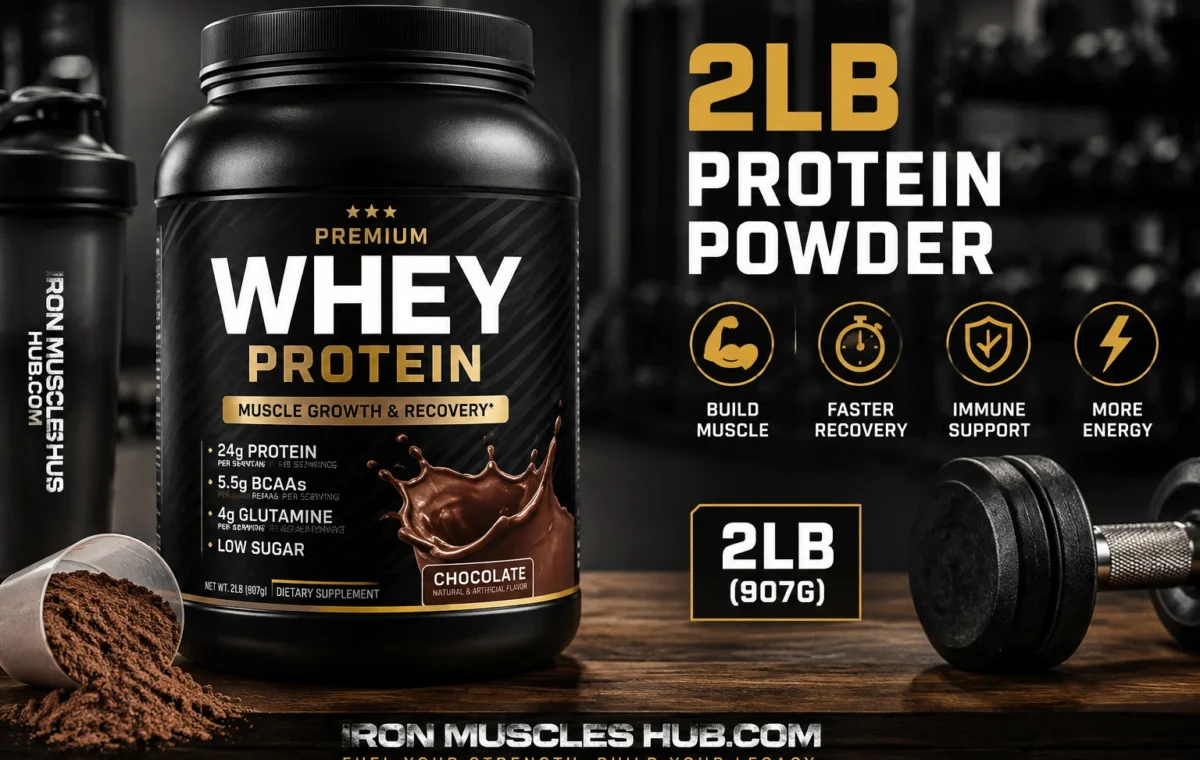
If you’re looking at 2lb protein powder, you’re usually trying to answer three questions: how long the tub will last, how much protein you actually need, and which type makes sense for you.
- Quick Answer
- What Is 2lb Protein Powder?
- The basic calculation
- A simple buying rule
- Worked Example: 80 kg Beginner
- What about height?
- Good reasons to use it
- You may not need it if:
- Whey Protein
- Whey concentrate
- Whey isolate
- Step 1: Check serving size
- Step 2: Check protein
- Step 3: Check calories
- Step 4: Read the ingredients
- Mistake 1: Thinking 2 lb Means 2 lb of Protein
- Mistake 2: Taking Multiple Shakes Without Checking Food Intake
- Mistake 3: Believing You Must Drink It Immediately After Training
- Mistake 4: Buying the Biggest Tub First
- Mistake 5: Choosing by Marketing Instead of the Label
- Mistake 6: Assuming More Protein Always Means More Muscle
- For beginners
- Beginner A
- Beginner B
- Choose concentrate if:
- Consider isolate if:
- The scoop isn't always the answer
- 1. How long does 2lb protein powder last?
- 2. How many scoops are in a 2lb protein powder tub?
- 3. Is 2lb protein powder enough for a month?
- 4. How much protein should I take from protein powder?
- 5. Is whey protein better than plant protein for muscle gain?
A 2-lb tub contains about 907 g (2 lb) of powder. The number of shakes you get depends on the serving size printed on the label, so two 2-lb tubs can provide different numbers of servings. Protein powder can make it easier to reach your daily protein target, but it isn’t required if you already get enough protein from normal food. Research supports protein supplementation as a useful addition to resistance training, particularly when it helps you reach an adequate total daily intake. For more insights read here :- 100 protein powder and boost protein powder .
Quick Answer
- 2 lb = about 907 g of protein powder.
- A 30-g serving would give you about 30 servings from a 2-lb tub.
- Your ideal protein intake depends primarily on body weight, activity, diet and goals, not the size of your protein tub.
- For exercising adults, research commonly supports roughly 1.4–2.0 g of protein per kg of body weight per day.
- Protein powder is a convenience food. It doesn’t replace resistance training, adequate calories, sleep or a balanced diet.
What Is 2lb Protein Powder?
A 2lb protein powder product simply means the container holds approximately two pounds of powder. Two pounds equals about 907 g.
The “2lb” label doesn’t tell you whether the powder is whey concentrate, whey isolate, casein, soy, pea, rice or a blended plant protein.
That’s important for beginners.
You shouldn’t choose a protein powder based only on the size of the tub. Check:
- Protein per serving
- Serving size in grams
- Protein source
- Calories per serving
- Added sugar
- Ingredient list
- Allergens
- Third-party testing or certification
A 2-lb tub with a 25-g serving and a 2-lb tub with a 40-g serving aren’t equivalent in the number of servings you’ll get.
The basic calculation
Use this simple formula:
Total powder ÷ serving size = approximate servings
For a hypothetical 2-lb tub:
907 g ÷ 30 g = about 30 servings
If the serving size is 25 g:
907 g ÷ 25 g = about 36 servings
If the serving size is 40 g:
907 g ÷ 40 g = about 23 servings
These are mathematical examples, not claims about a particular brand.
Always use the serving size printed on your own product label.
How Long Does 2lb Protein Powder Last?
A 2-lb tub can last anywhere from a few weeks to several months depending on how often you use it.
For example, if your tub contains approximately 907 g:
| Powder per day | Approximate days from 2 lb |
|---|---|
| 20 g | 45 days |
| 25 g | 36 days |
| 30 g | 30 days |
| 40 g | 23 days |
| 50 g | 18 days |
| 60 g | 15 days |
This is one of the most useful ways to compare protein powders.
Don’t just compare the price of two tubs.
Compare the price per gram of protein or price per serving.
A cheaper 2-lb container isn’t automatically better value if each serving provides less protein or contains a large amount of non-protein ingredients.
A simple buying rule
If you’re comparing two products, calculate:
Total protein in the tub = number of servings × protein per serving
Then:
Cost per 25 g protein = price ÷ total protein in tub × 25
That gives you a much cleaner comparison than simply looking at the size of the container.
How Much Protein Do You Actually Need?
This is where many beginners make things unnecessarily complicated.
For healthy people who exercise regularly, a commonly cited range is approximately 1.4–2.0 g of protein per kg of body weight per day.
A large meta-analysis of resistance-training studies found that protein supplementation improved gains in fat-free mass and strength, with the analysis finding no additional fat-free-mass benefit beyond approximately 1.62 g/kg/day of total protein intake.
That doesn’t mean everyone should eat exactly 1.62 g/kg.
Your needs can vary based on your training, total calorie intake, body composition goals and individual circumstances.
For a beginner, the easiest approach is to establish a sensible daily target first.
Worked Example: 80 kg Beginner
Imagine a beginner weighs:
80 kg (176 lb)
Using a target of 1.6 g/kg/day:
80 × 1.6 = 128 g protein per day
So the person’s practical target could be around 128 g of protein per day.
Now imagine food provides approximately 100 g.
The gap is:
128 − 100 = 28 g
A protein shake providing roughly 25–30 g protein could conveniently cover most of that gap.
The powder isn’t doing anything magical.
It’s simply providing protein in an easy-to-consume form.
What about height?
Suppose the same lifter is:
175 cm (about 69 inches)
That height can be useful when considering overall nutrition and body composition, but the protein calculation above is based on body weight, not height.
That’s an important beginner distinction.
Should You Take Protein Powder Every Day?
Not necessarily.
If you consistently get enough protein from foods such as eggs, dairy, meat, fish, soy, beans, lentils or other protein-rich foods, you may not need protein powder.
Protein supplements are useful mainly because they’re convenient.
The International Society of Sports Nutrition’s position stand notes that active people can meet protein requirements through a varied diet, while supplemental protein can be a practical way to help ensure adequate protein intake.
Think of protein powder as a tool, not a requirement.
Good reasons to use it
You might find a 2-lb tub useful if:
- You’re struggling to reach your protein target.
- You need a quick option after training.
- Your work or school schedule makes meals difficult.
- You prefer shakes as snacks.
- You want an easy protein source for smoothies or breakfast.
- You don’t want to cook another protein-rich meal.
You may not need it if:
- You already hit your protein target comfortably.
- You dislike the taste or texture.
- It causes digestive problems.
- You’re buying it because you think supplements are required for muscle growth.
- Your diet is already meeting your needs at a lower cost.
Whey vs Plant Protein: Which Should You Choose?
The best type depends on your diet, tolerance and preference.
Whey Protein
Whey comes from milk and is widely used in sports nutrition.
Common forms include:
- Whey concentrate
- Whey isolate
- Hydrolyzed whey
Whey can be a practical choice for people who tolerate dairy and want a convenient, protein-dense supplement.
Research involving resistance training has found benefits from protein supplementation overall, while different protein sources can have different nutritional characteristics.
Whey concentrate
Usually less processed than isolate and often less expensive.
It can contain more lactose, fat and carbohydrate than an isolate, depending on the product.
Whey isolate
Usually undergoes additional processing to increase protein concentration.
Some people who have difficulty with higher-lactose products find whey isolate easier to tolerate, although individual responses vary.
Don’t assume “isolate” automatically means better for everyone.
Plant Protein
Plant-based protein powders can work well for people who avoid dairy or prefer plant foods.
Common options include:
- Pea protein
- Soy protein
- Rice protein
- Mixed plant proteins
A plant blend can combine different protein sources to improve the overall amino-acid profile.
The important point is simple:
You don’t need whey to build muscle.
You need adequate protein, progressive resistance training, enough overall nutrition and consistency.
Original Comparison Table: What Should a Beginner Look For?
| Factor | What to look for | Why it matters |
|---|---|---|
| Tub size | 2 lb / ~907 g | Convenient middle-sized purchase |
| Protein per serving | Check the label | Determines how much protein you’re getting |
| Serving size | Compare grams | Determines how many servings the tub provides |
| Protein source | Whey, casein, soy, pea, blend | Affects dietary fit and tolerance |
| Calories | Check nutrition panel | Useful when managing total energy intake |
| Added sugar | Lower can be useful | Avoids unnecessary calories |
| Ingredients | Clear, understandable list | Helps identify allergens and additives |
| Testing | Independent certification where available | Adds quality-control information |
| Flavor | Choose one you’ll actually drink | Consistency matters |
| Cost | Compare cost per protein amount | Better measure of value |
How to Read a Protein Powder Label
Don’t spend five minutes staring at the front of the tub.
Turn it around.
The nutrition panel and ingredient list tell you much more.
Step 1: Check serving size
You might see something like:
Serving size: 30 g
Remember that this doesn’t mean the product contains 30 g of protein.
It means the whole powder serving weighs 30 g.
Step 2: Check protein
If a 30-g serving provides 24 g protein, then:
24 ÷ 30 × 100 = 80% protein by powder weight
That’s a useful way to understand protein density.
Step 3: Check calories
A protein powder can contain protein plus carbohydrates, fats and other ingredients.
If you’re trying to keep calories controlled, pay attention to the entire nutrition panel.
Step 4: Read the ingredients
Look for the main protein source near the beginning.
Also check for ingredients you personally need to avoid.
For people with food allergies, intolerances or medical conditions, don’t rely on marketing claims alone.
Common Mistakes → Why → Fix
Mistake 1: Thinking 2 lb Means 2 lb of Protein
Why: The 2-lb figure describes the total weight of the powder.
Fix: Check the actual protein grams per serving.
A 2-lb tub isn’t necessarily 2 lb of pure protein.
Mistake 2: Taking Multiple Shakes Without Checking Food Intake
Why: A shake is easy to consume, so it’s easy to add protein without considering your existing diet.
Fix: Estimate your daily protein from food first, then use powder to fill the gap.
Mistake 3: Believing You Must Drink It Immediately After Training
Why: The “post-workout window” is often presented as an extremely narrow period.
Fix: Focus on your overall daily protein intake and consistent training. Research supports protein intake around resistance exercise, but total daily intake remains an important foundation.
Mistake 4: Buying the Biggest Tub First
Why: Bigger tubs can appear cheaper per serving.
Fix: If you’re trying a flavor or brand for the first time, a smaller purchase can reduce the risk of being stuck with a product you dislike.
Mistake 5: Choosing by Marketing Instead of the Label
Why: Words such as “premium,” “advanced” or “performance” don’t tell you how much protein you’re actually consuming.
Fix: Compare protein per serving, ingredients, calories and independent quality testing.
Mistake 6: Assuming More Protein Always Means More Muscle
Why: Beginners often assume more is automatically better.
Fix: Build your total diet around an appropriate protein target rather than endlessly increasing powder intake.
The large resistance-training meta-analysis found no additional fat-free-mass benefit when total protein intake went beyond approximately 1.62 g/kg/day in its analysis.
A 30-Second Protein Powder Decision Rule
Before buying a 2-lb protein powder, ask yourself these five questions:
1. Do I actually need supplemental protein?
If your food intake already covers your target, you may not.
2. Does the protein source fit my diet?
Whey isn’t suitable for everyone.
3. Does the serving provide enough protein for my purpose?
Check the nutrition panel.
4. Can I tolerate the ingredients?
Consider dairy, soy, sweeteners and other ingredients relevant to you.
5. Will I actually use it?
A theoretically perfect protein powder that sits unopened in your cupboard has zero practical value.
If you answer “yes” to all five, a 2-lb tub can be a sensible starting size.
How to Use 2lb Protein Powder
You don’t need an elaborate shake.
A basic shake can be:
- Protein powder
- Water or milk
- Ice if desired
You can also add protein powder to:
- Oatmeal
- Yogurt
- Smoothies
- Pancake mixtures
- Cereal
- Homemade high-protein snacks
The best method is the one that fits your normal eating pattern.
For beginners
Start with the serving size printed on the label.
You don’t need to immediately double or triple the serving.
First calculate your daily protein intake.
Then determine whether one serving fills a genuine nutritional gap.
Does Protein Powder Build Muscle by Itself?
No.
This is one of the most important points for beginners.
Protein provides amino acids needed for many functions in the body and supports muscle remodeling. Resistance training provides the training stimulus.
The combination matters.
A major meta-analysis involving 49 studies and 1,863 participants found that protein supplementation during prolonged resistance training increased gains in strength and fat-free mass compared with resistance training alone.
But that doesn’t mean drinking a shake replaces training.
If your training isn’t progressively challenging, your recovery is poor and your overall diet is inadequate, simply adding more powder isn’t a complete muscle-building strategy.
Is a 2lb Protein Powder Tub Enough for Muscle Gain?
It can be.
But the tub size isn’t what determines whether you’ll gain muscle.
Imagine two beginners.
Beginner A
- 80 kg (176 lb)
- Eats enough total calories
- Gets around 125–130 g protein daily
- Resistance trains consistently
- Uses one protein shake when convenient
Beginner B
- 80 kg (176 lb)
- Drinks three shakes daily
- Eats poorly
- Doesn’t train consistently
- Sleeps poorly
Beginner A has the stronger overall setup.
The powder itself isn’t the deciding factor.
Who Is a 2lb Protein Powder NOT For?
A 2-lb tub may not be the right purchase for you if:
- You already meet your protein needs easily through food.
- You have a known allergy to an ingredient.
- The product causes persistent digestive symptoms.
- You’re using it as a replacement for most of your normal meals.
- You’re buying it because you believe supplements are necessary for beginners.
- You’re following medical nutrition advice that requires a specific dietary approach.
- You haven’t checked the ingredient and nutrition labels.
People with kidney disease or other medical conditions that affect protein intake should speak with an appropriate healthcare professional before significantly changing protein intake.
Protein Powder and Digestive Problems
Some people tolerate protein powder without any issue.
Others experience:
- Bloating
- Gas
- Stomach discomfort
- Changes in bowel habits
The cause can vary.
For whey products, lactose may be relevant for people who don’t tolerate it well. Other products contain sweeteners, sugar alcohols, gums or other ingredients that some people find difficult to tolerate.
Don’t assume you need to “push through” persistent symptoms.
Try identifying the ingredient responsible, changing the protein source or discussing the problem with a qualified healthcare professional.
Quality and Third-Party Testing
Protein powder is a dietary supplement, so quality control deserves attention.
Look for products with transparent labels and, where available, credible independent testing or certification.
Third-party testing can provide additional information about whether a product meets specified standards for ingredients and contaminants.
This doesn’t mean an expensive powder is automatically better.
It means you should pay attention to quality assurance rather than marketing language.
Also be cautious about suspiciously cheap products, especially when purchasing imported supplements through unfamiliar sellers.
Should You Buy Whey Concentrate or Whey Isolate?
For most beginners, neither is universally “best.”
Choose concentrate if:
- You tolerate dairy well.
- You want a simple whey option.
- Price matters.
- You don’t specifically need a lower-lactose option.
Consider isolate if:
- You prefer a higher-protein-density product.
- You want less lactose than many concentrates provide.
- You don’t mind paying more for additional processing.
Your actual dietary needs should decide.
Don’t spend extra money on an isolate simply because you think it will automatically produce more muscle.
How Many Servings Are in 2lb Protein Powder?
There isn’t one universal answer.
The tub contains approximately 907 g.
So:
| Serving size | Approx. servings |
|---|---|
| 20 g | 45 |
| 25 g | 36 |
| 30 g | 30 |
| 35 g | 26 |
| 40 g | 23 |
| 45 g | 20 |
| 50 g | 18 |
These numbers are rounded mathematical estimates.
Your actual number of servings depends on the product’s labeled serving size and how accurately you measure each serving.
The scoop isn’t always the answer
Many people assume one scoop equals one standard serving.
That’s not always safe to assume.
The label is more reliable than the scoop appearance.
If accuracy matters, weigh the powder with a kitchen scale.
Is 2lb Protein Powder Better Than a 5lb Tub?
Not necessarily.
A 2-lb tub can be better for beginners because you’re committing to less product.
A 5-lb tub can offer a lower cost per serving in some cases, but only if you actually like and tolerate the product.
For your first purchase, 2 lb is often a practical middle ground.
You get enough product to evaluate:
- Taste
- Mixability
- Digestion
- Convenience
- Cost
- Whether you actually use it consistently
If everything works, you can consider a larger container later.
FAQ: Real Beginner Questions
1. How long does 2lb protein powder last?
It depends on your serving size and frequency. A 2-lb tub contains about 907 g of powder. At 30 g per serving, that’s roughly 30 servings. If you use one serving each day, that would be about one month. At 25 g per serving, it would provide about 36 servings. Always calculate from your product’s actual serving size.
2. How many scoops are in a 2lb protein powder tub?
There’s no universal number because scoop sizes vary between products. The reliable method is to divide the total powder weight, approximately 907 g, by the labeled serving size in grams. If a product lists 30 g per serving, the mathematical estimate is about 30 servings. Don’t assume every scoop contains the same amount of powder.
3. Is 2lb protein powder enough for a month?
It can be. If your product uses a 30-g serving and you take one serving each day, approximately 907 g ÷ 30 g gives around 30 servings. If you use two servings per day, the same tub would last about 15 days. Your food intake should determine how much supplemental protein you actually need.
4. How much protein should I take from protein powder?
Don’t start with a powder target. Start with your total daily protein target. For active adults, research supports approximately 1.4–2.0 g/kg/day as a useful range, while a large meta-analysis found no additional fat-free-mass benefit above roughly 1.62 g/kg/day in its analysis. Use protein powder to fill the gap left by your normal diet.
5. Is whey protein better than plant protein for muscle gain?
Whey is a convenient high-quality protein source, but you don’t need whey specifically to build muscle. Plant proteins can also fit a muscle-building diet. The important factors are adequate total protein, a suitable amino-acid profile, resistance training and overall nutrition. Research on protein supplementation during resistance training supports protein supplementation generally rather than making a 2-lb package size the deciding factor.
Final Takeaway
A 2lb protein powder tub is simply a convenient amount of supplement containing about 907 g (2 lb) of powder. The right product depends on the protein source, protein per serving, ingredients, calories, dietary needs, tolerance and quality assurance. Don’t choose based on the biggest scoop or the loudest label claim. First estimate how much protein you’re getting from food, then use powder to cover a practical gap. For active adults, evidence supports roughly 1.4–2.0 g/kg/day as a useful protein range, while more isn’t automatically better.
If you’re a beginner, a 2-lb tub can be a sensible starting size because it lets you test the product without committing to a very large container. Build your results around consistent resistance training, adequate nutrition and recovery—not the size of your protein tub.