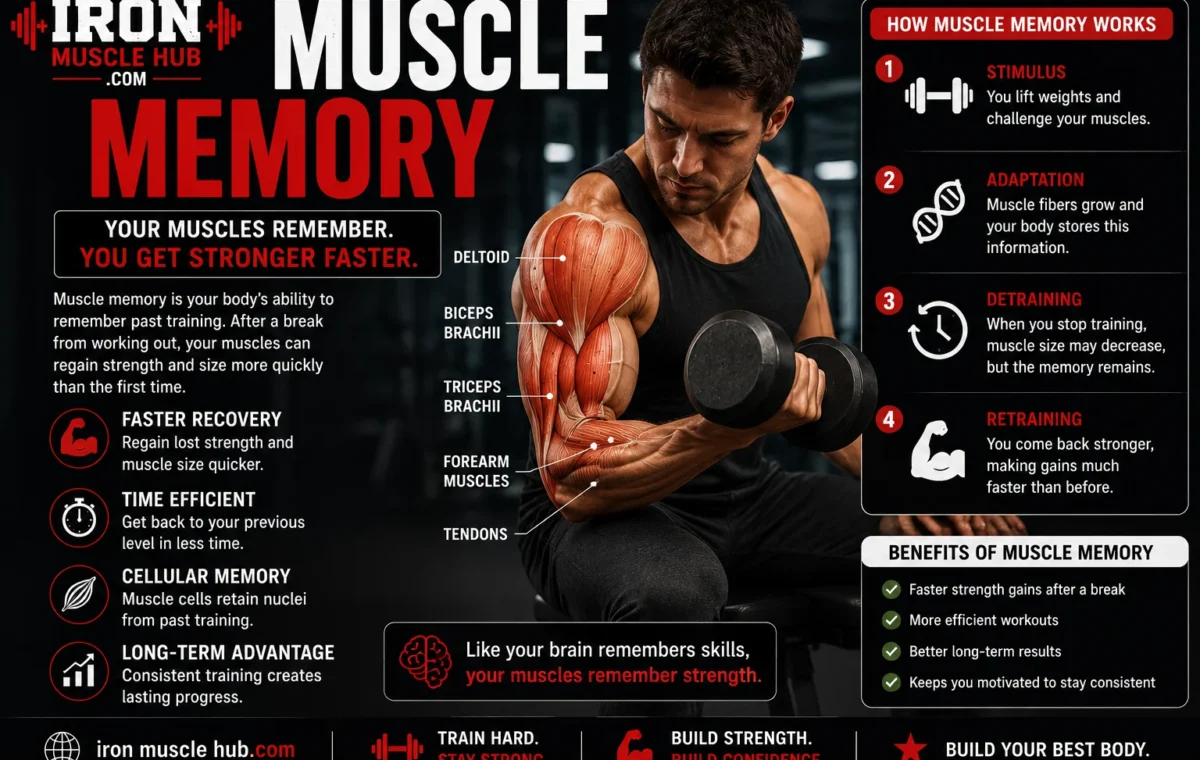
Muscle memory is the body’s ability to retain adaptations from previous training that may help you respond to exercise again after a break. It doesn’t mean your muscles literally remember a workout like your brain remembers a skill. Instead, researchers are studying lasting changes inside muscle cells, including changes involving myonuclei, proteins, and gene regulation, that may influence how muscles respond when training resumes.
- Quick Answer: What Is Muscle Memory?
- What Is Muscle Memory?
- How Does Muscle Memory Work?
- 1. Myonuclei may play a role
- 2. Epigenetic changes may matter
- 3. Muscle proteins can retain training-related changes
- Muscle Memory After a Break: What Actually Happens?
- Does Muscle Memory Help You Regain Muscle Faster?
- A Simple Example of Muscle Memory
- How to Regain Muscle After a Break
- 1. Begin below your previous workload
- 2. Focus on resistance training
- 3. Don't chase your old personal records
- 4. Eat enough to support training
- 5. Sleep and recover
- How Long Does Muscle Memory Last?
- Muscle Memory vs. Muscle Memory in Your Brain
- Common Muscle Memory Mistakes
- Mistake 1: Assuming you haven't lost anything
- Mistake 2: Returning at your old training volume
- Mistake 3: Treating muscle memory as a guarantee
- Mistake 4: Ignoring why you stopped
- A Practical Muscle-Memory Return Plan
- What Current Research Really Says
- Internal Link Ideas for Iron Muscle Hub
- Frequently Asked Questions
- What is muscle memory?
- Does muscle memory really exist?
- Can you regain muscle faster after a long break?
- How long does muscle memory last?
- Does muscle memory mean I can lift my old weights immediately?
- Does muscle memory work for beginners?
- The Bottom Line on Muscle Memory
- Can Muscle Memory Help After Months Away From the Gym?
- What Happens During Retraining?
- Why Previous Training Experience Matters
- Muscle Memory Isn't the Same as Staying Fit
- How to Return to Training Without Doing Too Much
- Start With Manageable Training
- Increase Training Gradually
- Don't Judge Progress by Muscle Soreness
- Does Muscle Memory Mean You Can Regain Everything?
- The Role of Nutrition During Muscle Regain
- Prioritize Protein-Rich Foods
- Don't Turn Your Return Into an Extreme Diet
- Muscle Memory and Strength Memory
- A Better Way to Think About Muscle Memory
- What Science Still Doesn't Know
- A Simple Muscle-Memory Checklist
- Final Thoughts: Muscle Memory Is a Head Start, Not a Shortcut
That matters if you’ve ever stopped lifting because of work, illness, injury, travel, or simply life getting busy. Losing some muscle or strength during a break doesn’t necessarily mean you’re starting from zero. For more insights read here :- Protein Breakfast and Post Workout Meal.
Quick Answer: What Is Muscle Memory?
| Question | Short answer |
|---|---|
| What is muscle memory? | A lasting adaptation that may help previously trained muscle respond to training again. |
| Do muscles literally remember? | No. The term describes biological adaptations, not conscious memory. |
| Can you regain lost muscle? | Previously trained people can often regain strength and muscle after detraining, although the speed varies. |
| Does science support muscle memory? | Yes, but the exact mechanisms and size of the effect are still being studied. |
| Does muscle memory last forever? | There’s no reliable evidence that a training advantage lasts indefinitely in every person. |
| Do you need to train again? | Yes. Muscle memory isn’t a substitute for progressive exercise and recovery. |
What Is Muscle Memory?
Muscle memory describes the tendency for previously trained muscles to adapt again after a period of reduced or stopped training.
Imagine you spent a year consistently doing resistance training. You became stronger and added muscle. Then you stopped for several months. Your muscles may shrink and your performance may decline, but returning to structured training can produce a different experience from your first-ever training period.
Research reviews describe this as a form of skeletal muscle memory, with scientists investigating several possible explanations for why previously trained muscle can respond differently during retraining.
The important distinction is this:
Muscle memory isn’t a promise that you’ll regain everything quickly. It’s a biological phenomenon that researchers are still working to understand.
How Does Muscle Memory Work?
There isn’t one single explanation. Current research points to several possible mechanisms.
1. Myonuclei may play a role
Muscle fibers are unusual cells because they can contain multiple nuclei called myonuclei.
During muscle growth, satellite cells can contribute nuclei to muscle fibers. Researchers have proposed that some of these nuclei may remain after muscle size decreases during detraining.
The theory is that retaining these cellular features could give a previously trained muscle an advantage when resistance training starts again. However, the human evidence isn’t completely settled, so it’s better to describe myonuclear permanence as a potential mechanism, not a proven explanation for every case of muscle memory.
2. Epigenetic changes may matter
Training can also influence how genes are regulated.
These changes don’t necessarily alter the DNA sequence itself. Instead, they can affect how certain genes are switched on or off in response to stimuli.
Scientists are investigating whether some exercise-related epigenetic changes remain after training stops and influence the response to later exercise. Current reviews identify epigenetic regulation as another possible contributor to muscle memory.
3. Muscle proteins can retain training-related changes
Newer research has added another piece to the puzzle.
A 2025 human study reported that some proteins changed by resistance training remained altered after approximately 2.5 months without training. Other protein changes moved closer to their previous levels during detraining and changed again during retraining.
That doesn’t prove that these proteins alone cause faster muscle growth, but it provides evidence that muscle tissue can retain measurable molecular changes after training stops.
Muscle Memory After a Break: What Actually Happens?
Stopping exercise doesn’t switch your muscles from “trained” to “untrained” overnight.
The changes happen progressively, and the outcome depends on factors such as your previous training history, how long you stop, your activity during the break, age, nutrition, and the reason for the interruption.
Research describes detraining as the partial or complete loss of exercise-induced adaptations after training is reduced or stopped. Longer periods without sufficient training can produce larger reductions in muscle size and strength.
A useful way to think about it is:
Training → adaptation → break → some adaptations decline → retraining → adaptation again
The second training phase isn’t necessarily identical to your first experience.
Does Muscle Memory Help You Regain Muscle Faster?
There is evidence suggesting that previously trained people can regain muscle and strength efficiently during retraining.
An earlier review of human and animal research noted observations in which people who had trained previously regained muscle characteristics during retraining more rapidly than during their original training period.
However, newer research gives us an important reality check.
A 2024 human study involving young adults found evidence that myonuclei increased with training and remained relatively stable through a 16-week detraining period. Myonuclei increased again during retraining, but the researchers did not find clear evidence that retaining these nuclei automatically produced a greater hypertrophic response during retraining.
So the safest conclusion is:
Muscle memory appears to be real as a broader biological phenomenon, but scientists haven’t established one simple mechanism that explains exactly how quickly every person will regain muscle.
A Simple Example of Muscle Memory
Suppose you trained consistently for several years and built a solid base of strength and muscle.
You then take an extended break.
When you return, you may notice:
- Your previous weights feel familiar sooner than they did when you first started.
- Your technique comes back relatively quickly.
- Your strength begins improving again.
- Your muscles may regain lost size with consistent resistance training.
- Your progress may not follow exactly the same timeline as a complete beginner.
That doesn’t mean you can immediately lift your old maximums.
Your muscles, connective tissues, coordination, work capacity, and recovery ability may all be at different levels after a break.
Muscle memory can help, but it doesn’t remove the need for gradual progression.
How to Regain Muscle After a Break
If you’ve stopped training, the smartest approach isn’t to prove how strong you used to be.
Start by rebuilding your training habit.
1. Begin below your previous workload
Your old program may have been appropriate when you were training regularly.
After a long break, jumping straight back to the same volume or intensity can create unnecessary soreness and make it harder to train consistently.
Start with manageable sessions and increase the workload progressively.
2. Focus on resistance training
Muscle growth requires an appropriate training stimulus.
A practical program can include movements that train the major muscle groups through exercises such as:
- Squats or leg presses
- Hip hinges
- Rows
- Pull-downs or pull-ups
- Presses
- Curls
- Triceps exercises
- Calf raises
You don’t need dozens of exercises. A consistent program that you can recover from is usually more useful than an elaborate routine you can’t maintain.
3. Don’t chase your old personal records
Your previous strength is useful as context, but it isn’t a reason to rush.
Think of your first few weeks back as a rebuilding phase. Pay attention to technique, range of motion, recovery, and how your body responds.
If you’re returning after an injury, follow the guidance of an appropriate healthcare or rehabilitation professional rather than using muscle memory as a reason to accelerate your return.
4. Eat enough to support training
Resistance training and adequate nutrition work together.
Protein is particularly relevant because muscle tissue needs amino acids to support repair and adaptation. Your overall energy intake also matters.
You don’t need an extreme diet simply because you’ve returned to the gym. Focus first on regular meals, sufficient protein, nutritious foods, and a sustainable eating pattern.
5. Sleep and recover
Muscle memory doesn’t make recovery irrelevant.
Training creates the stimulus. Recovery gives your body the opportunity to adapt.
Build rest into your routine, especially if you’re returning after months away.
How Long Does Muscle Memory Last?
There is no scientifically established expiration date that applies to everyone.
Research has examined different detraining periods, including weeks and months, and results vary depending on the study, participants, muscles examined, training history, and measurement methods.
For example, a recent human study examined a 16-week detraining period and found evidence that some myonuclear adaptations persisted, although the findings did not clearly demonstrate a faster hypertrophic response caused by that persistence.
That’s why claims such as “muscle memory lasts exactly X years” should be treated cautiously.
Your previous training history may continue to matter after a break, but the size and duration of the advantage aren’t guaranteed.
Muscle Memory vs. Muscle Memory in Your Brain
The phrase can cause confusion because muscle memory is also used to describe learned movement skills.
For example, someone who has played piano, ridden a bicycle, or practiced a sport for years may perform familiar movements with less conscious effort after a break.
That’s a motor-learning concept.
Skeletal muscle memory is different. It refers to biological adaptations within muscle tissue that may influence later responses to exercise.
The two ideas can overlap in everyday conversation, but they aren’t the same scientific process.
Common Muscle Memory Mistakes
Mistake 1: Assuming you haven’t lost anything
You can lose muscle size and strength during detraining. Muscle memory doesn’t mean your previous adaptations remain completely unchanged.
Mistake 2: Returning at your old training volume
Your previous program may be too demanding after a long layoff.
Reduce the starting workload and build it back up.
Mistake 3: Treating muscle memory as a guarantee
Research supports the existence of long-lasting training-related adaptations, but individual responses differ.
Don’t promise yourself that you’ll regain everything within a specific number of weeks.
Mistake 4: Ignoring why you stopped
A vacation, busy schedule, injury, illness, and prolonged inactivity aren’t the same situation.
If you stopped because of pain or an injury, the right return-to-training plan may be different from simply restarting after a holiday.
A Practical Muscle-Memory Return Plan
Use this simple framework rather than trying to recreate your old routine immediately:
| Phase | Main goal | What to focus on |
| First sessions | Rebuild the habit | Technique, controlled movements, manageable workload |
| Early return | Restore consistency | Regular resistance training and recovery |
| Progression | Rebuild strength | Gradually increase resistance or training volume |
| Longer term | Regain previous adaptations | Consistency, nutrition, sleep, progressive training |
There isn’t one perfect schedule for everyone. Your starting point should reflect how long you’ve been away, what your previous training looked like, and whether you have any health or injury concerns.
What Current Research Really Says
The science has moved beyond the simple idea that “your muscles remember.”
Current research suggests that muscle tissue can retain molecular and cellular signatures after training stops. Potential mechanisms include myonuclear changes, satellite-cell activity, epigenetic regulation, and retained protein signatures.
At the same time, researchers are still debating how much each mechanism contributes to faster regrowth in humans.
That distinction matters.
It’s reasonable to say that previous training can influence how your body responds when you train again. It’s not reasonable to claim that science has established a guaranteed, permanent shortcut to rebuilding muscle.
Internal Link Ideas for Iron Muscle Hub
For readers who want to continue learning, consider linking this article to:
- Foods to Eat to Gain Muscle — nutrition basics for supporting muscle growth.
- High Protein Foods for Muscle Growth — practical protein-rich food ideas.
- Protein Shake Without Protein Powder — a simple food-based option for people who don’t use supplements.
Frequently Asked Questions
What is muscle memory?
Muscle memory is the term used for lasting adaptations in skeletal muscle that may influence how the tissue responds when training resumes after a period of detraining. Researchers are studying several possible mechanisms, including myonuclei, epigenetic changes, satellite cells, and retained protein signatures.
Does muscle memory really exist?
Yes, research supports the broader concept of skeletal muscle memory, but the exact mechanisms and practical size of the effect are still being investigated. Human studies provide evidence of retained cellular and molecular changes, while some experiments have not shown that these changes always produce faster muscle growth during retraining.
Can you regain muscle faster after a long break?
Previously trained people can often regain lost strength and muscle efficiently after returning to resistance training. However, the rate differs from person to person. The length of the break, previous training experience, age, nutrition, activity level, and the quality of the retraining program can all influence the outcome.
How long does muscle memory last?
There is no confirmed time limit that applies to everyone. Studies have investigated periods ranging from weeks to months and have found evidence of retained muscle adaptations after detraining. However, researchers haven’t established that the training advantage remains unchanged indefinitely.
Does muscle memory mean I can lift my old weights immediately?
No. Previous training may help your body and movement skills adapt again, but your current strength and work capacity still matter. Returning too aggressively can create excessive soreness or increase injury risk. Start at a manageable level and gradually work toward your previous performance.
Does muscle memory work for beginners?
The biggest practical benefit is generally discussed in people who have previously completed meaningful training and then return after detraining. Someone with little or no previous resistance-training experience doesn’t have the same training history to draw on, so they should approach muscle development as a new training process.
The Bottom Line on Muscle Memory
Muscle memory isn’t magic, and your muscles don’t literally remember every workout. The term describes a collection of lasting adaptations that can influence how skeletal muscle responds when training resumes.
Research increasingly supports the idea that previous training can leave cellular and molecular changes behind, including potential myonuclear, epigenetic, and protein-related adaptations. But scientists are still working out exactly how those changes translate into faster muscle regain in humans.
If you’ve taken a break, don’t assume you’ve lost all your progress. Start sensibly, train consistently, eat well, recover properly, and let your previous experience work in your favor.
Can Muscle Memory Help After Months Away From the Gym?
Yes, previous training can still matter after a substantial break, but the amount of muscle and strength you regain depends on several factors.
If you trained consistently before your break, your body has already experienced resistance training. Your movement patterns, training tolerance, and some cellular adaptations may differ from those of someone beginning for the first time.
That doesn’t mean you’ll instantly return to your previous physique.
A long break can reduce muscle size, strength, conditioning, and familiarity with heavier training. The useful part is that retraining may allow you to rebuild those adaptations without having to follow exactly the same path you did as a beginner.
What Happens During Retraining?
When you restart resistance training, your muscles receive a new stimulus. Over time, that stimulus can promote adaptations involving muscle protein turnover, strength, coordination, and muscle size.
Your first few sessions may feel surprisingly difficult. That’s normal.
You may also regain some strength quickly because strength isn’t determined only by muscle size. Your nervous system and movement skill contribute to how efficiently you perform an exercise.
This is one reason someone returning to squats, presses, or rows may improve their performance relatively quickly even before substantial muscle growth has occurred.
Why Previous Training Experience Matters
Consider two people returning to the gym.
Person A has never lifted weights before.
Person B trained consistently for three years, stopped for several months, and then returned.
They may both need to rebuild their fitness, but they aren’t starting from exactly the same place.
Person B already has experience with resistance training, exercise technique, training habits, and the physical demands of lifting. Previous adaptations may also influence how the body responds to retraining.
That’s the practical value of muscle memory.
Muscle Memory Isn’t the Same as Staying Fit
This distinction is important.
Muscle memory doesn’t mean you remain in the same physical condition while doing nothing.
If you stop resistance training, you can lose some of the adaptations you built. Your strength and muscle size can decline, particularly with prolonged inactivity.
The potential advantage comes from what happens when you start training again.
Think of it this way:
A break can reduce your current performance without necessarily erasing your entire training history.
How to Return to Training Without Doing Too Much
One of the biggest mistakes people make after a long break is trying to prove that they haven’t lost their progress.
That’s usually the wrong goal.
Your first objective should be rebuilding consistency.
Start With Manageable Training
Choose exercises you’re already familiar with and use a workload that allows you to maintain good technique.
You don’t need to test your one-repetition maximum on your first week back.
Instead, focus on completing quality sessions and gradually increasing the challenge.
Increase Training Gradually
As your body adjusts, you can increase resistance, repetitions, sets, or another appropriate training variable.
You don’t have to increase everything simultaneously.
A simple progression might look like:
- Re-establish your routine.
- Practice your main exercises.
- Build tolerance to training volume.
- Gradually increase resistance or repetitions.
- Continue monitoring recovery.
- Adjust your program as your performance improves.
The exact progression will vary based on your experience and circumstances.
Don’t Judge Progress by Muscle Soreness
Severe soreness isn’t proof that muscle memory is working.
In fact, doing far too much after a long break can leave you sore enough to interfere with your next workout.
A better measure is whether you’re gradually becoming stronger, more comfortable with the exercises, and more consistent with your training.
Does Muscle Memory Mean You Can Regain Everything?
Not necessarily.
Previous training can give you an advantage during retraining, but there are no guarantees that you’ll return to your previous physique or performance at the same speed.
Age, training history, length of the break, nutrition, sleep, physical activity, and health can all influence the outcome.
Your previous best isn’t a deadline.
If you used to bench a certain weight or perform a certain number of repetitions, treat that as historical information rather than a target you must immediately reproduce.
The Role of Nutrition During Muscle Regain
Training provides the stimulus, but nutrition supports the process.
If your goal is to regain muscle after a break, pay attention to your overall diet rather than looking for one special food or supplement.
Prioritize Protein-Rich Foods
Protein provides amino acids needed for muscle protein synthesis.
Practical options include:
- Eggs
- Greek yogurt
- Milk
- Chicken
- Fish
- Lean meat
- Beans
- Lentils
- Tofu
- Cottage cheese
You don’t need to rely on protein powder if you can comfortably meet your nutritional needs through ordinary foods.
Don’t Turn Your Return Into an Extreme Diet
Some people return to the gym and immediately make several drastic changes at once.
They train every day, severely restrict calories, eliminate entire food groups, and take numerous supplements.
That isn’t necessary for most people.
A sustainable eating pattern is easier to maintain and gives you a better foundation for consistent training.
Muscle Memory and Strength Memory
Muscle size and strength aren’t identical.
You can regain strength partly through improvements in coordination and nervous-system adaptations. This means your performance may improve before visible muscle growth becomes obvious.
For example, after returning to an exercise you used to perform regularly, your technique may become more efficient over several sessions.
That doesn’t necessarily mean you’ve rebuilt all your previous muscle.
It means multiple adaptations contribute to performance.
A Better Way to Think About Muscle Memory
Instead of asking:
“How quickly can I get my old body back?”
A more useful question is:
“How can I rebuild consistently without rushing the process?”
That change in mindset can make returning to training much easier.
Your previous experience is an asset, but consistency is still the foundation.
What Science Still Doesn’t Know
Muscle memory research has produced interesting findings, but some questions remain open.
Scientists are still studying:
- How long different training-related adaptations persist.
- Which cellular mechanisms matter most.
- Why people respond differently to retraining.
- How age changes the muscle-memory response.
- How previous training volume affects later retraining.
- How molecular changes translate into actual muscle growth in humans.
This is why strong claims such as “muscle memory lasts forever” should be treated carefully.
Research supports lasting adaptations, but the human body doesn’t follow one identical timeline for everyone.
A Simple Muscle-Memory Checklist
If you’re returning after a long training break, use this as a practical starting point:
- Start with manageable resistance.
- Prioritize exercise technique.
- Avoid immediately testing old personal records.
- Rebuild training frequency gradually.
- Eat enough nutritious food to support your goals.
- Include adequate protein in your diet.
- Get enough recovery between demanding sessions.
- Track performance over several weeks rather than judging one workout.
- Adjust your plan if pain or unusual symptoms develop.
- Be patient with the process.
The goal isn’t to recreate your old routine on day one.
The goal is to create a routine you can continue.
Final Thoughts: Muscle Memory Is a Head Start, Not a Shortcut
Muscle memory is one of the most interesting reasons a previous training history can still matter after a break. Your muscles don’t literally remember every workout, but research suggests that exercise can leave lasting cellular and molecular changes that may influence how muscle responds when training begins again.
The practical lesson is simple: don’t assume a training break means you’ve returned to zero.
You may have lost some strength or muscle, but your previous experience can still be valuable. Start gradually, rebuild your routine, eat well, recover properly, and give your body time to adapt.
Most importantly, don’t let the idea of muscle memory encourage you to rush.
Your old strength is something you can work toward again, not something you need to prove immediately.