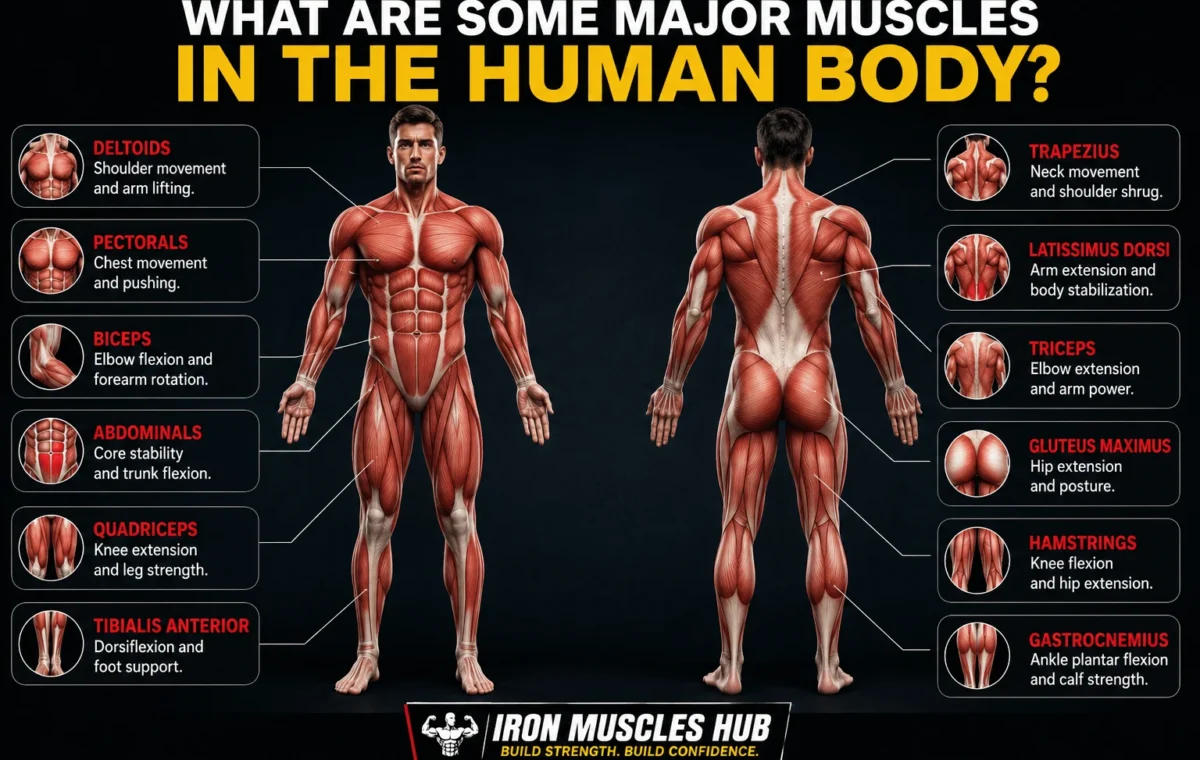
The answer to what are some major muscles in the human body is the large muscle groups that help you move, maintain posture, lift objects, breathe, and perform everyday activities. Some of the most important muscles include the pectoralis major (chest), latissimus dorsi (back), deltoids (shoulders), biceps, triceps, abdominal muscles, quadriceps, hamstrings, and gluteus maximus.
- Quick Answer: Major Muscles of the Human Body
- 1. Skeletal Muscles
- 2. Cardiac Muscle
- 3. Smooth Muscle
- Pectoralis Major (Chest Muscle)
- Latissimus Dorsi (Back Muscle)
- Deltoids (Shoulders)
- Trapezius (Upper Back and Neck)
- Biceps
- Triceps
- Rectus Abdominis
- Obliques
- Transverse Abdominis
- Gluteus Maximus
- Quadriceps
- Hamstrings
- Calf Muscles
- Better Exercise Choices
- Injury Prevention
- Improved Fitness Knowledge
- Mistake 1: Only Training Visible Muscles
- Mistake 2: Ignoring Smaller Supporting Muscles
- Mistake 3: Thinking Bigger Muscles Always Mean More Strength
- How many muscles are in the human body?
- What is the largest muscle in the human body?
- What are the most important muscles to train?
- Which muscles help you walk?
- Are muscles only used for movement?
- What are the main muscles beginners should learn first?
- Main functions:
- Exercises that target chest muscles:
- Popular back exercises:
- Front Deltoid
- Side Deltoid
- Rear Deltoid
- Shoulder exercises:
- Biceps
- Triceps
- Forearm Muscles
- Core exercises:
- Quadriceps
- Hamstrings
- Glute Muscles
- 1. Only Training Chest and Arms
- 2. Ignoring Leg Training
- 3. Using Poor Exercise Form
- How to Build and Strengthen Major Muscle Groups (Beginner Workout Guide)
- Compound Exercises
- Best Beginner Chest Exercises:
- Push-Ups
- Bench Press
- Dumbbell Chest Press
- Best Back Exercises:
- Pull-Ups
- Rows
- Lat Pulldowns
- Beginner Shoulder Exercises:
- Shoulder Press
- Lateral Raises
- Reverse Flys
- Biceps Exercises:
- Triceps Exercises:
- Beginner Core Exercises:
- Planks
- Leg Raises
- Dead Bugs
- Squats
- Lunges
- Romanian Deadlifts
- Protein
- Carbohydrates
- Healthy Fats
- Mistake 1: Changing Workouts Too Quickly
- Mistake 2: Ignoring Progressive Overload
- Mistake 3: Not Eating Enough
- Workout A
- Workout B
Your body contains more than 600 muscles, including skeletal, smooth, and cardiac muscle tissue. Skeletal muscles are the muscles you can consciously control, such as the muscles used for walking, lifting, and exercising.
Understanding the major muscles helps beginners learn how the body moves, why strength training works, and how different exercises target different areas. For more insights read here:-athletic muscular build and lean muscle physique.
Quick Answer: Major Muscles of the Human Body
| Muscle Group | Location | Main Function |
|---|---|---|
| Pectoralis Major | Chest | Pushing movements and arm movement |
| Latissimus Dorsi | Upper and middle back | Pulling movements and shoulder movement |
| Deltoids | Shoulders | Raising and rotating the arms |
| Biceps | Front upper arm | Bending the elbow |
| Triceps | Back upper arm | Straightening the arm |
| Abdominal Muscles | Core area | Stability and trunk movement |
| Gluteus Maximus | Buttocks | Hip movement, standing, climbing |
| Quadriceps | Front thighs | Straightening the knee |
| Hamstrings | Back thighs | Bending the knee and hip movement |
| Gastrocnemius | Calves | Walking and ankle movement |
What Are the Three Main Types of Muscle?
Before learning individual muscles, it helps to understand the three categories of muscle tissue.
1. Skeletal Muscles
Skeletal muscles attach to bones through tendons and allow voluntary movement. These are the muscles people usually think about when discussing fitness, bodybuilding, and strength training.
Examples include:
- Biceps
- Quadriceps
- Chest muscles
- Back muscles
2. Cardiac Muscle
Cardiac muscle is found only in the heart. It works automatically to keep blood moving throughout your body.
3. Smooth Muscle
Smooth muscles are found inside organs such as the stomach and blood vessels. They work without conscious control.
Major Muscles in the Upper Body
The upper body contains several important muscles responsible for pushing, pulling, lifting, and controlling arm movements.
Pectoralis Major (Chest Muscle)
The pectoralis major is the large muscle covering the front of your chest.
It helps with:
- Pushing objects
- Moving your arms across your body
- Pressing exercises like push-ups and bench presses
A stronger chest improves upper-body pushing strength and supports shoulder movement.
Latissimus Dorsi (Back Muscle)
The latissimus dorsi, often called the “lats,” is a broad muscle across the back.
It helps with:
- Pulling movements
- Pull-ups
- Rows
- Shoulder extension
Strong lats contribute to upper-body power and better posture.
Deltoids (Shoulders)
The deltoids are the rounded muscles covering your shoulders.
They are divided into three sections:
- Front deltoid
- Side deltoid
- Rear deltoid
Their main job is helping you lift and rotate your arms.
Trapezius (Upper Back and Neck)
The trapezius is a large muscle that extends across your upper back and neck area.
It helps with:
- Shoulder movement
- Neck support
- Maintaining posture
Major Arm Muscles
Your arm muscles help with lifting, carrying, pushing, and pulling.
Biceps
The biceps sit on the front of your upper arm.
Main functions:
- Bending the elbow
- Rotating the forearm
Common exercises:
- Bicep curls
- Chin-ups
Triceps
The triceps are located on the back of your upper arm.
They are responsible for:
- Straightening the elbow
- Pushing movements
The triceps make up a large portion of upper-arm muscle mass.
Major Core Muscles
Your core includes muscles around your abdomen, sides, and lower back.
Rectus Abdominis
This is the muscle commonly called the “six-pack” muscle.
It helps with:
- Bending the spine
- Supporting posture
Obliques
The oblique muscles are located on the sides of your abdomen.
They help with:
- Twisting movements
- Side bending
- Core stability
Transverse Abdominis
This deeper abdominal muscle works like a natural support belt around your midsection.
It helps stabilize your spine during movement.
Major Lower Body Muscles
The lower body contains some of the largest and strongest muscles in the human body.
Gluteus Maximus
The gluteus maximus is one of the largest muscles in the body.
It helps with:
- Standing up
- Running
- Climbing stairs
- Hip extension
This muscle plays a major role in powerful lower-body movements.
Quadriceps
The quadriceps are a group of four muscles located on the front of your thighs.
They help with:
- Straightening the knee
- Walking
- Running
- Squatting
Hamstrings
The hamstrings are located on the back of the thighs.
They help with:
- Bending the knee
- Hip movement
- Running speed
Calf Muscles
The main calf muscles include:
- Gastrocnemius
- Soleus
They help you:
- Walk
- Jump
- Stand on your toes
Major Muscle Groups Summary Table
| Body Area | Main Muscles | Everyday Examples |
|---|---|---|
| Chest | Pectoralis major | Pushing doors, lifting |
| Back | Latissimus dorsi, trapezius | Pulling, posture |
| Shoulders | Deltoids | Raising arms |
| Arms | Biceps, triceps | Carrying objects |
| Core | Abs, obliques | Balance and stability |
| Legs | Quadriceps, hamstrings | Walking and running |
| Glutes | Gluteus maximus | Standing and climbing |
| Calves | Gastrocnemius, soleus | Walking and jumping |
Why Learning Major Muscles Matters
Knowing your main muscles can help you understand:
Better Exercise Choices
Different exercises target different muscle groups.
Examples:
- Push-ups → chest, shoulders, triceps
- Squats → quadriceps, glutes, hamstrings
- Pull-ups → back and biceps
Injury Prevention
Understanding muscle function can help you train with better form and avoid unnecessary strain.
Improved Fitness Knowledge
Learning anatomy makes it easier to follow workout plans and understand how your body changes through exercise.
Common Beginner Mistakes About Muscles
Mistake 1: Only Training Visible Muscles
Many beginners focus only on chest and arms.
A balanced routine should also include:
- Back
- Legs
- Core
Balanced training supports overall strength.
Mistake 2: Ignoring Smaller Supporting Muscles
Smaller muscles help stabilize joints and improve movement quality.
Examples:
- Rotator cuff muscles
- Calf muscles
- Core stabilizers
Mistake 3: Thinking Bigger Muscles Always Mean More Strength
Muscle size and strength are related, but they are not exactly the same. Training technique, nervous system adaptation, and experience also affect performance.
How Do Muscles Work?
Muscles create movement by contracting and relaxing.
A simple example:
- Your brain sends a signal to a muscle.
- Muscle fibers contract.
- The muscle pulls on bones through tendons.
- The joint moves.
Skeletal muscles work together in groups rather than acting alone.
For example, walking requires cooperation between:
- Glutes
- Quadriceps
- Hamstrings
- Calves
- Core muscles
Frequently Asked Questions
How many muscles are in the human body?
The human body has more than 600 muscles, depending on how individual muscles are counted. These include skeletal muscles, smooth muscles, and cardiac muscle.
What is the largest muscle in the human body?
The gluteus maximus is considered the largest muscle by mass. It plays an important role in hip extension, standing, climbing, and running.
What are the most important muscles to train?
There is no single “most important” muscle group. A balanced approach trains major areas such as the chest, back, shoulders, arms, core, and legs.
Which muscles help you walk?
Walking uses many muscles, including the glutes, quadriceps, hamstrings, calves, and core muscles. These muscles work together to create movement and maintain balance.
Are muscles only used for movement?
No. Muscles also help maintain posture, stabilize joints, support organs, and produce body heat.
What are the main muscles beginners should learn first?
Beginners should start with major groups: chest, back, shoulders, arms, core, and legs. Learning these provides a foundation for understanding exercise and fitness.
Understanding Your Muscles Starts With the Basics
Learning what are some major muscles in the human body gives you a better understanding of how movement, exercise, and strength development work. The biggest muscle groups — including your chest, back, shoulders, arms, core, and legs — all have specific jobs that help you perform everyday activities.
You don’t need to memorize every muscle name to understand your body. Start with the major groups, learn their functions, and build your knowledge step by step.
Related articles on Iron Muscle Hub:
- How to Build Muscle Quickly for Beginners
- Best Beginner Strength Training Exercises
- How to Gain Lean Muscle Naturally
The Most Important Muscle Groups for Strength and Movement
Your body’s muscles work together as a connected system. While individual muscles have specific jobs, most daily movements require multiple muscle groups working at the same time.
For beginners, understanding the main muscle groups makes it easier to learn exercise techniques, create balanced workouts, and understand how your body becomes stronger.
1. Chest Muscles (Pectorals)
The chest muscles, mainly the pectoralis major and pectoralis minor, are located on the front of your upper body.
They help you perform pushing movements and control arm movement.
Main functions:
- Pushing objects away from your body
- Moving your arms inward
- Supporting shoulder movement
Exercises that target chest muscles:
- Push-ups
- Bench press
- Dumbbell chest press
- Cable flys
A strong chest is not only about appearance. These muscles help with everyday tasks like pushing doors, lifting objects, and supporting upper-body strength.
2. Back Muscles (Latissimus Dorsi, Trapezius & Rhomboids)
The back contains some of the largest muscle groups in the human body.
Important back muscles include:
| Muscle | Location | Function |
|---|---|---|
| Latissimus Dorsi | Side and middle back | Pulling and arm movement |
| Trapezius | Upper back and neck | Shoulder movement and posture |
| Rhomboids | Between shoulder blades | Pulling shoulders backward |
Strong back muscles help maintain good posture and balance the pushing muscles of your chest.
Popular back exercises:
- Pull-ups
- Lat pulldowns
- Rows
- Deadlifts
3. Shoulder Muscles (Deltoids)
The shoulders are controlled mainly by the deltoid muscles.
The deltoid has three major parts:
Front Deltoid
Helps raise your arm forward.
Side Deltoid
Creates shoulder width by lifting your arm sideways.
Rear Deltoid
Supports pulling movements and shoulder stability.
Shoulder exercises:
- Shoulder press
- Lateral raises
- Front raises
- Reverse flys
Healthy shoulders are important because they allow a wide range of arm movements.
4. Arm Muscles: Biceps, Triceps and Forearms
Your arms contain several muscles that work together.
Biceps
The biceps are located on the front of the upper arm.
They help with:
- Curling movements
- Pulling actions
- Rotating the forearm
Examples:
- Dumbbell curls
- Barbell curls
Triceps
The triceps are found on the back of the upper arm.
They are responsible for:
- Straightening the elbow
- Pushing movements
Examples:
- Tricep pushdowns
- Dips
- Close-grip push-ups
Forearm Muscles
Forearms control grip strength and wrist movement.
They help you:
- Hold objects
- Lift weights
- Perform daily tasks
Exercises:
- Farmer’s carries
- Wrist curls
- Dead hangs
5. Core Muscles: More Than Just Abs
Many people think the core only means six-pack muscles, but the core includes several muscles.
Main core muscles:
| Muscle | Function |
|---|---|
| Rectus Abdominis | Bending the spine |
| Obliques | Twisting and side movement |
| Transverse Abdominis | Core stability |
| Lower Back Muscles | Spine support |
A strong core improves:
- Balance
- Athletic performance
- Posture
- Movement control
Core exercises:
- Planks
- Leg raises
- Mountain climbers
- Dead bugs
6. Leg Muscles: The Power Center of Your Body
Your legs contain some of the strongest muscles because they support your body weight every day.
Quadriceps
Located at the front of the thigh.
They help with:
- Walking
- Running
- Jumping
- Squatting
Exercises:
- Squats
- Lunges
- Leg press
Hamstrings
Located at the back of the thigh.
They help with:
- Knee bending
- Sprinting
- Hip movement
Exercises:
- Romanian deadlifts
- Hamstring curls
Glute Muscles
The glutes include:
- Gluteus maximus
- Gluteus medius
- Gluteus minimus
The gluteus maximus is one of the strongest muscles in the human body.
Functions:
- Hip movement
- Standing
- Running
- Jumping
Exercises:
- Hip thrusts
- Squats
- Lunges
7. Calf Muscles
The calves are located on the lower part of your legs.
Main muscles:
- Gastrocnemius
- Soleus
They help with:
- Walking
- Running
- Jumping
- Standing on your toes
Exercises:
- Standing calf raises
- Seated calf raises
How Major Muscles Work Together
Muscles rarely work alone. A simple movement like lifting a box requires cooperation between many areas.
Example: Picking up a heavy object:
- Legs provide power
- Core stabilizes your body
- Back supports your spine
- Arms grip and lift
This teamwork allows your body to move efficiently.
Beginner Muscle Training Mistakes to Avoid
1. Only Training Chest and Arms
Many beginners focus only on visible muscles.
A balanced routine should include:
✅ Chest
✅ Back
✅ Shoulders
✅ Arms
✅ Core
✅ Legs
2. Ignoring Leg Training
Leg muscles support overall strength and movement.
Skipping leg workouts can create muscle imbalance.
3. Using Poor Exercise Form
Correct technique is more important than lifting heavy weights.
Poor form can reduce results and increase injury risk.
Simple Weekly Muscle Group Plan for Beginners
| Day | Focus |
|---|---|
| Day 1 | Chest, shoulders, triceps |
| Day 2 | Back, biceps |
| Day 3 | Rest or light activity |
| Day 4 | Legs and core |
| Day 5 | Full body workout |
| Weekend | Recovery |
Beginners should focus on consistency, proper form, and gradual improvement.
How to Build and Strengthen Major Muscle Groups (Beginner Workout Guide)
Building stronger muscles is not only about lifting heavy weights. Your muscles grow when you combine smart training, proper nutrition, recovery, and consistency.
After learning about the major muscles in the human body, the next step is understanding how to train them effectively. Whether your goal is to gain strength, improve fitness, or build a more muscular physique, a balanced approach will give you better long-term results.
How Does Muscle Growth Happen?
Muscle growth happens when your muscles experience a challenge they are not used to.
A simple process looks like this:
- You train a muscle with resistance.
- Small changes happen inside the muscle fibers.
- Your body repairs and adapts those fibers.
- The muscle becomes stronger over time.
This process is called muscle hypertrophy.
Muscles need repeated training signals, enough food, and recovery time to grow.
The Best Way to Train Major Muscle Groups
A beginner-friendly workout should focus on compound movements because they train multiple muscles at the same time.
Compound Exercises
Compound exercises involve several joints and muscle groups.
Examples:
| Exercise | Main Muscles Worked |
|---|---|
| Squat | Legs, glutes, core |
| Bench Press | Chest, shoulders, triceps |
| Pull-Up | Back, biceps |
| Deadlift | Back, legs, glutes |
| Shoulder Press | Shoulders, arms |
These exercises help beginners build a strong foundation.
Chest Muscle Training
The chest muscles help with pushing strength and upper-body power.
Best Beginner Chest Exercises:
Push-Ups
Targets:
- Chest
- Shoulders
- Triceps
- Core
Beginner option:
- Perform fewer repetitions
- Use your knees if needed
Bench Press
Targets:
- Pectoralis major
- Front shoulders
- Triceps
Focus on controlled movement instead of lifting the heaviest weight.
Dumbbell Chest Press
Benefits:
- Improves balance between both sides of your body
- Allows a natural movement pattern
Building Strong Back Muscles
A strong back supports posture and improves pulling strength.
Best Back Exercises:
Pull-Ups
Works:
- Latissimus dorsi
- Biceps
- Upper back
Beginners can start with assisted pull-ups.
Rows
Examples:
- Dumbbell rows
- Cable rows
- Barbell rows
Rows strengthen the middle and upper back.
Lat Pulldowns
This exercise is useful for beginners who cannot perform full pull-ups yet.
Shoulder Muscle Development
Strong shoulders improve arm movement and upper-body appearance.
Beginner Shoulder Exercises:
Shoulder Press
Works:
- Deltoids
- Triceps
Lateral Raises
Targets:
- Side deltoids
Reverse Flys
Targets:
- Rear deltoids
Training all three parts of the shoulder helps create balanced development.
Building Bigger Arms
The arms contain several important muscles, especially the biceps and triceps.
Biceps Exercises:
- Dumbbell curls
- Barbell curls
- Hammer curls
These movements strengthen pulling muscles.
Triceps Exercises:
- Triceps pushdowns
- Dips
- Close-grip push-ups
Since the triceps make up a large part of the upper arm, training them is important for overall arm size.
Strengthening Core Muscles
A strong core improves stability and supports almost every movement.
Beginner Core Exercises:
Planks
Benefits:
- Improves core endurance
- Supports posture
Leg Raises
Targets:
- Lower abdominal muscles
- Hip flexors
Dead Bugs
Helps improve core control and stability.
Building Powerful Leg Muscles
Leg training develops some of the strongest muscles in your body.
Squats
Targets:
- Quadriceps
- Glutes
- Hamstrings
- Core
Squats are one of the most effective lower-body exercises.
Lunges
Benefits:
- Improves balance
- Builds single-leg strength
Romanian Deadlifts
Targets:
- Hamstrings
- Glutes
- Lower back
How Often Should Beginners Train Muscles?
A beginner does not need to train every muscle every day.
A common approach is:
| Training Style | How It Works |
|---|---|
| Full Body | Train most muscles in one session |
| Upper/Lower Split | Separate upper and lower body days |
| Push/Pull/Legs | Group muscles by movement pattern |
Many beginners benefit from training 2–4 days per week, depending on schedule, fitness level, and recovery ability.
Nutrition for Building Muscle
Exercise creates the signal for growth, but nutrition provides the building materials.
Important nutrients include:
Protein
Protein helps repair and maintain muscle tissue.
Good protein sources:
- Eggs
- Chicken
- Fish
- Greek yogurt
- Beans
- Lentils
- Tofu
Carbohydrates
Carbohydrates provide energy for workouts.
Examples:
- Rice
- Potatoes
- Oats
- Fruits
- Whole grains
Healthy Fats
Healthy fats support normal body functions.
Examples:
- Nuts
- Seeds
- Olive oil
- Avocado
The Importance of Recovery
Muscles do not grow during the workout itself. Recovery is when your body adapts.
Helpful recovery habits:
- Sleep enough each night
- Take rest days
- Stay hydrated
- Avoid training the same muscles excessively
Common Muscle-Building Mistakes Beginners Make
Mistake 1: Changing Workouts Too Quickly
Many beginners switch routines every few days.
Better approach:
Stay consistent with a good program and improve gradually.
Mistake 2: Ignoring Progressive Overload
Your muscles need increasing challenges over time.
Examples:
- Add a little more weight
- Increase repetitions
- Improve exercise form
Mistake 3: Not Eating Enough
Muscle growth requires enough energy and nutrients.
Training hard while under-eating can slow progress.
Simple Full-Body Beginner Workout Example
Workout A
Squats
3 sets × 8–12 reps
Push-Ups
3 sets × 8–15 reps
Rows
3 sets × 8–12 reps
Shoulder Press
3 sets × 8–12 reps
Plank
3 rounds
Workout B
Lunges
3 sets
Bench Press
3 sets
Lat Pulldown
3 sets
Bicep Curls
3 sets
Leg Raises
3 sets
Final Thoughts on Major Muscles in the Human Body
Understanding the major muscles in the human body is the first step toward better fitness knowledge. Your chest, back, shoulders, arms, core, and legs all work together to help you move, perform daily activities, and become stronger.
You don’t need complicated routines to make progress. Focus on learning proper technique, training consistently, eating well, and giving your body time to recover.
A strong body is built through small improvements repeated over time.