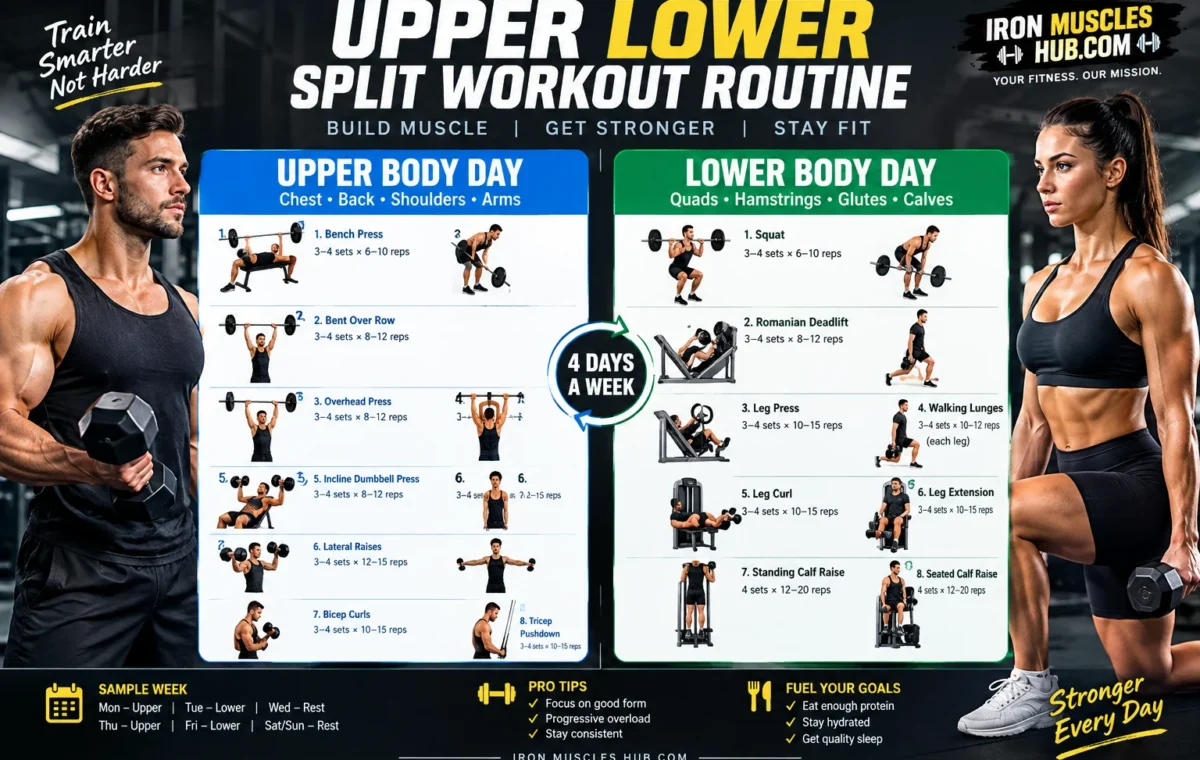
If you want to train four days a week without spending six days in the gym, an upper lower split workout routine is a practical option. You train your upper body twice and lower body twice, spreading your work across the week instead of trying to train everything in one session.
- Quick Answer
- What Is an Upper Lower Split Workout Routine?
- Why train each area twice?
- Day 1 — Upper A
- Coaching notes
- Day 2 — Lower A
- Coaching notes
- Day 3 — Rest
- Day 4 — Upper B
- Day 5 — Lower B
- A sensible starting range
- 1. Learn the movement
- 2. Build repetitions
- 3. Increase the load
- 4. Repeat
- Mistake 1: Starting with too much volume
- Mistake 2: Going to failure on every set
- Mistake 3: Changing exercises every week
- Mistake 4: Treating soreness as the goal
- Mistake 5: Adding extra chest and arm work
- Mistake 6: Ignoring recovery
- Mistake 7: Treating the program like a test
- It may not be ideal if:
- 1. Is an upper lower split good for beginners?
- 2. How many days a week should I do an upper lower split?
- 3. Can I build muscle with an upper lower split?
- 4. Is upper/lower better than full-body workouts?
- 5. How long should an upper lower workout take?
- Weeks 1–2: Learn
- Weeks 3–4: Build
- Weeks 5–6: Progress
- Weeks 7–8: Evaluate
- Closing Summary
For beginners, though, four days isn’t automatically better than three. The best setup is the one you can recover from and follow consistently. Current ACSM guidance emphasizes consistency, appropriate training volume, and matching the program to your goal rather than making the routine unnecessarily complicated. For more insights read here :- protein pictures and most protein per calorie .
Quick Answer
- Train: 4 days per week.
- Schedule: Upper A, Lower A, rest, Upper B, Lower B.
- Goal: Build basic strength and muscle while practicing major movement patterns.
- Starting point: Use controlled weights and leave a little room before technical failure.
- Progression: Add repetitions first, then increase the load when your form stays solid.
- Beginner note: If you’re completely new to resistance training, a 2–3-day full-body routine may be easier to start with. NSCA guidance lists 2–3 weekly resistance-training days as a useful frequency for novice clients.
What Is an Upper Lower Split Workout Routine?
An upper lower split divides your resistance training into two basic session types.
Upper-body workouts train movements involving the chest, back, shoulders and arms. Lower-body workouts focus on the quads, hamstrings, glutes, calves and related lower-body movements.
A common four-day schedule looks like this:
| Day | Workout | Main Focus |
|---|---|---|
| Monday | Upper A | Chest, back, shoulders, arms |
| Tuesday | Lower A | Quads, hamstrings, glutes, calves |
| Wednesday | Rest | Recovery |
| Thursday | Upper B | Chest, back, shoulders, arms |
| Friday | Lower B | Quads, hamstrings, glutes, calves |
| Saturday | Rest | Recovery |
| Sunday | Rest | Recovery |
The major advantage is simple: you don’t need to cram all your weekly work into one workout.
Research comparing split routines with full-body routines found no meaningful overall advantage for one structure when training volume is appropriately matched. In other words, the split itself isn’t magic. The value comes from having a practical way to organize your training.
Why train each area twice?
Training frequency can help you distribute your weekly workload.
A PubMed systematic review found that, when weekly volume is equated, training frequency by itself does not appear to create a major difference in muscle growth. This means twice-weekly training isn’t automatically superior simply because it’s twice weekly. It can, however, make a larger workload easier to distribute across manageable sessions.
That’s exactly where an upper/lower structure becomes useful.
Instead of doing a huge amount of chest, back and shoulder work on Monday, you can split that work between Upper A and Upper B.
The same idea applies to your legs.
The 4-Day Upper Lower Split Workout Routine
The following plan is designed for a beginner or early intermediate lifter who can train four days per week and has access to a normal commercial gym.
You don’t need to use every exercise exactly as written. The goal is to learn the movement patterns, perform quality repetitions and gradually improve.
Day 1 — Upper A
| Exercise | Sets | Reps | Rest |
|---|---|---|---|
| Dumbbell or Barbell Bench Press | 3 | 6–10 | 2–3 min |
| Lat Pulldown | 3 | 8–12 | 1–2 min |
| Seated Cable Row | 3 | 8–12 | 1–2 min |
| Dumbbell Shoulder Press | 2 | 8–12 | 1–2 min |
| Dumbbell Curl | 2 | 10–15 | 1–2 min |
| Cable Triceps Pressdown | 2 | 10–15 | 1–2 min |
Coaching notes
Start with the exercise that requires the most coordination and effort.
For most beginners, that means the bench press or dumbbell press comes first. Your pulling exercises follow, then smaller shoulder and arm movements.
Don’t turn every set into a maximum-effort attempt.
If you have to twist your body, bounce the weight or shorten the movement to complete the final repetitions, the load is probably too heavy.
Day 2 — Lower A
| Exercise | Sets | Reps | Rest |
|---|---|---|---|
| Goblet Squat or Back Squat | 3 | 6–10 | 2–3 min |
| Romanian Deadlift | 3 | 8–10 | 2–3 min |
| Leg Press | 2 | 10–12 | 1–2 min |
| Seated or Lying Leg Curl | 2 | 10–15 | 1–2 min |
| Standing Calf Raise | 2 | 10–15 | 1–2 min |
| Plank | 2 | 20–45 sec | 60–90 sec |
Coaching notes
You don’t need to start with a heavy barbell squat if you haven’t learned the movement.
A goblet squat is a perfectly reasonable starting point.
The same principle applies to Romanian deadlifts. Learn to control the hip hinge before worrying about lifting a large number.
Your lower-body sessions should feel challenging, but you should finish with enough technical control to know what you did.
Day 3 — Rest
Take the day off from structured resistance training.
Walking, normal daily activity and easy mobility work are fine if they feel good.
Don’t turn the recovery day into another hard leg workout.
The point of the split is to organize training and recovery together.
Day 4 — Upper B
| Exercise | Sets | Reps | Rest |
|---|---|---|---|
| Incline Dumbbell Press | 3 | 8–12 | 2 min |
| Chest-Supported Dumbbell Row | 3 | 8–12 | 2 min |
| Assisted Pull-Up or Lat Pulldown | 2 | 8–12 | 1–2 min |
| Cable or Dumbbell Lateral Raise | 2 | 12–15 | 1–2 min |
| Hammer Curl | 2 | 10–15 | 1–2 min |
| Overhead Cable Triceps Extension | 2 | 10–15 | 1–2 min |
The second upper session uses different variations rather than simply repeating Monday.
That’s useful for two reasons.
First, it gives you another opportunity to practice similar movement patterns.
Second, it can make the program less repetitive without requiring a complicated exercise rotation.
Day 5 — Lower B
| Exercise | Sets | Reps | Rest |
|---|---|---|---|
| Leg Press or Front Squat | 3 | 8–12 | 2–3 min |
| Hip Thrust | 3 | 8–12 | 2 min |
| Bulgarian Split Squat | 2 | 8–12 each leg | 2 min |
| Leg Curl | 2 | 10–15 | 1–2 min |
| Seated Calf Raise | 2 | 10–15 | 1–2 min |
| Dead Bug | 2 | 8–12 each side | 60–90 sec |
If Bulgarian split squats are difficult to balance, hold onto a rack lightly or replace them with another stable single-leg exercise.
You don’t earn extra points for making an exercise unnecessarily difficult.
How Many Sets and Reps Should Beginners Use?
For general resistance training, ACSM’s 2026 guidance emphasizes adjusting volume and load according to the goal. Its updated recommendations indicate roughly 10 weekly sets per muscle group as a useful reference for hypertrophy, while stressing that the exact amount should be individualized.
That doesn’t mean a beginner needs to jump immediately to 10 direct sets for every muscle.
Your pressing movements already train the triceps and front delts. Rows and pulldowns involve the biceps. Squats and leg presses train more than just the quads.
So don’t add extra exercises simply because a calculator says you need more sets.
A sensible starting range
For many exercises in this plan:
- Main lifts: 2–3 working sets
- Smaller accessory movements: 2 working sets
- Larger compound movements: mostly 6–12 reps
- Isolation movements: mostly 10–15 reps
- Core work: controlled repetitions or timed sets
These are programming choices, not laws.
NSCA material commonly uses 2–3 sets of 8–12 repetitions for intermediate resistance training, while beginner programs can start with less volume.
The key is to start with a workload you can recover from and improve.
How Heavy Should You Lift?
You don’t need to know your exact one-repetition maximum to begin.
Pick a load that allows you to perform the target repetitions with good technique.
For example, suppose your program says:
Dumbbell bench press — 3 × 8–10
You might choose a pair of 18 kg dumbbells (about 40 lb each).
Your first session could look like:
- Set 1: 10 reps
- Set 2: 9 reps
- Set 3: 8 reps
If all three sets are controlled and you could probably have completed another repetition or two, that is a reasonable starting point.
If the same weight produces:
- Set 1: 10 reps
- Set 2: 7 reps
- Set 3: 5 reps
the load may be too heavy for your current target.
The goal isn’t to prove how much you can lift on day one.
The goal is to give yourself room to improve.
Worked Example: How to Progress Your Weights
Here’s a simple progression method.
Suppose your target is 3 × 8–10 on the dumbbell bench press.
You start with:
18 kg / 40 lb per dumbbell
Week 1:
- 10
- 9
- 8
Week 2:
- 10
- 10
- 9
Week 3:
- 10
- 10
- 10
Now you have reached the top of your target range.
At the next suitable session, move to the next available dumbbell size.
For example:
20 kg / 44 lb per dumbbell
You may then get:
- 9
- 8
- 8
That’s not a step backward.
The heavier load gives you a new progression target.
Over time, you want more repetitions, better technique, more load, or some combination of these.
This is a simple form of progressive overload.
What About Pounds and Kilograms?
US gyms commonly display dumbbells and plates in pounds, while many UK and European gyms use kilograms.
Here’s a useful reference:
| Kilograms | Pounds |
|---|---|
| 5 kg | 11 lb |
| 10 kg | 22 lb |
| 15 kg | 33 lb |
| 20 kg | 44 lb |
| 25 kg | 55 lb |
| 30 kg | 66 lb |
| 40 kg | 88 lb |
| 50 kg | 110 lb |
| 60 kg | 132 lb |
| 80 kg | 176 lb |
| 100 kg | 220 lb |
For body measurements:
- 150 cm ≈ 59.1 in
- 160 cm ≈ 63.0 in
- 170 cm ≈ 66.9 in
- 180 cm ≈ 70.9 in
- 190 cm ≈ 74.8 in
You don’t need to obsess over body measurements to run an upper/lower program.
Use the units that your gym equipment uses and track your training consistently.
How Much Rest Should You Take Between Sets?
Rest should be long enough that you can perform the next set properly.
For bigger compound exercises, 2–3 minutes is a practical starting point.
For smaller isolation exercises, 1–2 minutes is often enough.
Don’t force yourself to rest exactly 60 seconds if you’re still breathing hard and your next set would suffer.
Likewise, you don’t need to sit for 10 minutes between every set.
The quality of your next set matters more than following a rigid stopwatch rule.
How to Progress the Upper Lower Split
A good beginner progression system should be boring.
That’s a compliment.
Try this four-step process:
1. Learn the movement
Before increasing weight, make sure you understand the basic technique.
2. Build repetitions
If your target is 8–12 reps, gradually work toward 12 with the same load.
3. Increase the load
Once you can reach the top of the range with clean form, increase the weight by the smallest practical amount.
4. Repeat
Your repetitions may fall when you add weight.
That’s normal.
Build them back up again.
This approach prevents you from chasing heavier weights every workout while your technique is still developing.
ACSM’s 2026 position stand also stresses that consistency and appropriate programming matter more than adding complicated training methods.
Upper Lower vs Full Body vs Push Pull Legs
There isn’t one universally best workout split.
Your schedule, training experience, recovery and preferences all matter.
| Feature | Upper/Lower | Full Body | Push/Pull/Legs |
|---|---|---|---|
| Typical weekly sessions | 4 | 2–3 | 3–6 |
| Muscle frequency | Usually 2× | Usually 2–3× | Depends on schedule |
| Beginner friendly | Good after basics | Excellent | Can be more demanding |
| Session focus | Moderate | Broad | Narrower |
| Recovery flexibility | Good | Very good | Depends on frequency |
| Best use | 4-day schedules | New lifters/busy schedules | Lifters wanting more gym days |
| Main advantage | Balanced structure | Efficient | More room for exercise volume |
A 2024 systematic review and meta-analysis found that split and full-body routines produced similar strength and muscle-growth outcomes when training variables were appropriately matched.
So don’t choose a split because somebody calls it the “best.”
Choose the structure that allows you to train consistently.
Common Mistakes → Why → Fix
Mistake 1: Starting with too much volume
Why: Beginners often assume more exercises mean faster progress.
Fix: Start with the listed sets. Add work only when your recovery and performance support it.
Mistake 2: Going to failure on every set
Why: Constantly pushing every set to failure can create unnecessary fatigue and make later exercises worse.
Fix: Most sets should finish with good technique still available. Save true limit efforts for situations where they make sense, rather than making every set a test.
The 2026 ACSM review found that training to momentary muscular failure is not consistently necessary for the average healthy adult to achieve useful outcomes.
Mistake 3: Changing exercises every week
Why: New exercises feel exciting, but constant variation makes progress harder to measure.
Fix: Keep the main movements for several weeks. Change an exercise when there’s a clear reason, such as equipment availability, discomfort, poor fit or stalled progress.
Mistake 4: Treating soreness as the goal
Why: Being sore doesn’t automatically mean the workout was effective.
Fix: Track performance instead. Look for better repetitions, improved technique and gradual increases in training load.
Mistake 5: Adding extra chest and arm work
Why: Arms and chest are visible muscles, so beginners often add more exercises for them.
Fix: Remember that compound pressing and pulling already contribute to your weekly upper-body workload.
Mistake 6: Ignoring recovery
Why: Four lifting days still create a meaningful training demand.
Fix: Protect sleep, eat adequately, manage other hard activities and use rest days as actual recovery days.
Mistake 7: Treating the program like a test
Why: Beginners sometimes think every workout should prove they’re stronger.
Fix: Think in weeks and months, not individual workouts.
A session where you maintain your previous performance while improving technique can still be productive.
30-Second Self-Test: Is Upper/Lower Right for You?
Ask yourself these five questions:
- Can I realistically train 4 days per week?
- Can I recover between sessions?
- Do I already know basic squat, hinge, push and pull patterns?
- Do I want more training volume than a simple 2–3-day full-body plan?
- Can I follow the same program for several weeks without constantly changing it?
If you answer yes to at least four, an upper/lower split may be a good fit.
If you answer no to several questions, start with a simpler program.
The best split is the one you can actually complete.
Who This Upper Lower Split Is NOT For
This particular four-day version isn’t the best starting point for everyone.
It may not be ideal if:
- You’re completely new to resistance training.
- You can only train once or twice each week.
- Four gym sessions create problems with your schedule.
- You’re already struggling to recover from your current training.
- You have an injury that affects the exercises in the plan.
- You don’t yet understand basic lifting technique.
NSCA guidance suggests novice clients can benefit from two or three weekly resistance-training sessions, particularly when using full-body training.
That means you don’t need to rush into four days simply because an upper/lower split looks more advanced.
Start where you are.
How Beginners Should Warm Up
You don’t need a complicated 25-minute warm-up before lifting.
Start with several minutes of general movement if you need to raise your body temperature.
Then perform lighter sets of your first exercise.
For example, if your working squat weight is 60 kg / 132 lb, you might begin with an unloaded or very light set and then gradually approach your working weight.
The exact warm-up depends on the exercise and the individual.
The goal is to prepare for the movement, not to fatigue yourself before the working sets.
What If You Miss a Workout?
Don’t try to squeeze four workouts into the remaining days just to “catch up.”
For example, if you miss Thursday’s Upper B workout, you can move the schedule forward:
- Friday: Upper B
- Saturday: Lower B
- Sunday: Rest
Or simply resume your normal schedule the following week.
One missed session isn’t a reason to rewrite the entire program.
Consistency over months matters much more than one imperfect week.
Can You Do Upper/Lower 3 Days Per Week?
Yes, but you need to rotate the sessions.
For example:
Week 1
- Monday: Upper A
- Wednesday: Lower A
- Friday: Upper B
Week 2
- Monday: Lower B
- Wednesday: Upper A
- Friday: Lower A
You could also use a different three-day structure.
However, if you can consistently train only three days, a full-body routine may be simpler because you can train the major movement patterns during every session.
The split should serve your schedule rather than forcing your schedule to serve the split.
Can You Do Upper/Lower 5 or 6 Days Per Week?
You can modify the structure, but more sessions aren’t automatically better.
The research on training frequency is important here.
A systematic review and meta-analysis found that higher resistance-training frequency can be associated with greater strength gains, but much of that relationship appears to be explained by differences in total training volume. When volume is equated, the independent effect of frequency becomes much smaller.
For muscle growth, another systematic review found no meaningful difference between higher and lower frequencies when weekly volume was equated.
So don’t add two extra gym days just because you think you need them.
First make four days work.
Upper Lower Split for Strength
If strength is your main goal, keep your primary exercises toward the lower end of the repetition range.
For example:
- Bench press: 3 × 5–8
- Squat: 3 × 5–8
- Row: 3 × 6–10
- Romanian deadlift: 3 × 6–10
Accessories can remain in moderate-to-higher repetition ranges.
ACSM’s 2026 recommendations indicate heavier loading around 80% of 1RM with 2–3 sets per exercise as one approach for strength-focused training.
Beginners don’t need to calculate 1RM every week.
Use a load you can control and progress gradually.
Upper Lower Split for Muscle Growth
If your main goal is hypertrophy, you can use a wider range of repetitions.
For example:
- Compound lifts: roughly 6–12 reps
- Machines: roughly 8–15 reps
- Isolation movements: roughly 10–20 reps
The exact repetition number is less important than performing challenging, technically sound sets and accumulating an appropriate amount of weekly work.
ACSM’s 2026 position stand points toward approximately 10 weekly sets per muscle group as a useful reference for hypertrophy, while emphasizing that the right amount depends on the person and goal.
For a beginner, start below your maximum recoverable workload.
You can always add later.
It’s much harder to recover from work you shouldn’t have added in the first place.
FAQ
1. Is an upper lower split good for beginners?
Yes, it can be, especially for a beginner who already understands basic resistance-training movements and can consistently train four days per week. However, a completely new lifter doesn’t need four sessions to make progress. NSCA guidance supports two or three weekly sessions for novice clients, while four-day split routines can become useful as training experience and scheduling capacity increase.
2. How many days a week should I do an upper lower split?
The classic upper/lower arrangement uses four training days: two upper-body sessions and two lower-body sessions. A common schedule is Monday upper, Tuesday lower, Thursday upper and Friday lower. You can move those days around to fit your schedule. The important point is that you have enough recovery and don’t add sessions simply to increase frequency.
3. Can I build muscle with an upper lower split?
Yes. An upper/lower routine can provide enough resistance-training volume for muscle growth when the exercises, sets, loads and progression are appropriate. Current ACSM guidance emphasizes sufficient weekly volume while also stressing consistency and individualization. Research comparing split and full-body routines suggests neither structure has a major advantage when the overall training work is properly matched.
4. Is upper/lower better than full-body workouts?
Not automatically. A 2024 systematic review and meta-analysis comparing split and full-body resistance training found similar improvements in strength and muscle growth when training variables were appropriately matched. Full-body training can be excellent for beginners who train two or three days per week, while upper/lower can be more convenient for someone who wants four focused sessions.
5. How long should an upper lower workout take?
There isn’t a required workout duration. A beginner session using the program above may take around 45–75 minutes depending on warm-ups, rest periods and gym availability. Don’t rush your compound exercises just to finish faster. If a session becomes consistently much longer because you’re adding many extra exercises, reduce unnecessary volume before trying to shorten rest periods.
A Simple 8-Week Way to Run This Program
Don’t judge the program after one workout.
Give yourself time to learn the exercises and collect useful training data.
Weeks 1–2: Learn
Focus on:
- Technique
- Consistent exercise order
- Comfortable loads
- Recording sets and reps
Weeks 3–4: Build
Try to add repetitions while keeping form consistent.
Don’t increase every exercise at once.
Weeks 5–6: Progress
Increase load on exercises where you’ve reached the top of the repetition range.
For example:
3 × 8–12
If you can perform:
12 / 12 / 12
with controlled technique, increase the load slightly.
Weeks 7–8: Evaluate
Ask:
- Are my lifts improving?
- Is my technique better?
- Am I recovering?
- Am I enjoying the schedule?
- Are any exercises causing persistent discomfort?
- Am I consistently completing all four sessions?
If the answers are mostly positive, keep going.
You don’t need to replace a working routine just because you found a new workout online.
Final Upper Lower Split Checklist
Before each week, make sure you have:
- 2 upper sessions
- 2 lower sessions
- At least 3 recovery days
- A clear exercise order
- A logbook or app for tracking
- Loads you can control
- A progression target
- Enough recovery between hard sessions
Most importantly, don’t confuse complexity with quality.
A well-executed four-day routine built around presses, pulls, squats, hinges and sensible accessory work can take you a long way.
The current evidence doesn’t show that you need an exotic split, constant exercise rotation or advanced techniques to make progress. ACSM’s 2026 update puts strong emphasis on consistency and matching training variables to your goals.
Closing Summary
A good upper lower split workout routine gives you a simple way to organize four weekly strength sessions. You train your upper body twice and lower body twice, then use the remaining days for recovery. Start with manageable sets and repetitions, learn the exercises, and gradually increase your training load as your technique improves.
If you’re completely new to resistance training, don’t feel pressured to begin with four days. A two- or three-day full-body routine may be a better starting point. If four days fits your schedule and you can recover well, the upper/lower structure gives you a clear framework to build strength and muscle without making your training unnecessarily complicated.