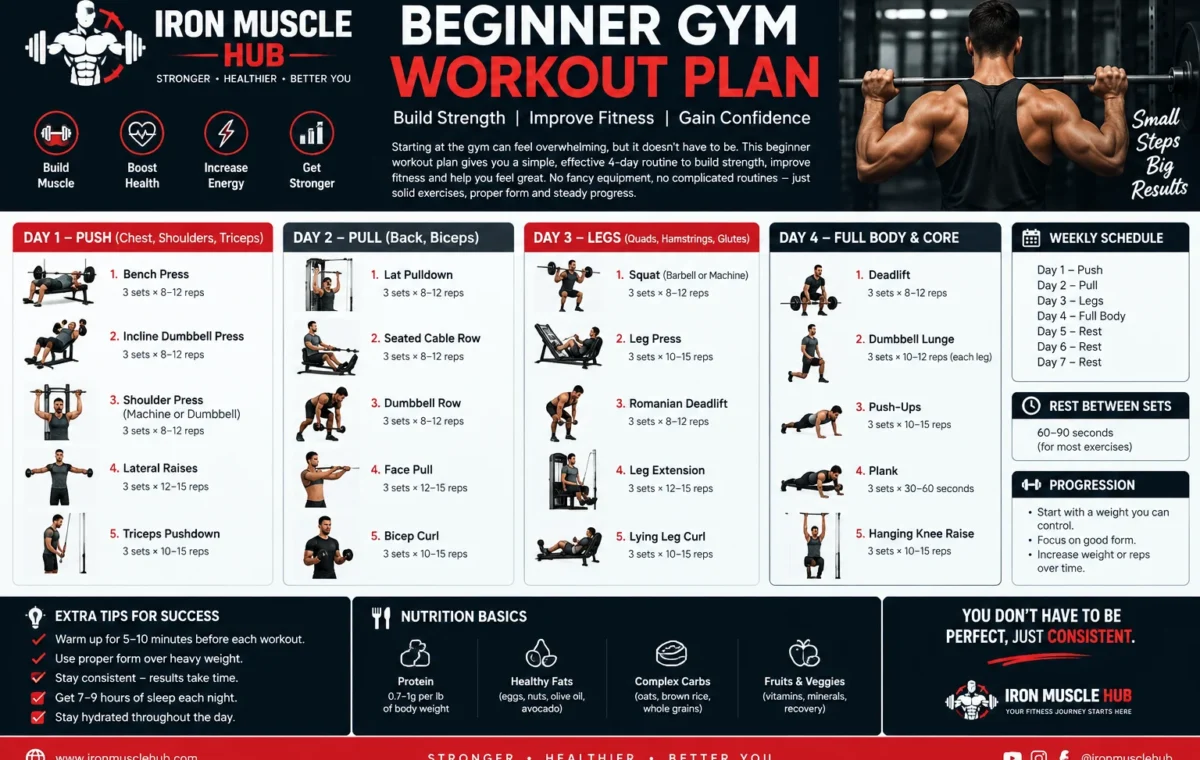
If you’re new to the gym, you don’t need a complicated split or a six-day schedule. A beginner gym workout plan built around full-body training 2–3 days per week is a practical place to start. Your first goal is to learn the main movement patterns, use manageable weights, recover between sessions, and build the habit of training consistently.
- Quick Answer
- Your Weekly Schedule
- Workout A
- Workout B
- Monday — Workout A
- 1. Leg Press or Goblet Squat
- 2. Dumbbell Bench Press
- 3. Seated Cable Row
- 4. Dumbbell Romanian Deadlift
- 5. Plank
- 1. Leg Press or Squat Variation
- 2. Lat Pulldown
- 3. Dumbbell or Machine Shoulder Press
- 4. Hip-Hinge Exercise
- 5. Core Exercise
- Why Full-Body Training Works Well for Beginners
- The Beginner Weight-Selection Rule
- How many days a week should a beginner go to the gym?
- What is the best workout for a beginner at the gym?
- How many sets and reps should a beginner do?
- Should beginners lift weights every day?
- Should a beginner train every set to failure?
- Final Thoughts
This guide gives you a complete beginner routine with exercises, sets, reps, rest guidance, weight-selection rules, progression steps, common mistakes, alternatives, and a simple way to know when you’re ready to increase the load. For more insights read here :- person working out and boost protein powder.
Quick Answer
- Train 2–3 non-consecutive days per week when you’re starting resistance training.
- Use a full-body routine so you practice the major movement patterns regularly.
- Start with controlled weights that let you perform the target repetitions with good technique.
- Progress gradually instead of trying to lift as much as possible during your first weeks.
- You don’t need to train every set to complete muscular failure to make progress.
NSCA guidance specifically recommends two or three weekly full-body sessions for novice lifters, with recovery between sessions. The 2026 ACSM position stand also found that resistance training improves strength, muscle size, power, endurance, and several measures of physical function in healthy adults.
What Is the Best Beginner Gym Workout Plan?
For most healthy adults who are new to resistance training, a simple full-body program performed two or three times per week is a strong starting point. Train on non-consecutive days so the same muscles and movement patterns have time to recover.
A beginner doesn’t need to divide the week into separate chest, back, shoulder, arm, and leg days. Full-body training gives you repeated practice with basic exercises while keeping the amount of work in each session manageable. NSCA guidance recommends two or three non-consecutive resistance-training days per week for novice clients.
The routine below alternates between Workout A and Workout B. If you train twice per week, perform A and B. If you train three times per week, use A, B, A during one week and B, A, B the next.
Your Weekly Schedule
| Training frequency | Example schedule | Best for |
|---|---|---|
| 2 days/week | Monday + Thursday | Very busy beginners |
| 3 days/week | Monday + Wednesday + Friday | Most beginners |
| 3 days/week | Tuesday + Thursday + Saturday | Alternative schedule |
| 4+ days/week | Not necessary initially | Better saved for later |
The important point isn’t choosing the “perfect” weekday. It’s leaving recovery time between your full-body sessions.
A Monday-Wednesday-Friday schedule works well because you aren’t trying to train the same major movement patterns on consecutive days.
Your 3-Day Beginner Gym Workout Plan
The easiest way to start is to alternate two workouts.
Workout A
| Exercise | Sets | Reps |
|---|---|---|
| Leg press or goblet squat | 2 | 8–12 |
| Dumbbell bench press or machine chest press | 2 | 8–12 |
| Seated cable row | 2 | 8–12 |
| Dumbbell Romanian deadlift | 2 | 8–12 |
| Plank | 2 | Controlled hold |
Workout B
| Exercise | Sets | Reps |
|---|---|---|
| Leg press or squat variation | 2 | 8–12 |
| Lat pulldown | 2 | 8–12 |
| Dumbbell shoulder press or machine press | 2 | 8–12 |
| Hip hinge variation | 2 | 8–12 |
| Cable or machine core exercise | 2 | 8–12 |
These exercises cover the major movement categories you need at the beginning:
- Knee-dominant leg work
- Hip-dominant work
- Horizontal pushing
- Vertical pushing
- Horizontal pulling
- Vertical pulling
- Core training
You don’t have to perform every exercise with a barbell. Machines, dumbbells, cables, and bodyweight exercises can all be useful tools.
The 2026 ACSM position stand found that equipment type did not consistently determine resistance-training outcomes, which supports using equipment that allows you to train safely and consistently.
How to Perform the Plan
Monday — Workout A
1. Leg Press or Goblet Squat
Start with a movement you can control through a comfortable range of motion.
For a leg press, keep your feet stable and avoid allowing your lower back to lose contact with the pad. For a goblet squat, hold the dumbbell close to your chest and keep the movement controlled.
Perform:
2 sets × 8–12 reps
Don’t worry about impressing anyone with the amount of weight on the machine.
Your first objective is learning the movement.
2. Dumbbell Bench Press
Choose dumbbells that you can lower under control and press without twisting your body.
Keep your feet planted. Lower the weights with control, then press them upward without aggressively bouncing or throwing the dumbbells.
Perform:
2 sets × 8–12 reps
A machine chest press is an excellent alternative if you’re uncomfortable setting up a bench.
3. Seated Cable Row
Sit tall and pull the handle toward your torso.
Don’t turn the movement into a backward lean. Think about moving your elbows toward your sides while maintaining control.
Perform:
2 sets × 8–12 reps
4. Dumbbell Romanian Deadlift
The Romanian deadlift teaches the hip-hinge pattern.
Keep the dumbbells close to your legs. Push your hips backward while keeping the spine controlled. Stop when you reach the range you can maintain comfortably.
You should feel the hamstrings and glutes working rather than trying to force the dumbbells toward the floor.
Perform:
2 sets × 8–12 reps
5. Plank
Use the plank as a simple introduction to trunk stability.
Keep your body controlled rather than trying to hold the position for as long as possible.
Perform:
2 controlled sets
If a traditional plank is too difficult, place your hands on a bench or another stable elevated surface.
Wednesday — Workout B
After a rest day, perform Workout B.
1. Leg Press or Squat Variation
Use the same general movement pattern as Workout A.
You don’t need to change exercises constantly. Repeating the same movement helps you learn technique.
Perform:
2 sets × 8–12 reps
2. Lat Pulldown
Use a grip that feels comfortable.
Pull the bar toward the upper chest while keeping your torso reasonably stable. Don’t swing backward to force the weight down.
Perform:
2 sets × 8–12 reps
3. Dumbbell or Machine Shoulder Press
Start with a light load.
Keep your ribs and torso controlled instead of turning every repetition into a full-body movement.
Perform:
2 sets × 8–12 reps
If overhead pressing bothers your shoulder, use a comfortable machine variation or ask a qualified coach to check your technique.
4. Hip-Hinge Exercise
You can use a dumbbell Romanian deadlift, cable pull-through, or another suitable hinge variation.
The goal is to practice moving through the hips while maintaining control.
Perform:
2 sets × 8–12 reps
5. Core Exercise
Choose a controlled machine, cable, dead-bug variation, or plank.
Perform:
2 sets
Friday — Workout A Again
Finish the week with Workout A.
The following week, reverse the order:
- Monday: Workout B
- Wednesday: Workout A
- Friday: Workout B
This alternating structure means both workouts receive regular practice.
You don’t need to keep adding exercises simply because you’re spending more time in the gym.
Why Full-Body Training Works Well for Beginners
A beginner has two jobs in the gym:
- Build physical capacity
- Learn how to train
Full-body training supports both.
You’re repeatedly practicing squatting or leg pressing, pushing, pulling, hinging, and bracing rather than waiting an entire week before repeating a movement.
NSCA’s beginner frequency guidance recommends two or three full-body resistance-training sessions per week, with recovery between sessions.
The 2026 ACSM evidence review analyzed 137 systematic reviews involving more than 30,000 participants and found that resistance training improved strength, hypertrophy, power, endurance, balance, gait speed, and several other physical-function outcomes compared with no exercise.
How Many Sets and Reps Should a Beginner Do?
A practical starting point is 2 sets of 8–12 repetitions for most exercises in this program.
That isn’t a magical range. It’s simply an easy-to-manage starting point that gives you enough practice without turning your first weeks into marathon sessions.
Older ACSM progression guidance recommended novice lifters begin with loads corresponding to approximately an 8–12 repetition maximum and recommended resistance training two to three days per week.
The newer 2026 ACSM position stand places more emphasis on the overall training prescription rather than treating one repetition range as mandatory.
So don’t panic if you perform 9 reps instead of 10, or 11 instead of 12.
Your technique and control matter more than hitting an arbitrary number at all costs.
How Heavy Should Beginners Lift?
Choose a weight that allows you to complete the planned repetitions with controlled technique.
For example, suppose you’re using a dumbbell chest press.
You try:
- 10 kg / 22 lb per dumbbell
- 10 controlled repetitions
- Good technique
- You feel that you could have completed a few additional clean reps
That’s a sensible starting load.
If 10 kg / 22 lb causes you to twist, bounce the weights, shorten the movement dramatically, or lose control, it’s too heavy for your current ability.
The goal isn’t to discover your maximum strength on day one.
The goal is to find a load you can own.
The Beginner Weight-Selection Rule
Use this simple decision rule:
If you can’t perform the movement with consistent technique → reduce the weight.
If you can easily exceed the target range with excellent technique → consider a small increase next time.
If the final repetitions are challenging but controlled → keep the weight and build skill.
The 2026 ACSM position stand found that heavier loads are particularly useful for maximizing voluntary strength, while different resistance-training prescriptions can produce improvements in muscle size and function.
How to Progress Your Beginner Workout
Progressive overload doesn’t mean adding weight every single workout.
It means gradually asking your body to do more over time while maintaining good technique.
You can progress through:
- More repetitions with the same weight
- Slightly more weight
- Better technique
- Greater range of motion when appropriate
- More total training volume over time
For a beginner, the easiest method is repetition progression.
Suppose your target is 8–12 reps.
Week 1:
10 kg / 22 lb — 8, 8
Week 2:
10 kg / 22 lb — 9, 8
Week 3:
10 kg / 22 lb — 10, 9
Week 4:
10 kg / 22 lb — 12, 11
Once you can comfortably reach the upper end of the prescribed range with controlled technique, you can consider increasing the load by the smallest practical increment.
The next session might look like:
12 kg / 26.5 lb — 8, 8
That’s progression.
You don’t need to double the weight.
Worked Example: Choosing Your Starting Weight
Imagine you’re 175 cm tall, which is about 5 ft 9 in, and you’ve never performed a structured resistance-training program.
Your body height does not tell you exactly how much you should lift.
Two people who are both 175 cm / 5 ft 9 in can have completely different strength levels.
Instead, use the exercise itself to select your starting load.
Suppose you’re performing a machine chest press.
You test:
20 kg / 44 lb:
12 reps feel extremely easy.
You test:
30 kg / 66 lb:
10 reps are controlled, but the final few repetitions require concentration.
You test:
40 kg / 88 lb:
You can perform only 5 repetitions before technique breaks down.
For this example, 30 kg / 66 lb is the more sensible starting point.
This isn’t a universal prescription. It’s an illustration of how to select a manageable training load rather than guessing from body weight or height.
How Much Rest Should Beginners Take?
Rest long enough that you can perform the next set with reasonable technique.
Don’t rush because someone told you that short rest is automatically better.
If your breathing is still very heavy and your muscles feel unable to perform the movement properly, take additional recovery time.
ACSM’s earlier progression guidance used approximately 1–2 minutes between sets for many hypertrophy-oriented prescriptions, while heavier strength-focused work can require longer recovery.
For a beginner, the practical rule is:
Recover enough to perform the next set safely and with control.
Your rest period doesn’t need to be identical for every exercise.
A challenging lower-body movement may require more recovery than a smaller isolation exercise.
Should Beginners Train to Failure?
Not as a default.
Training to failure means reaching the point where you cannot complete another repetition with the required technique.
A beginner can make progress without repeatedly taking sets to that point.
The 2026 ACSM position stand found that training to momentary muscular fatigue did not consistently improve training outcomes across the evidence it reviewed.
A 2026 systematic review and meta-analysis also found that non-failure resistance training produced better dynamic-strength outcomes than failure training, while finding no significant difference between the approaches for several other outcomes including hypertrophy.
For your first phase of training, leave some room for technique.
Your final repetition should look like a repetition—not a completely different exercise.
Common Beginner Gym Mistakes → Why → Fix
| Common mistake | Why it’s a problem | Better fix |
|---|---|---|
| Changing the routine every workout | You never get enough practice with movements | Keep the main exercises consistent |
| Starting too heavy | Technique often breaks down | Begin with a controllable load |
| Training every day | Recovery becomes difficult | Start with 2–3 non-consecutive sessions |
| Copying an advanced lifter | Advanced programs aren’t automatically beginner programs | Build your base first |
| Taking every set to failure | Can create unnecessary fatigue | Keep most sets controlled |
| Adding exercises endlessly | More isn’t automatically better | Cover the main movement patterns |
| Ignoring technique | Poor movement can limit safe progression | Reduce weight and learn the movement |
| Never recording workouts | You don’t know whether you’re progressing | Log exercise, weight and reps |
| Chasing soreness | Soreness isn’t the same as progress | Track performance and consistency |
| Skipping warm-up preparation | Going straight into hard sets may feel poor | Start with easier preparation sets |
A 30-Second Beginner Self-Test
Before increasing the weight, ask yourself three questions:
1. Can I control every repetition?
If no, don’t increase the load.
2. Does my technique look similar from the first rep to the last?
If your last repetition looks completely different, the weight may be too heavy.
3. Could I repeat the exercise next session without excessive fatigue?
If the answer is no, you may be doing more than you currently need.
If you answer yes to all three, you’re probably ready to consider a small progression.
This isn’t a medical test or a laboratory assessment. It’s simply a coaching decision rule for managing beginner training.
Who This Beginner Gym Workout Plan Is NOT For
This routine isn’t designed to replace medical or rehabilitation programming.
Get professional guidance before starting or modifying exercise if you have a medical condition, significant pain, a recent injury, unexplained symptoms, or another reason exercise may require individual supervision.
It’s also not intended for an experienced lifter who already needs specialized programming for a specific strength, physique, sport, or performance goal.
Beginners don’t need to train like competitive powerlifters, bodybuilders, or athletes.
Build your foundation first.
What If You Can Only Train Twice a Week?
That’s completely workable.
Use:
Monday — Workout A
Thursday — Workout B
The following week:
Monday — Workout A
Thursday — Workout B
You don’t need to feel guilty because you can’t make it to the gym three times every week.
NSCA guidance specifically recognizes two or three weekly full-body sessions as an appropriate frequency for novice lifters.
Consistency matters.
Two well-performed sessions every week can be much more useful than planning five sessions and repeatedly missing them.
What If You Miss a Workout?
Don’t try to “make up” the missed workout by doubling your next session.
Simply continue with your next scheduled workout.
For example:
Monday: Workout A
Wednesday: Missed
Friday: Workout B
That’s fine.
If you miss an entire week, return to your normal routine rather than trying to compensate with excessive volume.
Your program should fit your life.
Should Beginners Use Machines or Free Weights?
Both can work.
Machines can be particularly useful when you’re learning because they may provide a more straightforward setup and movement path.
Free weights can teach you to control the resistance through space and can be progressed in many ways.
The 2026 ACSM position stand found that equipment type did not consistently affect the major training outcomes it evaluated.
So don’t get caught in the “machines versus free weights” argument.
Use the tool that lets you perform the exercise safely, comfortably, and consistently.
What About Cardio?
Cardio can be included alongside resistance training.
Walking, cycling, swimming, jogging, or other cardiovascular activities can complement a strength-training routine.
However, you don’t need to turn every gym visit into a huge combination of cardio and weights.
If your main goal is learning resistance training, make your strength sessions focused.
On non-lifting days, normal physical activity such as walking can be an easy way to stay active without adding another demanding workout.
How Long Should You Follow This Plan?
Don’t feel pressured to change exercises every week.
Keep the core movements consistent long enough to learn them and track your performance.
You can modify an exercise if:
- It causes pain
- Your gym doesn’t have the required equipment
- You cannot perform it comfortably
- A qualified coach recommends a better variation
- Your goals or training experience change
A beginner program becomes much easier to evaluate when the exercises stay stable.
If you change everything every session, you won’t know whether you’re getting stronger or simply getting better at different exercises.
Beginner Gym Workout Plan Checklist
Before each workout:
- Bring your training log.
- Wear comfortable training clothes.
- Choose appropriate footwear.
- Drink enough fluid for your needs.
- Start with an easy preparation set.
- Check your equipment setup.
- Use a manageable starting load.
During the workout:
- Control the movement.
- Use the planned repetition range.
- Rest as needed.
- Record your sets.
- Stop if something causes concerning pain.
- Don’t compare your working weights with another lifter.
After the workout:
- Record the session.
- Note anything that felt unusually difficult.
- Recover before your next full-body session.
- Look for gradual improvement rather than dramatic day-to-day changes.
Beginner Gym Workout Plan at a Glance
| Category | Starting recommendation |
|---|---|
| Training frequency | 2–3 days/week |
| Session style | Full body |
| Weekly schedule | Non-consecutive days |
| Main exercises | 4–5 per session |
| Starting sets | 2 per exercise |
| Common rep target | 8–12 |
| Equipment | Machines, dumbbells, cables or barbells |
| Main goal | Technique + consistent progression |
| Progression | Reps first, then small load increases |
| Failure training | Not required as the default |
| Tracking | Exercise + sets + reps + load |
The frequency recommendation is supported by NSCA beginner guidance, while the broader resistance-training benefits and evidence around loading, volume, equipment and fatigue are supported by the 2026 ACSM position stand and PubMed evidence.
FAQ
How many days a week should a beginner go to the gym?
Most beginners can start with two or three resistance-training sessions per week, using full-body workouts on non-consecutive days. NSCA guidance specifically recommends this frequency for novice clients because it provides repeated practice while allowing recovery between sessions. If your schedule only allows two sessions, don’t assume the program is ineffective. Two consistent workouts are a better foundation than a five-day schedule you can’t maintain.
What is the best workout for a beginner at the gym?
A full-body workout covering the major movement patterns is a practical choice. Your program should include a leg movement, hip-hinge movement, pushing exercise, pulling exercise and core work. Machines, dumbbells, cables and barbells can all be useful. The 2026 ACSM position stand found that equipment type did not consistently determine resistance-training outcomes, so beginners don’t need to obsess over one particular type of equipment.
How many sets and reps should a beginner do?
A simple starting point is 2 sets of 8–12 repetitions for many exercises in a beginner program. This range isn’t a requirement for every exercise or every person. ACSM’s evidence indicates that different resistance-training prescriptions can improve strength and hypertrophy, with heavier loads particularly useful for maximizing strength. Beginners should prioritize controlled technique and gradual progression instead of chasing a specific rep number at the expense of form.
Should beginners lift weights every day?
Usually, there’s no need to perform full-body resistance training every day when you’re starting. NSCA recommends two or three weekly sessions for novice clients, with recovery between training days. You can still be physically active on other days through normal activities such as walking or other appropriate exercise. More training isn’t automatically better if it reduces your ability to recover, learn technique and consistently complete your next workout.
Should a beginner train every set to failure?
No. Beginners don’t need to take every set to complete muscular failure. The 2026 ACSM position stand found that training to momentary muscular fatigue did not consistently improve outcomes across the evidence it reviewed. A 2026 systematic review also found an advantage for non-failure training in dynamic strength, while several other outcomes showed no significant difference. For beginners, maintaining controlled technique and accumulating consistent training is a sensible priority.
Your First Step
Don’t wait until you know every exercise in the gym.
Start with the simple structure:
Train 2–3 days per week.
Use full-body workouts.
Perform a small number of basic movements.
Start with manageable weights.
Record your reps and loads.
Progress gradually.
Your first month isn’t about proving how strong you are. It’s about becoming comfortable in the gym and learning how to train.
Once the movements feel familiar, you’ll have a much better foundation for deciding whether you want to focus on muscle growth, general fitness, strength, fat loss, sport performance, or another goal.
The best beginner gym workout plan is ultimately one you can perform safely, recover from, and repeat consistently.
Final Thoughts
Starting the gym doesn’t require a complicated workout or perfect knowledge of every exercise. This beginner gym workout plan gives you a simple foundation: train 2–3 days per week, focus on the major movement patterns, use manageable weights, and improve gradually.
Your biggest advantage as a beginner is consistency. Keep practicing the basics, record your workouts, and give your body enough time to recover. Don’t worry about lifting as much as someone else. Focus on performing each exercise with control and becoming a little stronger and more confident over time.
Stick with the basics, stay patient, and let your training build from there.